A woman buried in Greece in the Neolithic era

Download PDF creates a visual, rasterized copy. Use Print for selectable text and better assistive-technology support.

Loading Report

Preparing your ancestry journey

Preparing the available report content...

Your report will open automatically.

Skip to main content
Reference library / Sample profile

A woman buried in Greece in the Neolithic era

Explore the recorded context, genetic comparisons and research behind this reference sample.

GreeceGreece Peloponnese N

A reference profile describes this sample. It does not establish a personal or family relationship.

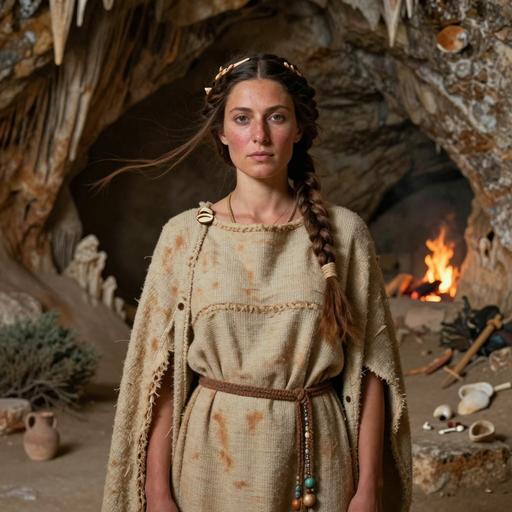
AI portrait reconstruction for A woman buried in Greece in the Neolithic era
AI-generated artistic reconstruction, not a photograph of the individual.
Record

Sample details

Recorded details and available lineage markers.

Individual

Aegean Neolithic individual, Greece

Sample ID: I2937

Date Range

5477 BCE - 5331 BCE

Cultural Period

Greece Peloponnese N

Biological Sex

Female

mtDNA Haplogroup

K1a26

Y-DNA Haplogroup

Not available

Social Role

Laborer (AI estimate, era-typical)

Geography

Location

Where this individual was discovered

Country Greece
Locality Diros. Alepotrypa Cave
Coordinates 36.6383, 22.3825
Chronology

Date range

When this individual lived in the broader context of human history

Aegean Neolithic individual, Greece 5477 BCE - 5331 BCE
Context

Historical context

Background information associated with the reference record.

Region & Environment

The Peloponnese offers a varied Neolithic landscape of mountains, valleys, and access to marine resources. Communities balanced cultivation in more favorable soils with herding in upland areas, using settlement placement to manage water availability and arable patches.

Historical Context

From the mid-7th millennium into the 4th millennium BCE, the Peloponnese participated in long-lasting Neolithic transformations characterized by growing reliance on domestic plants and animals. “Peloponnesian Neolithic” is a regional archaeological label, used to group material patterns rather than to assert a single unified state.

Populations & Lifeways

Most people lived in farming villages and smaller rural installations, where household labor supported cereal production, animal herding, and food processing. Daily life also included building and maintaining dwellings, producing and repairing tools, and managing domestic production tasks.

Archaeology & Material Culture

Archaeology for Peloponnesian Neolithic phases relies heavily on pottery styles, chipped-stone tool technologies, and the spatial organization of settlements. Differences between phases can appear in ceramic design, manufacturing technique, and the proportions of tool types, reflecting changing preferences and regional contact.

Culture & Society

While the exact structure of authority and belief systems cannot be recovered directly, recurring domestic practices suggest shared norms and learning networks. The durability of material traditions over centuries implies continuity in community identity, alongside periodic changes in craft conventions.

Legacy & Transition

The Peloponnesian Neolithic transitions toward later prehistoric periods as material culture and settlement patterns evolve. This sequence documents long-term adaptation and gradual change in the Aegean rather than a single abrupt replacement of populations.

Analysis

Genetic comparisons

These comparisons show genetic similarity, not identity or origin. The populations listed are those whose genomes show statistical alignment to this ancient individual.

Similarity reflects shared history, not shared identity. These are analytical comparisons, not claims about who this person was.

Modern Genetic Admixture

This analysis compares the DNA profile with present-day reference populations, showing statistical similarity to modern reference populations from different regions. The excavation site records where this individual was found, not a fixed modern genetic identity.

Europe 90.0%
Southern European 90.0%
Italian 50.3%
Sardinian 32.8%
Balkan 6.8%
Asia 10.0%
Arab, Egyptian & Levantine 8.6%
Arabian 8.6%
Northern West Asian 1.5%
Cypriot 1.5%

Closest Modern Populations

These are the modern populations showing the closest statistical alignment to A woman buried in Greece in the Neolithic era, ranked by genetic distance. Lower distance values indicate closer statistical similarity. Cross-region similarity can reflect shared ancestry, population movement, continuity, or later admixture.

1
Belmonte Jew
6.1275
2
Sardinian
6.3243
3
Turkish Sabbatean
7.0007
4
Italian Jew
7.0144
5
Sicilian West
7.1573
6
Maltese
7.2393
7
Ashkenazi Germany
7.3176
8
Sicilian East
7.3238
9
Algerian Jew
7.3350
10
Italian Calabria
7.3473
Context

Related Samples

This individual exists within a broader network of ancient samples. No ancient genome stands alone.

Individual Culture/Period Date Location Action
Crete Hg Charalambos EMBA individual, Greece Minoan Lassithi, Greece 2400 BCE Crete. Lassithi, Greece View
Apatheia BA individual, Greece Mycenaean Greece 1400 BCE Peloponnese. Galatas Apatheia, Greece View
Crete Hg Charalambos EMBA individual, Greece Minoan Lassithi, Greece 2400 BCE Crete. Lassithi, Greece View
Salamis BA individual, Greece Mycenaean Greece 1413 BCE Agia Kyriaki. Salamis, Greece View
Peristeria BA individual, Greece Mycenaean Greece 1418 BCE Peristeria Tryfilia. Peloponnese, Greece View
Apatheia BA individual, Greece Mycenaean Greece 1400 BCE Peloponnese. Galatas Apatheia, Greece View
Crete Necropolisof Armenoi BA individual, Greece Armenoi Site, Crete, Greece 1370 BCE Armenoi. Crete, Greece View
Crete Moni Odigitria BA individual, Greece Minoan Odigitria, Greece 2210 BCE Crete. Heraklion. Moni Odigitria, Greece View
BA individual, Turkey Early Bronze Age Turkey 2621 BCE Mediterranean. Isparta. Harmanören-Göndürle Höyük, Turkey View
BA individual, Turkey Early Bronze Age Turkey 2560 BCE Mediterranean. Isparta. Harmanören-Göndürle Höyük, Turkey View
Aegean Neolithic individual, Greece Neolithic Peloponnese, Greece 5477 BCE Diros. Alepotrypa Cave, Greece View
BA individual, Turkey Early Bronze Age Turkey 2836 BCE Mediterranean. Isparta. Harmanören-Göndürle Höyük, Turkey View
Greece N individual, Greece 5477 BCE Diros. Alepotrypa Cave, Greece View
Page 1
Individual Culture/Period Date Location Action
Peloponnese N individual, Greece Neolithic Peloponnese, Greece 5500 BCE Diros. Alepotrypa Cave, Greece View
Peloponnese N individual, Greece Neolithic Peloponnese, Greece 4036 BCE Diros. Alepotrypa Cave, Greece View
Aegean Neolithic individual, Greece Neolithic Peloponnese, Greece 4049 BCE Argolid. Franchthi Cave, Greece View
Aegean Neolithic individual, Greece Neolithic Peloponnese, Greece 5477 BCE Diros. Alepotrypa Cave, Greece View
Peloponnese N individual, Greece Neolithic Peloponnese, Greece 3938 BCE Diros. Alepotrypa Cave, Greece View
Page 1
Sources

References

Scientific publications and genetic data that inform this profile.

G25 Coordinates

These coordinates represent a position in genetic space, a tool for comparison, not a conclusion. You can use these to perform custom admixture analysis in G25 Studio.

I2937,0.10003456,0.15726784,-0.00068658,-0.06868704,0.04049262,-0.03303792,-0.00408412,0.00248888,0.04498302,0.05466234,0.00126606,0.00503728,-0.00632362,-0.01024696,-0.01125256,0.00882716,0.00500088,0.00149224,0.00285298,0.00132202,0.00477914,0.00854458,-0.0127057,-0.01598894,0.00165231
Continue in G25 Studio
Use code for 30% off • Expires Nov 16