Menu
Store
Blog
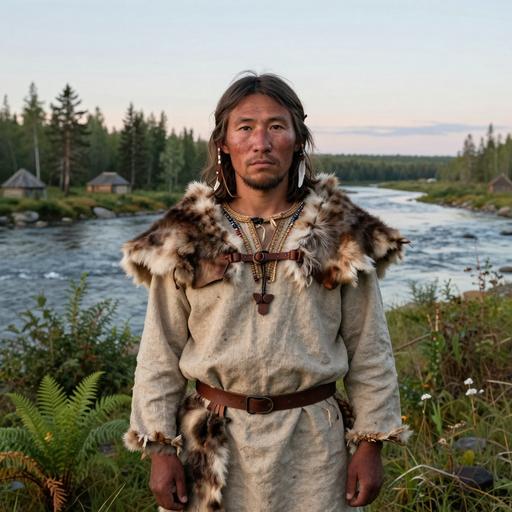
Portrait reconstruction of ANG001
Ancient Individual

A man buried in Russia in the Early Neolithic era

ANG001
5373 BCE - 5228 BCE
Male
Early Neolithic Angara, Siberia, Russia
Russia
Scroll to begin
Chapter I

Identity

The biological and cultural markers that define this ancient individual

Sample ID

ANG001

Date Range

5373 BCE - 5228 BCE

Biological Sex

Male

mtDNA Haplogroup

Z-a

Y-DNA Haplogroup

BT

Cultural Period

Early Neolithic Angara, Siberia, Russia

Chapter II

Place

Where this individual was discovered

Country Russia
Locality Siberia. Angara river. Angara
Chapter III

Time

When this individual lived in the broader context of human history

ANG001 5373 BCE - 5228 BCE
Chapter IV

Story

The narrative of this ancient life

The Early Neolithic Angara culture of Siberia, Russia represents a fascinating period in the history of Siberian hunter-gatherers, set against the backdrop of the vast and often harsh landscape of Eastern Siberia. This era is characterized by the distinctive adaptation strategies and cultural practices of the communities that thrived along the banks of the Angara River, one of the major waterways flowing through this region.

Geographical Context

The Angara River region, with its subarctic climate, dense forests, and abundant water resources, provided a rich ecological environment for early human settlements. The river served as a crucial corridor for movement, interaction, and the exchange of goods and ideas, making it an essential lifeline for the hunter-gatherer communities that inhabited its banks.

Subsistence Strategies

The Early Neolithic Angara people primarily engaged in a hunter-gatherer lifestyle, heavily reliant on the abundant natural resources of their environment. Their diet would have been rich in fish, game, and plant materials available in the diverse biomes present in this part of Siberia. Fishing was particularly important, given the proximity to the river, and they likely developed sophisticated methods for catching and processing fish. Hunting of terrestrial animals such as deer, elk, and smaller mammals would have been supplemented by the gathering of wild berries, nuts, and roots.

Material Culture

The archaeological record of the Angara culture reveals a rich material culture. Early Neolithic tools and implements, typically made of stone, bone, and wood, reflect the ingenuity of these communities. Stone tools, such as scrapers, blades, and arrowheads, indicate a society well-adapted to exploiting their environment efficiently. The emergence of pottery during this period represents a significant cultural advancement, with ceramic vessels suggesting changes in food storage, preparation, and consumption practices.

Settlements and Dwellings

The Angara River's banks were dotted with temporary and semi-permanent settlements. These sites would have consisted of small clusters of dwellings constructed from available materials such as wood and animal hides. The seasonal movement patterns of the inhabitants were likely dictated by the migration of wildlife and the availability of plants, resulting in a semi-nomadic lifestyle. Evidence suggests that people returned to favored hunting or fishing spots regularly, establishing a pattern of repeated site use.

Social Organization and Rituals

The social structure of the Early Neolithic Angara communities is not well-documented due to the paucity of direct evidence. However, like many hunter-gatherer societies, they were likely organized in small, kin-based groups that facilitated cooperative hunting, gathering, and construction activities. The presence of elaborate stone tools and ornaments suggests the importance of craftsmanship and possibly trade with other groups.

Rituals and symbolic behavior can be inferred from burial practices and the occasional discovery of petroglyphs or carvings. These artifacts suggest that the Angara people had complex belief systems that may have included animistic or shamanistic elements, reflecting a deep connection with the natural world around them.

Environmental Challenges and Adaptation

The climate during the Early Neolithic period in Siberia presented significant challenges, with cold temperatures and heavy snowfall in the winter months. The Angara communities developed adaptation strategies to cope with these harsh conditions, including clothing made from animal skins for warmth and the use of fire for heating and cooking.

Legacy

The legacy of the Early Neolithic Angara culture is marked by their adaptability and ingenuity in a challenging environment. They were among the early communities that laid the foundations for the later development of more complex societies in Siberia. Their material culture and subsistence strategies provide valuable insights into the progression of human adaptation in subarctic environments.

In summary, the Early Neolithic Angara culture of Siberia, Russia, represents a pivotal era in the history of Siberian hunter-gatherers. Their development of innovative tools, adaptation to challenging environments, and rich cultural practices offer a window into the resilience and resourcefulness of these early communities.

Chapter V

Genetics

The genetic ancestry of this ancient individual

Ancient Genetic Admixture

This analysis compares the DNA profile of ANG001 with ancient reference populations, showing the genetic composition in terms of prehistoric ancestral groups.

Ancient Asians 83.9%
Neolithic Farmers 10.6%
Ancient Native Americans 2.9%
Ancient Oceanians 2.6%

Modern Genetic Admixture

This analysis compares the DNA profile with present-day reference populations, showing what percentage of genetic makeup resembles modern populations from different regions.

Asia 85.6%
Northern Asian 61.9%
Siberian 44.5%
Mongolian 17.4%
Chinese & Southeast Asian 13.4%
Chinese 13.4%
Japanese & Korean 10.0%
Japanese 10.0%
America 11.5%
America 11.5%
Native American 11.5%
Oceania 1.7%
Melanesian 1.7%
Papuan 1.7%
Africa 1.2%
Congolese & Southern East African 1.2%
South East African 1.2%

Closest Modern Populations

These are the modern populations showing the closest statistical alignment to A man buried in Russia in the Early Neolithic era, ranked by genetic distance. Lower distance values indicate closer statistical similarity.

1
Khamnegan
5.5764
2
Tuvinian
7.0039
3
Mogush
7.1319
4
Buryat
7.4804
5
Mongol
7.7176
6
Evenk O
8.3018
7
Kalmyk
8.3060
8
Mongol Xinjiang
8.7472
9
Mongolian
8.7783
10
Todzin
8.8835
Chapter VI

Context

Other ancient individuals connected to this sample

Sources

References

Scientific publications and genetic data

Scientific Publication

Paleolithic to Bronze Age Siberians Reveal Connections with First Americans and across Eurasia

Authors Yu H, Spyrou MA, Karapetian M
Abstract

Modern humans have inhabited the Lake Baikal region since the Upper Paleolithic, though the precise history of its peoples over this long time span is still largely unknown. Here, we report genome-wide data from 19 Upper Paleolithic to Early Bronze Age individuals from this Siberian region. An Upper Paleolithic genome shows a direct link with the First Americans by sharing the admixed ancestry that gave rise to all non-Arctic Native Americans. We also demonstrate the formation of Early Neolithic and Bronze Age Baikal populations as the result of prolonged admixture throughout the eighth to sixth millennium BP. Moreover, we detect genetic interactions with western Eurasian steppe populations and reconstruct Yersinia pestis genomes from two Early Bronze Age individuals without western Eurasian ancestry. Overall, our study demonstrates the most deeply divergent connection between Upper Paleolithic Siberians and the First Americans and reveals human and pathogen mobility across Eurasia during the Bronze Age.

G25 Coordinates

The G25 coordinates for sample ANG001 can be used for detailed admixture analysis in our G25 Studio tool.

ANG001,0.04061954,-0.36755232,0.08228722,-0.01538636,-0.06917784,-0.0363097,-0.00106956,0.00027414,0.00787386,0.00531764,0.00527546,-0.00212944,0.00288178,-0.01110162,-0.01384068,-0.01223768,-0.00726032,0.00697622,0.01814504,0.01157838,0.01357192,-0.02319286,0.00307922,0.00929536,0.01150823
Analyze in G25 Studio
Use code for 40% off Expires Feb 27