Menu
Store
Blog
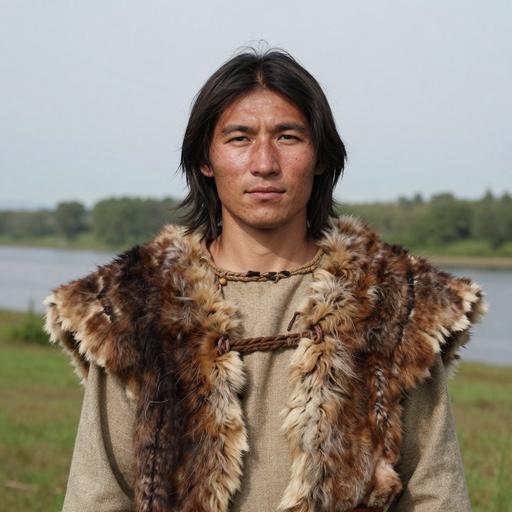
Portrait reconstruction of KAG001
Ancient Individual

A man buried in Russia in the Early Neolithic era

KAG001
4980 BCE - 4841 BCE
Male
Early Neolithic Lena River, Siberia, Russia
Russia
Scroll to begin
Chapter I

Identity

The biological and cultural markers that define this ancient individual

Sample ID

KAG001

Date Range

4980 BCE - 4841 BCE

Biological Sex

Male

mtDNA Haplogroup

A8a

Y-DNA Haplogroup

BT

Cultural Period

Early Neolithic Lena River, Siberia, Russia

Chapter II

Place

Where this individual was discovered

Country Russia
Locality Siberia. Lena river. Kachug
Chapter III

Time

When this individual lived in the broader context of human history

KAG001 4980 BCE - 4841 BCE
Chapter IV

Story

The narrative of this ancient life

The Early Neolithic era along the Lena River in Siberia marks a significant period of transition and adaptation for the Paleo-Siberian cultures. This era, generally dated to around 7000-5000 BCE, witnessed the gradual shift from a purely nomadic, hunter-gatherer lifestyle to one that incorporated elements of sedentism and early agriculture, albeit adapted to the harsh climates of Siberia.

Geographical Context: The Lena River, one of the longest rivers in the world, is a critical geographical feature of Siberia. It stretches over 4,400 kilometers from its source in the Baikal Mountains, flowing northwards to the Laptev Sea in the Arctic Ocean. The region is characterized by its extreme continental climate, with long, harsh winters and short, but relatively warm summers. During the Early Neolithic period, the river's floodplains, surrounding forests, and tundra provided a diverse range of resources.

Cultural and Technological Developments: The populations living along the Lena River during the Early Neolithic were primarily small, semi-nomadic groups. These groups were adept at exploiting the diverse ecosystems of the river valley. Key developments of this era include:

  1. Tool Technology: The Early Neolithic peoples of the Lena River refined their lithic technology. They developed microblade technology, which involved crafting small, sharp blades from flint and other stones. These microblades were often used as inserts in composite tools made from bone or wood, such as knives, arrows, and spears.

  2. Subsistence Strategies: The hunting and gathering practices remained robust, with a continued reliance on large game such as reindeer and elk, which were abundant in the region. Fishing became increasingly important, supported by innovations in fish traps and weirs, as the Lena River teemed with species like sturgeon and salmon. Additionally, the collection of wild plants, nuts, and berries supplemented the diet.

  3. Settlement Patterns: There was a gradual shift towards more permanent settlements, particularly in locations that provided strategic advantages in terms of resource availability and protection from harsh weather. These early settlements were often semi-subterranean dwellings, providing insulation against the cold. Excavations have uncovered remnants of circular or oval huts built with wooden frames and covered with animal hides and earth.

  4. Cultural Artifacts and Art: Artifacts such as pottery suggest an enhancement in domestic life. Although initially simplistic, Early Neolithic pottery shows an evolution in design and function over this period. Decorative motifs, which may have held symbolic or cultural significance, began to appear. Additionally, carved bone and ivory figurines, as well as rock art found in the region, hint at spiritual or ritualistic practices.

  5. Social Structure and Trade: Evidence suggests an increase in social complexity, possibly leading to the formation of tribes or extended family groups with shared territories and resources. Trade networks began to emerge, as indicated by the distribution of non-local materials such as obsidian, indicating contact with distant groups. These networks allowed for the exchange of not just goods, but ideas and innovations as well.

Ecological and Environmental Influence: The environment played a crucial role in shaping the lifestyle and culture of the Early Neolithic peoples along the Lena River. The Pleistocene-Holocene transition brought about climatic changes, leading to the spread of boreal forests and the retreat of glaciers. These environmental changes facilitated the diversification of flora and fauna, providing new opportunities and challenges for human populations.

Conclusion: The Early Neolithic era along the Lena River is a tapestry of human adaptation and ingenuity in the face of a demanding environment. It showcases the beginnings of settled life, early technological advances, and cultural developments among the Paleo-Siberian peoples. While these communities maintained many traditional elements of their hunter-gatherer ancestors, they also laid the groundwork for more complex societal structures that would emerge in subsequent periods.

Chapter V

Genetics

The genetic ancestry of this ancient individual

Ancient Genetic Admixture

This analysis compares the DNA profile of KAG001 with ancient reference populations, showing the genetic composition in terms of prehistoric ancestral groups.

Ancient Asians 85.0%
Western Steppe Pastoralists 8.7%
Neolithic Farmers 3.3%
Ancient Native Americans 3.0%

Modern Genetic Admixture

This analysis compares the DNA profile with present-day reference populations, showing what percentage of genetic makeup resembles modern populations from different regions.

Asia 92.9%
Northern Asian 71.2%
Siberian 47.6%
Mongolian 23.7%
Japanese & Korean 9.4%
Japanese 9.4%
Central Asian, Northern Indian & Pakistani 8.0%
Central Asian 8.0%
Chinese & Southeast Asian 4.4%
Tibetan 4.4%
America 5.0%
America 5.0%
Native American 5.0%
Oceania 1.2%
Melanesian 1.2%
Papuan 1.2%
Africa 0.9%
African Hunter-Gatherer 0.9%

Closest Modern Populations

These are the modern populations showing the closest statistical alignment to A man buried in Russia in the Early Neolithic era, ranked by genetic distance. Lower distance values indicate closer statistical similarity.

1
Mogush
4.6410
2
Tuvinian
4.8040
3
Khamnegan
6.1948
4
Buryat
7.2977
5
Altaian Kizhi
7.3319
6
Kalmyk
7.4277
7
Todzin
7.4439
8
Evenk O
7.5058
9
Mongol Xinjiang
7.6019
10
Mongolian
7.7250
Chapter VI

Context

Other ancient individuals connected to this sample

Sources

References

Scientific publications and genetic data

Scientific Publication

Paleolithic to Bronze Age Siberians Reveal Connections with First Americans and across Eurasia

Authors Yu H, Spyrou MA, Karapetian M
Abstract

Modern humans have inhabited the Lake Baikal region since the Upper Paleolithic, though the precise history of its peoples over this long time span is still largely unknown. Here, we report genome-wide data from 19 Upper Paleolithic to Early Bronze Age individuals from this Siberian region. An Upper Paleolithic genome shows a direct link with the First Americans by sharing the admixed ancestry that gave rise to all non-Arctic Native Americans. We also demonstrate the formation of Early Neolithic and Bronze Age Baikal populations as the result of prolonged admixture throughout the eighth to sixth millennium BP. Moreover, we detect genetic interactions with western Eurasian steppe populations and reconstruct Yersinia pestis genomes from two Early Bronze Age individuals without western Eurasian ancestry. Overall, our study demonstrates the most deeply divergent connection between Upper Paleolithic Siberians and the First Americans and reveals human and pathogen mobility across Eurasia during the Bronze Age.

G25 Coordinates

The G25 coordinates for sample KAG001 can be used for detailed admixture analysis in our G25 Studio tool.

KAG001,0.04587788,-0.34265916,0.0883422,-0.00253136,-0.07421678,-0.03599454,0.00469038,0.00672932,0.00545048,0.0046779,0.00845696,-0.0010769,0.00011334,-0.01057796,-0.0093465,-0.01431624,-0.00869612,0.00662432,0.01491994,0.01048848,0.00164444,-0.01829966,0.00174824,0.00519768,0.00813214
Analyze in G25 Studio
Use code for 40% off Expires Feb 27