Menu
Store
Blog
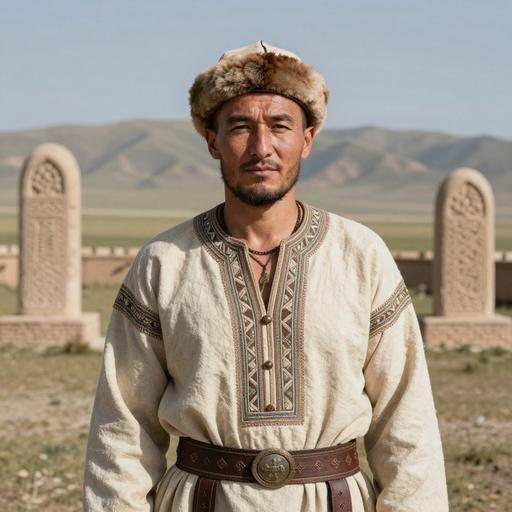
Portrait reconstruction of BSK004
Ancient Individual

A man buried in Kyrgyzstan in the Middle Ages era

BSK004
1267 CE - 1340 CE
Male
Medieval Kyrgyzstan
Kyrgyzstan
Scroll to begin
Chapter I

Identity

The biological and cultural markers that define this ancient individual

Sample ID

BSK004

Date Range

1267 CE - 1340 CE

Biological Sex

Male

mtDNA Haplogroup

Not available

Y-DNA Haplogroup

R1b1a2

Cultural Period

Medieval Kyrgyzstan

Chapter II

Place

Where this individual was discovered

Country Kyrgyzstan
Locality ChüyRegion. Buranacemetery
Coordinates 42.7167, 75.2430
Chapter III

Time

When this individual lived in the broader context of human history

BSK004 1267 CE - 1340 CE
Chapter IV

Story

The narrative of this ancient life

During the medieval period, the region now known as Kyrgyzstan was a vibrant and dynamic landscape influenced by various cultures, empires, and nomadic tribes. This era saw the rise and fall of several significant historical entities and was profoundly affected by the movements and interactions of Turkic nomadic groups. Here is a detailed exploration of the era and culture of medieval Kyrgyzstan, with a focus on the Chüy Valley, the Burana Tower, and the impact of the Black Death.

Turkic Nomadic Culture

Social Structure and Lifestyle

  1. Nomadism: The people of medieval Kyrgyzstan primarily followed a nomadic lifestyle, moving with their herds across the steppes and mountains. This mobility was essential for their survival, allowing them to utilize various resources throughout different seasons.

  2. Tribal Confederations: Society was organized into clans and tribes, often forming larger confederations for mutual protection and cooperation. Leadership was typically hereditary, but strong leaders could rise to prominence through displays of valor, wisdom, and skill.

  3. Economy: The economy was predominantly pastoral, centered on livestock such as sheep, horses, camels, and yaks. Trade played a crucial role as well, with the Silk Road facilitating the exchange of goods such as wool, leather, and textiles for silk, spices, and other luxury items.

  4. Culture and Beliefs: The Turkic nomads had a rich oral tradition, with epics, songs, and poetry being integral to their culture. Shamanistic beliefs coexisted with the gradual spread of Islam, which began to take root in the region during this period.

Influence and Interaction

  1. Silk Road: The Chüy Valley was an integral part of the Silk Road, serving as a bridge between East and West. This brought diverse influences to the region, including cultural, religious, and technological exchanges.

  2. Military Prowess: The Turkic tribes were known for their formidable cavalry, which was both a defensive necessity and an offensive force. Conflicts with neighboring empires, such as the Tang Dynasty and later the Abbasid Caliphate, were common.

Chüy Valley and the Burana Tower

The Chüy Valley, located in the northern part of Kyrgyzstan, was a significant hub during the medieval period. It was dotted with various settlements and cities that facilitated trade and cultural exchange.

  1. Burana Tower: The most iconic remnant of this era in the Chüy Valley is the Burana Tower, which stands near the ruins of the ancient city of Balasagun. The tower is believed to be a minaret for a mosque and is part of a larger complex that once included a cemetery, castle, and various burial mounds.

  2. Balasagun: Founded by the Sogdians and later serving as a capital for the Karakhanid Khanate, Balasagun was a crucial city that illustrated the syncretism of the period—merging Turkic, Persian, and Islamic influences.

The Impact of the Black Death

During the 14th century, the Black Death swept through Asia, Europe, and Africa, leaving a profound impact on the populations it touched. While the historical documentation of the plague's effects in Central Asian regions like Kyrgyzstan is sparse, the consequences would have been significant.

  1. Demographic Shifts: As with elsewhere, it likely led to severe population declines, disrupting the social and economic fabric of the Turkic nomads.

  2. Economic Consequences: The decrease in population would have affected the pastoral economy and trade along the Silk Road, leading to periods of stagnation and economic transformation.

  3. Cultural and Religious Shifts: In the aftermath of the plague, religious and cultural attitudes may have shifted, potentially accelerating the region's Islamic assimilation as communities sought solace and meaning in spiritual matters.

Legacy

The medieval period laid the foundations for the rich tapestry of cultures seen in Kyrgyzstan today. The resilience and adaptability of the Turkic nomadic tribes, the integration of diverse cultural elements, and the strategic importance of trade routes like the Silk Road continue to influence the region's identity and historical narrative. The Burana Tower remains a testament to this era's architectural and cultural achievements, symbolizing a time of significant change and interaction in Central Asia's heart.

Chapter V

Genetics

The genetic ancestry of this ancient individual

Ancient Genetic Admixture

This analysis compares the DNA profile of BSK004 with ancient reference populations, showing the genetic composition in terms of prehistoric ancestral groups.

Neolithic Farmers 28.8%
European Hunter-Gatherers 28.3%
Western Steppe Pastoralists 26.0%
Ancient Africans 10.2%
Ancient Asians 3.6%
Ancient Oceanians 3.1%

Modern Genetic Admixture

This analysis compares the DNA profile with present-day reference populations, showing what percentage of genetic makeup resembles modern populations from different regions.

Europe 89.8%
Northwestern European 42.4%
Northwestern European 38.2%
Scandinavian 4.2%
Eastern European 33.1%
Southern European 14.2%
Sardinian 14.2%
Africa 9.5%
Northern East African 6.8%
Ethiopian 6.8%
North African 2.7%
North African 2.7%
Asia 0.7%
Arab, Egyptian & Levantine 0.7%
Arabian 0.7%

Closest Modern Populations

These are the modern populations showing the closest statistical alignment to A man buried in Kyrgyzstan in the Middle Ages era, ranked by genetic distance. Lower distance values indicate closer statistical similarity.

1
Turkish Deliorman
5.6356
2
Tatar Mishar
6.2244
3
Moldovan
6.5572
4
Moksha
6.7065
5
Turkish Rumeli
6.7143
6
Afrikaner
6.7737
7
Hungarian
6.7832
8
Mordovian
7.0125
9
Moldovan O
7.0560
10
Erzya
7.1436
Chapter VI

Context

Other ancient individuals connected to this sample

Sources

References

Scientific publications and genetic data

Scientific Publication

The source of the Black Death in fourteenth-century central Eurasia

Authors Spyrou MA, Musralina L, Gnecchi Ruscone GA
Abstract

The origin of the medieval Black Death pandemic (AD 1346-1353) has been a topic of continuous investigation because of the pandemic's extensive demographic impact and long-lasting consequences1,2. Until now, the most debated archaeological evidence potentially associated with the pandemic's initiation derives from cemeteries located near Lake Issyk-Kul of modern-day Kyrgyzstan1,3-9. These sites are thought to have housed victims of a fourteenth-century epidemic as tombstone inscriptions directly dated to 1338-1339 state 'pestilence' as the cause of death for the buried individuals9. Here we report ancient DNA data from seven individuals exhumed from two of these cemeteries, Kara-Djigach and Burana. Our synthesis of archaeological, historical and ancient genomic data shows a clear involvement of the plague bacterium Yersinia pestis in this epidemic event. Two reconstructed ancient Y. pestis genomes represent a single strain and are identified as the most recent common ancestor of a major diversification commonly associated with the pandemic's emergence, here dated to the first half of the fourteenth century. Comparisons with present-day diversity from Y. pestis reservoirs in the extended Tian Shan region support a local emergence of the recovered ancient strain. Through multiple lines of evidence, our data support an early fourteenth-century source of the second plague pandemic in central Eurasia.

G25 Coordinates

The G25 coordinates for sample BSK004 can be used for detailed admixture analysis in our G25 Studio tool.

BSK004,0.09829458,0.08251716,0.04678782,0.02985932,0.01301472,0.00551408,0.00612264,0.0090805,0.00265602,-0.01322826,0.00383366,-0.00203804,0.00076336,-0.00750826,-0.00137162,-0.00666634,-0.0065623,-0.00067856,-0.00607406,-0.00773612,-0.00140646,0.00487572,-0.00975232,0.00482478,-0.00118873
Analyze in G25 Studio
Use code for 40% off Expires Feb 27