Menu
Store
Blog
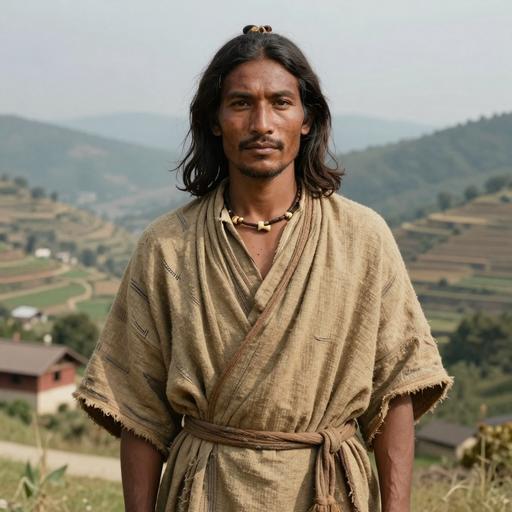
Portrait reconstruction of C1
Ancient Individual

A man buried in Nepal in the Bronze Age era

C1
1200 BCE - 450 BCE
Male
Chokhopani 2800BP
Nepal
Scroll to begin
Chapter I

Identity

The biological and cultural markers that define this ancient individual

Sample ID

C1

Date Range

1200 BCE - 450 BCE

Biological Sex

Male

mtDNA Haplogroup

D4j1b

Y-DNA Haplogroup

O-M117

Cultural Period

Chokhopani 2800BP

Chapter II

Place

Where this individual was discovered

Country Nepal
Locality Chokhopani Tomb. Nepal
Coordinates 28.7119, 83.6490
Chapter III

Time

When this individual lived in the broader context of human history

C1 1200 BCE - 450 BCE
Chapter IV

Story

The narrative of this ancient life

Chokhopani, approximately 2800 BP (Before Present), refers to a distinct cultural and historical era characterized by its unique advancements, socio-political structures, artistry, and interactions with the environment. This period can be traced back to a specific region, possibly in the vicinity of present-day South or Southeast Asia, where archaeological findings have shed light on the complexity and innovation of the Chokhopani people.

Geographical Context

The Chokhopani civilization thrived in a landscape rich with rivers, fertile plains, and dense forests. This environment supported a diverse ecosystem and provided the means for agricultural innovations. The river systems not only enabled irrigation and stable food production but also facilitated trade routes that connected Chokhopani to other contemporary cultures.

Socio-Political Structure

The Chokhopani society was structured around a hierarchical system with a prominent ruling class. This class, likely consisting of priests or warrior elites, held significant influence over religious and administrative matters. Local governance was conducted through a network of settlements that reported back to a central authority, indicating a complex system of political organization. Evidence suggests the existence of city-states, each governed by its own council but united under broader cultural traditions and religious beliefs.

Economy and Trade

Agriculture formed the backbone of the Chokhopani economy, with the cultivation of crops like barley, wheat, and rice. The region's favorable climate allowed for surplus production, supporting population growth and urbanization. Alongside agriculture, Chokhopani engaged in metallurgy, crafting tools and ornaments from copper, bronze, and iron.

Trade networks extended far beyond the Chokhopani heartland, as evidenced by the diversity of artifacts found in archaeological sites. It's believed that the civilization traded with the distant cultures of Mesopotamia, the Indus Valley, and beyond, exchanging goods such as textiles, spices, and crafted items, indicating a high degree of commercial sophistication.

Art and Culture

Chokhopani art reflects both the religious and social dynamics of the era. The discovery of intricately designed pottery, sculptures, and jewelry highlights a profound understanding of aesthetics and technical skill. Religious motifs dominated artistic expression, with figures often symbolizing gods, nature, or cosmological themes.

Music and dance were integral components of Chokhopani culture, celebrated during festivals and religious ceremonies. Songs and dances likely held both intergenerational significance and served as a means of preserving oral traditions.

Religion and Belief Systems

The Chokhopani civilization practiced a polytheistic religion, with a pantheon of gods associated with natural elements, agriculture, and societal values. Temples and shrines were common, serving as both places of worship and community gathering spaces. Rituals, possibly led by a dedicated priest class, would have played a central role in reinforcing the societal order and connecting the people to their deities.

Technological and Scientific Advancements

The Chokhopani are credited with advancements in various fields, including engineering, mathematics, and astronomy. Their understanding of agricultural cycles and celestial patterns improved farming techniques and informed their religious calendars. The remains of advanced irrigation systems and urban planning indicate a high level of technical expertise.

Legacy and Influence

The Chokhopani civilization left a lasting legacy through its contributions to art, trade, and cross-cultural interactions in the region. Subsequent cultures may have drawn from Chokhopani innovations in governance, agriculture, and religious practices. The study of Chokhopani provides valuable insights into the complexities and achievements of early human societies and their capacity for growth and adaptation.

In conclusion, the era and culture of Chokhopani 2800 BP represents a rich tapestry of human achievement, characterized by a blend of environmental harmony, sociopolitical sophistication, and cultural richness that continues to intrigue and inspire scholars in understanding the human past.

Chapter V

Genetics

The genetic ancestry of this ancient individual

Ancient Genetic Admixture

This analysis compares the DNA profile of C1 with ancient reference populations, showing the genetic composition in terms of prehistoric ancestral groups.

Ancient Asians 97.3%
Ancient Oceanians 2.7%

Modern Genetic Admixture

This analysis compares the DNA profile with present-day reference populations, showing what percentage of genetic makeup resembles modern populations from different regions.

Asia 95.6%
Chinese & Southeast Asian 64.9%
Chinese 35.1%
Tibetan 27.6%
Indonesian Khmer Thai Myanma 2.2%
Northern Asian 18.4%
Mongolian 18.4%
Japanese & Korean 6.7%
Japanese 6.7%
Central Asian, Northern Indian & Pakistani 5.6%
Indian 5.6%
Oceania 1.8%
Melanesian 1.8%
Papuan 1.8%
Africa 1.6%
West African 1.3%
Nigerian 1.3%
America 0.9%
America 0.9%
Native American 0.9%

Closest Modern Populations

These are the modern populations showing the closest statistical alignment to A man buried in Nepal in the Bronze Age era, ranked by genetic distance. Lower distance values indicate closer statistical similarity.

1
Tu
3.1997
2
Tibetan Xunhua
3.3352
3
Tibetan Gangcha
3.4018
4
Tibetan Shigatse
3.7911
5
Tibetan
4.0081
6
Tibetan Lhasa
4.0354
7
Tibetan Shannan
4.0496
8
Bonan
4.1562
9
Nepali Sherpa Rolwaling
4.2060
10
Tibetan Nagqu
4.2133
Chapter VI

Context

Other ancient individuals connected to this sample

Sources

References

Scientific publications and genetic data

Scientific Publication

Long-term genetic stability and a high-altitude East Asian origin for the peoples of the high valleys of the Himalayan arc

Authors Jeong C, Ozga AT, Witonsky DB
Abstract

The high-altitude transverse valleys [>3,000 m above sea level (masl)] of the Himalayan arc from Arunachal Pradesh to Ladahk were among the last habitable places permanently colonized by prehistoric humans due to the challenges of resource scarcity, cold stress, and hypoxia. The modern populations of these valleys, who share cultural and linguistic affinities with peoples found today on the Tibetan plateau, are commonly assumed to be the descendants of the earliest inhabitants of the Himalayan arc. However, this assumption has been challenged by archaeological and osteological evidence suggesting that these valleys may have been originally populated from areas other than the Tibetan plateau, including those at low elevation. To investigate the peopling and early population history of this dynamic high-altitude contact zone, we sequenced the genomes (0.04×-7.25×, mean 2.16×) and mitochondrial genomes (20.8×-1,311.0×, mean 482.1×) of eight individuals dating to three periods with distinct material culture in the Annapurna Conservation Area (ACA) of Nepal, spanning 3,150-1,250 y before present (yBP). We demonstrate that the region is characterized by long-term stability of the population genetic make-up despite marked changes in material culture. The ancient genomes, uniparental haplotypes, and high-altitude adaptive alleles suggest a high-altitude East Asian origin for prehistoric Himalayan populations.

G25 Coordinates

The G25 coordinates for sample C1 can be used for detailed admixture analysis in our G25 Studio tool.

C1,0.02075564,-0.41295702,0.00814342,-0.03773652,0.00991766,0.00752882,0.00715352,0.00875234,0.00366794,0.00993278,-0.05279718,-0.0056371,0.00723408,-0.00106372,-0.00661124,-0.00535238,0.0022323,0.0006043,-0.00270026,0.00189272,0.00887176,0.00931426,0.00532158,-0.00028954,0.02021012
Analyze in G25 Studio
Use code for 40% off Expires Feb 27