Menu
Store
Blog
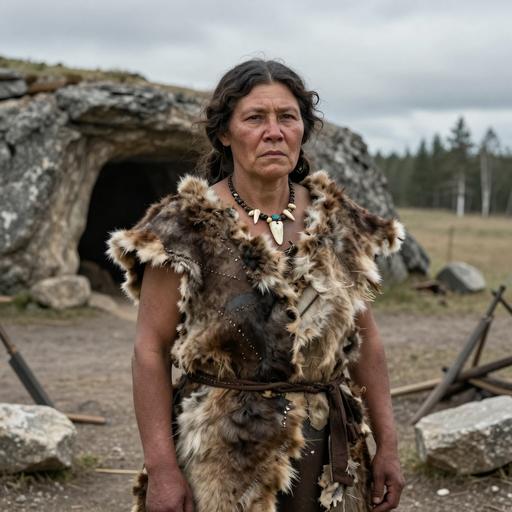
Portrait reconstruction of Chagyrskaya
Ancient Individual

An individual buried in Russia in the Pleistocene era

Chagyrskaya
98050 BCE - 58050 BCE
Not known
Chagyrskaya Cave Neanderthal, Russia
Russia
Scroll to begin
Chapter I

Identity

The biological and cultural markers that define this ancient individual

Sample ID

Chagyrskaya

Date Range

98050 BCE - 58050 BCE

Biological Sex

Not known

mtDNA Haplogroup

ND1b1*

Cultural Period

Chagyrskaya Cave Neanderthal, Russia

Chapter II

Place

Where this individual was discovered

Country Russia
Locality Chagyrskaya Cave
Coordinates 51.4441, 84.6722
Chapter III

Time

When this individual lived in the broader context of human history

Chagyrskaya 98050 BCE - 58050 BCE
Chapter IV

Story

The narrative of this ancient life

The Chagyrskaya Cave is a significant archaeological site located in the Altai Mountains of southern Siberia, Russia, and offers valuable insights into the lives and culture of Neanderthals. This site, along with others in the region, has been pivotal in understanding the interaction, movement, and genetic diversity of Neanderthals in Eurasia.

Geographic and Temporal Context

The Chagyrskaya Cave is situated in a region that features harsh climatic conditions, marked by cold temperatures and mountainous terrain. The cave has provided evidence of Neanderthal habitation dating back approximately 60,000 to 50,000 years ago. During this period, the environment was predominantly steppe-like, with open landscapes that facilitated the hunting of large herbivores, a crucial component of Neanderthal subsistence.

Archaeological Discoveries

The Chagyrskaya site has yielded a wealth of artifacts and remains that contribute to our understanding of Neanderthal life:

  1. Stone Tools: The artifacts primarily belong to the Micoquian or Keilmesser tradition, characterized by bifacially worked hand axes and foliated points. This indicates a complex toolkit designed for a variety of functions including hunting, butchering, and processing animal hides.

  2. Faunal Remains: The cave has revealed considerable animal remains, predominantly of species such as bison, horses, and other large mammals. This suggests a hunter-gatherer lifestyle that relied heavily on large game hunting.

  3. Human Remains: Notably, the site has produced Neanderthal remains, including skull fragments and bones, which have been crucial for genetic analysis. These remains have allowed researchers to explore Neanderthal genetics, revealing insights into their population dynamics and relationships with other hominin groups.

Genetic Insights

Genetic analyses from Chagyrskaya Neanderthals have provided profound insights into their population:

  • Lineage: The DNA evidence suggests that the Chagyrskaya Neanderthals are more closely related to European Neanderthals than to those from the nearby Denisova Cave, indicating distinct population movements or isolations.
  • Interbreeding: These findings contribute to the broader understanding of Neanderthal interaction with other hominins, including modern humans and Denisovans, highlighting a complex web of interbreeding events across Eurasia.

Cultural and Social Aspects

The Neanderthals of Chagyrskaya exhibited behaviors that reflect their adaptability and complex social structures:

  • Adaptation: The ability to survive in the challenging environments of Siberia suggests advanced skills in clothing production and possibly the use of fire to withstand cold climates.
  • Group Dynamics: The presence of numerous individuals at the site, along with the diversity of tools and remains, indicates a likely community structure capable of cooperative hunting and resource sharing.

Significance

The Chagyrskaya Cave Neanderthals are an important part of the puzzle in understanding Neanderthal distribution, adaptation, and interaction with other hominin groups. The site not only offers evidence of their technological and subsistence strategies but also enriches the narrative of human evolution by portraying the diversity and resilience of Neanderthal populations far beyond the traditional European heartlands.

Overall, Chagyrskaya Cave stands as a testament to the resourcefulness of Neanderthals and their ability to inhabit diverse and challenging environments, providing a critical link in tracing the migratory patterns and evolutionary history of ancient human populations.

Chapter V

Context

Other ancient individuals connected to this sample

Sources

References

Scientific publications and genetic data

Scientific Publication

A high-coverage Neandertal genome from Chagyrskaya Cave

Authors Mafessoni F, Grote S, de Filippo C
Abstract

We sequenced the genome of a Neandertal from Chagyrskaya Cave in the Altai Mountains, Russia, to 27-fold genomic coverage. We show that this Neandertal was a female and that she was more related to Neandertals in western Eurasia [Prüfer et al., Science 358, 655-658 (2017); Hajdinjak et al., Nature 555, 652-656 (2018)] than to Neandertals who lived earlier in Denisova Cave [Prüfer et al., Nature 505, 43-49 (2014)], which is located about 100 km away. About 12.9% of the Chagyrskaya genome is spanned by homozygous regions that are between 2.5 and 10 centiMorgans (cM) long. This is consistent with the fact that Siberian Neandertals lived in relatively isolated populations of less than 60 individuals. In contrast, a Neandertal from Europe, a Denisovan from the Altai Mountains, and ancient modern humans seem to have lived in populations of larger sizes. The availability of three Neandertal genomes of high quality allows a view of genetic features that were unique to Neandertals and that are likely to have been at high frequency among them. We find that genes highly expressed in the striatum in the basal ganglia of the brain carry more amino-acid-changing substitutions than genes expressed elsewhere in the brain, suggesting that the striatum may have evolved unique functions in Neandertals.

Use code for 40% off Expires Feb 27