Menu
Store
Blog
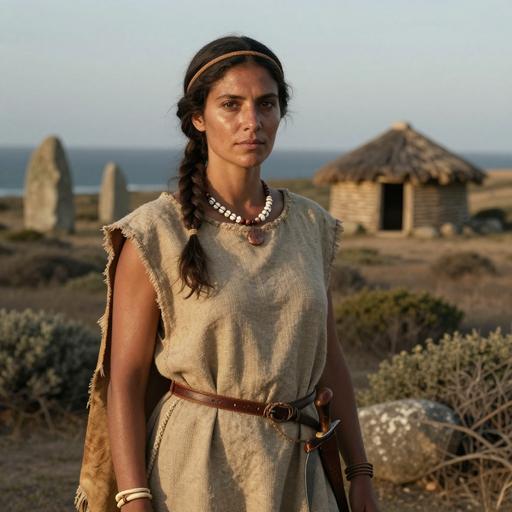
Portrait reconstruction of CovaMoura9B
Ancient Individual

A woman buried in Portugal in the Late Neolithic to Copper Age era

CovaMoura9B
2500 BCE - 2000 BCE
Female
Late Neolithic to Chalcolithic Portugal
Portugal
Scroll to begin
Chapter I

Identity

The biological and cultural markers that define this ancient individual

Sample ID

CovaMoura9B

Date Range

2500 BCE - 2000 BCE

Biological Sex

Female

mtDNA Haplogroup

J1c1b

Cultural Period

Late Neolithic to Chalcolithic Portugal

Chapter II

Place

Where this individual was discovered

Country Portugal
Locality Cova da Moura
Coordinates 38.7450, -9.2152
Chapter III

Time

When this individual lived in the broader context of human history

CovaMoura9B 2500 BCE - 2000 BCE
Chapter IV

Story

The narrative of this ancient life

The Late Neolithic to Chalcolithic period in Portugal marks a fascinating era in the evolution of Western European prehistoric societies, characterized by significant cultural, technological, and social developments. This period, roughly spanning from 3000 to 2000 BCE, is pivotal in the prehistoric timeline as it encompasses the transition from hunter-gatherer communities to more settled agricultural societies, alongside the introduction and development of metalworking technologies.

Geography and Environment

Portugal's geography during this time featured a diverse landscape of coastal regions, rolling plains, river valleys, and mountainous areas. The temperate climate provided fertile lands that were well-suited for agriculture. The landscape played a critical role in shaping the cultural and economic activities of the period. Proximity to the Atlantic Ocean not only influenced subsistence strategies but also facilitated maritime interactions with other regions, contributing to cultural exchanges and trade.

Subsistence and Economy

During the Late Neolithic to Chalcolithic period, Portugal saw a shift towards more permanent settlements as agriculture became increasingly important. Communities engaged in mixed farming, cultivating crops such as wheat and barley and domesticating animals like sheep, goats, and cattle. This agricultural base was complemented by hunting, fishing, and gathering, which remained important for subsistence.

The introduction of metallurgy, particularly copper working, marked the Chalcolithic era, leading to economic and technological advancements. This period saw the production of tools, ornaments, and weapons, which played a role in enhancing agricultural productivity, trade, and social hierarchy.

Social Structure and Settlements

Settlements during this period ranged from small hamlets to larger fortified sites, indicating a degree of social complexity and organization. Megalithic architecture, such as large stone tombs (dolmens) and standing stones (menhirs), became prominent, reflecting both advanced engineering skills and the social and ceremonial importance of these structures. These monumental constructions suggest the presence of organized labor and possibly a class of specialized workers or artisans.

The society of this era likely had a hierarchical structure, with emerging social stratification linked to control over resources, trade, and technological knowledge. Leaders or elites may have played pivotal roles in coordinating labor for monumental building projects and managing trade networks.

Megalithic Culture and Rituals

The Late Neolithic to Chalcolithic period in Portugal is notably marked by its megalithic culture, part of a broader Western European phenomenon. The construction of megalithic monuments for burial and ceremonial purposes indicates a complex belief system and a strong connection to ancestor worship. Tombs were often oriented in specific ways, suggesting astronomical alignments, which points to the importance of celestial events in their ritual practices.

These megalithic sites served as focal points for community gatherings, rituals, and ceremonies, reinforcing social cohesion and cultural identity. The presence of grave goods in these sites reflects varied burial practices and the belief in an afterlife, indicating a sophisticated spiritual and religious outlook.

Art and Craftsmanship

Art and decorative crafts flourished during this period, with pottery becoming more sophisticated in design and function. Pottery styles evolved from simple geometric decorations to more complex shapes and motifs, potentially influenced by interactions with other regions. Stone tools continued to be refined, with the production of polished stone axes, arrowheads, and other implements.

The emergence of metalworking, particularly in copper, represented a significant technological advance. Metallurgy not only provided new materials for tools and ornaments but also fostered specialized skills and knowledge, giving rise to a class of craftspeople within the society.

Trade and Interaction

The period was marked by dynamic trade networks both within the Iberian Peninsula and with other regions in Western Europe. Exchange of goods such as pottery, metals, and exotic materials indicates a well-established system of trade and cultural interaction. Maritime travel and coastal trading routes facilitated these exchanges, making the Iberian Peninsula a crucial cultural and economic hub in prehistoric Europe.

Conclusion

The Late Neolithic to Chalcolithic era in Portugal represents a transformative period characterized by technological innovation, social complexity, and cultural richness. The megalithic monuments stand as enduring testaments to the ingenuity and spiritual life of these prehistoric communities. This era laid the groundwork for subsequent developments in the Bronze Age, influencing the trajectory of cultural evolution in the region. As archaeological research continues to unfold, our understanding of this vibrant period deepens, revealing a tapestry of human endeavor in prehistoric Portugal.

Chapter V

Genetics

The genetic ancestry of this ancient individual

Ancient Genetic Admixture

This analysis compares the DNA profile of CovaMoura9B with ancient reference populations, showing the genetic composition in terms of prehistoric ancestral groups.

Neolithic Farmers 53.6%
European Hunter-Gatherers 28.9%
Western Steppe Pastoralists 17.5%

Modern Genetic Admixture

This analysis compares the DNA profile with present-day reference populations, showing what percentage of genetic makeup resembles modern populations from different regions.

Europe 98.1%
Southern European 97.7%
Iberian 57.6%
Sardinian 23.8%
Italian 16.3%
Africa 1.9%
North African 1.9%
North African 1.9%

Closest Modern Populations

These are the modern populations showing the closest statistical alignment to A woman buried in Portugal in the Late Neolithic to Copper Age era, ranked by genetic distance. Lower distance values indicate closer statistical similarity.

1
Sardinian
2.3219
2
French Corsica
6.0579
3
Spanish La Rioja
6.7421
4
Spanish Castilla La Mancha
6.9908
5
Spanish Murcia
7.0328
6
Spanish Menorca
7.0360
7
Spanish Castello
7.0411
8
Spanish Andalucia
7.0976
9
Spanish Pirineu
7.0999
10
Spanish Aragon
7.1357
Chapter VI

Context

Other ancient individuals connected to this sample

Sources

References

Scientific publications and genetic data

Scientific Publication

The population genomics of archaeological transition in west Iberia: Investigation of ancient substructure using imputation and haplotype-based methods

Authors Martiniano R, Cassidy LM, Ó&#x27
Abstract

We analyse new genomic data (0.05-2.95x) from 14 ancient individuals from Portugal distributed from the Middle Neolithic (4200-3500 BC) to the Middle Bronze Age (1740-1430 BC) and impute genomewide diploid genotypes in these together with published ancient Eurasians. While discontinuity is evident in the transition to agriculture across the region, sensitive haplotype-based analyses suggest a significant degree of local hunter-gatherer contribution to later Iberian Neolithic populations. A more subtle genetic influx is also apparent in the Bronze Age, detectable from analyses including haplotype sharing with both ancient and modern genomes, D-statistics and Y-chromosome lineages. However, the limited nature of this introgression contrasts with the major Steppe migration turnovers within third Millennium northern Europe and echoes the survival of non-Indo-European language in Iberia. Changes in genomic estimates of individual height across Europe are also associated with these major cultural transitions, and ancestral components continue to correlate with modern differences in stature.

G25 Coordinates

The G25 coordinates for sample CovaMoura9B can be used for detailed admixture analysis in our G25 Studio tool.

CovaMoura9B,0.12006398,0.1611571,0.02664116,-0.03922044,0.0578727,-0.01993142,-0.00219608,0.00576402,0.03874004,0.06890294,-0.00453714,0.0147845,-0.02629158,-0.01408076,-0.00913142,0.00453384,0.0108645,-0.00025896,-0.00060882,-0.00390488,0.00031412,0.00463838,-0.01229722,-0.0190842,0.00438087
Analyze in G25 Studio
Use code for 40% off Expires Feb 27