Menu
Store
Blog
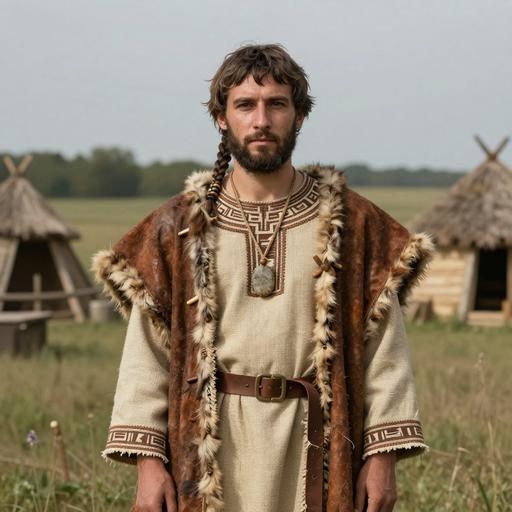
Portrait reconstruction of DA334
Ancient Individual

A man buried in Russia in the Early Bronze Age era

DA334
2284 BCE - 2055 BCE
Male
Early Bronze Age Shamanka, Russia
Russia
Scroll to begin
Chapter I

Identity

The biological and cultural markers that define this ancient individual

Sample ID

DA334

Date Range

2284 BCE - 2055 BCE

Biological Sex

Male

mtDNA Haplogroup

C4a2a1

Y-DNA Haplogroup

Q-FT375375

Cultural Period

Early Bronze Age Shamanka, Russia

Chapter II

Place

Where this individual was discovered

Country Russia
Locality Shamanka II
Chapter III

Time

When this individual lived in the broader context of human history

DA334 2284 BCE - 2055 BCE
Chapter IV

Story

The narrative of this ancient life

The Early Bronze Age Shamanka culture in Siberia is a fascinating subject of study, providing insights into the people who inhabited the region around Lake Baikal in modern-day Russia. This era, dating from approximately 3000 to 2000 BCE, marks a significant period of cultural and technological development for the ancient inhabitants of Siberia. Here is an extensive and detailed description of the Shamanka culture during the Early Bronze Age:

Geography and Environment

The Shamanka culture thrived in the Lake Baikal region, the world's largest freshwater lake by volume, located in south-central Siberia. The area is characterized by its harsh climate, with long, cold winters and short, mild summers. Despite the challenging environment, the region's abundant natural resources, including freshwater, fish, and game, supported human habitation. The surrounding taiga forests and steppes provided essential materials like wood and fibers for tools, shelter, and clothing.

Archaeological Discoveries

Archaeological sites linked to the Shamanka culture have been primarily studied around the southern part of Lake Baikal. Excavations have uncovered remarkable artifacts, including pottery, stone tools, and metal objects, which illustrate the cultural and technological advancements of these ancient communities.

Burial Sites: One of the most significant aspects of the Shamanka culture is its burial practices. Graves uncovered at sites like Shamanka II indicate complex social structures and spiritual beliefs. Individuals were often buried with grave goods, which included tools, pottery, jewelry, and animal remains. The orientation and arrangement of the bodies suggest specific rituals and ceremonial practices were involved in their burials.

Artifacts: Artifacts from this period include a variety of stone tools, such as arrowheads, knives, and scrapers, emphasizing the people's reliance on hunting and fishing. Pottery from the Shamanka culture often features intricate designs and craftsmanship, with some vessels exhibiting complex patterns that hint at a developed artistic tradition.

Economy and Subsistence

The Shamanka culture had an economy largely based on hunting, fishing, and gathering. The proximity to Lake Baikal provided a rich source of fish, while the surrounding forests and plains supported populations of deer and other game animals. Evidence of fishing equipment, such as hooks and net weights, indicates the importance of aquatic resources.

Meanwhile, the gathering of plant materials, including berries and nuts, likely supplemented their diet, providing necessary vitamins and nutrients. The people of the Shamanka culture would have also engaged in limited forms of trade or exchange with neighboring groups, exchanging raw materials and finished goods.

Social Structure and Lifestyle

Social organization within the Shamanka culture appears to have been complex, if not hierarchical, as suggested by the differentiation of grave goods among burial sites. The more elaborate the burial, the more likely it represented an individual of higher status or importance within the community.

The lifestyle of the Shamanka people was semi-nomadic, with groups likely moving between seasonal camps to exploit different resources across the landscape. This mobility required adaptability and knowledge of the regional geography and climate.

Spiritual Beliefs and Practices

The burial practices and grave goods found at Shamanka sites indicate a rich tapestry of spiritual beliefs. The inclusion of items such as animal remains and personal adornments in graves suggests a belief in an afterlife or the spiritual significance of animals and nature. Additionally, the specific orientation of burials and accompanying rituals point to a structured cosmology and the possibility of a shamanic tradition.

Technological Innovation

One of the hallmark characteristics of the Early Bronze Age generally is the emergence of metallurgy. While the primary economy of the Shamanka culture remained centered on stone tools and implements, there is evidence that they were beginning to incorporate metal, particularly copper, into their toolsets. This transition reflects broader patterns of technological evolution across the region.

Conclusion

The Early Bronze Age Shamanka culture offers a window into the lives of ancient Siberian peoples. Despite the harsh environment, these communities developed sophisticated social structures, spiritual beliefs, and technological advancements. Their legacy, preserved in the archaeological record, continues to provide critical insights into the resilience and ingenuity of human societies during the prehistoric periods.

Chapter V

Genetics

The genetic ancestry of this ancient individual

Ancient Genetic Admixture

This analysis compares the DNA profile of DA334 with ancient reference populations, showing the genetic composition in terms of prehistoric ancestral groups.

Ancient Asians 82.1%
Western Steppe Pastoralists 8.3%
Ancient Native Americans 6.7%
European Hunter-Gatherers 3.0%

Modern Genetic Admixture

This analysis compares the DNA profile with present-day reference populations, showing what percentage of genetic makeup resembles modern populations from different regions.

Asia 92.1%
Northern Asian 80.9%
Siberian 65.5%
Mongolian 15.4%
Chinese & Southeast Asian 6.7%
Tibetan 5.8%
Indonesian Khmer Thai Myanma 0.9%
Central Asian, Northern Indian & Pakistani 2.8%
Central Asian 2.8%
Japanese & Korean 1.7%
Japanese 1.7%
America 7.2%
America 7.2%
Native American 7.2%
Oceania 0.7%
Melanesian 0.7%
Papuan 0.7%

Closest Modern Populations

These are the modern populations showing the closest statistical alignment to A man buried in Russia in the Early Bronze Age era, ranked by genetic distance. Lower distance values indicate closer statistical similarity.

1
Mogush
7.4809
2
Tuvinian
7.8580
3
Evenk O
8.2608
4
Khakass Kachins
8.5848
5
Todzin
9.0300
6
Altaian Kizhi
9.1389
7
Altaian
9.3335
8
Dolgan
9.4210
9
Teleut O
9.7885
10
Khamnegan
10.5483
Chapter VI

Context

Other ancient individuals connected to this sample

Sources

References

Scientific publications and genetic data

Scientific Publication

The first horse herders and the impact of early Bronze Age steppe expansions into Asia

Authors de Barros Damgaard P, Martiniano R, Kamm J
Abstract

The Yamnaya expansions from the western steppe into Europe and Asia during the Early Bronze Age (~3000 BCE) are believed to have brought with them Indo-European languages and possibly horse husbandry. We analyzed 74 ancient whole-genome sequences from across Inner Asia and Anatolia and show that the Botai people associated with the earliest horse husbandry derived from a hunter-gatherer population deeply diverged from the Yamnaya. Our results also suggest distinct migrations bringing West Eurasian ancestry into South Asia before and after, but not at the time of, Yamnaya culture. We find no evidence of steppe ancestry in Bronze Age Anatolia from when Indo-European languages are attested there. Thus, in contrast to Europe, Early Bronze Age Yamnaya-related migrations had limited direct genetic impact in Asia.

G25 Coordinates

The G25 coordinates for sample DA334 can be used for detailed admixture analysis in our G25 Studio tool.

DA334,0.05316378,-0.3140074,0.10141792,0.01391998,-0.07797024,-0.04775478,0.00111138,0.00540588,0.00829062,0.00140928,0.02619586,-0.0010344,0.00275824,-0.02008282,-0.01726684,-0.0159016,-0.00730238,0.0097911,0.0195774,0.00950956,0.01622282,-0.01987344,0.01069722,0.00630392,0.01090582
Analyze in G25 Studio
Use code for 40% off Expires Feb 27