Menu
Store
Blog
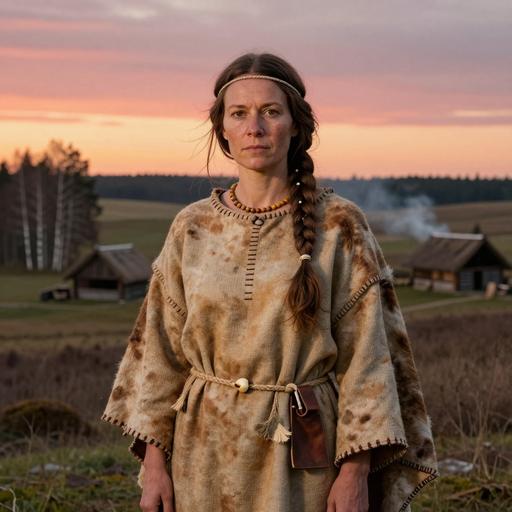
Portrait reconstruction of Gokhem5
Ancient Individual

A woman buried in Sweden in the Middle Neolithic era

Gokhem5
3331 BCE - 2930 BCE
Female
Middle Neolithic Funnel Beaker Culture, Sweden
Sweden
Scroll to begin
Chapter I

Identity

The biological and cultural markers that define this ancient individual

Sample ID

Gokhem5

Date Range

3331 BCE - 2930 BCE

Biological Sex

Female

mtDNA Haplogroup

Not available

Cultural Period

Middle Neolithic Funnel Beaker Culture, Sweden

Chapter II

Place

Where this individual was discovered

Country Sweden
Locality Gökhem. Västergötland
Coordinates 58.1740, 13.4080
Chapter III

Time

When this individual lived in the broader context of human history

Gokhem5 3331 BCE - 2930 BCE
Chapter IV

Story

The narrative of this ancient life

The Middle Neolithic Funnel Beaker Culture (TRB) in Sweden, roughly spanning from 4000 to 2800 BCE, represents a significant prehistoric period distinguished by its development and distinct cultural practices. The TRB culture is notable for its archaeological and anthropological implications, especially considering its role in the transition from hunter-gatherer societies to more settled agricultural communities.

Geographic and Temporal Context

The Funnel Beaker Culture is predominantly found in southern Sweden, with its origins traceable to northern Germany and Denmark. By the Middle Neolithic period, the TRB culture spread into parts of central Sweden, influenced by earlier Mesolithic traditions as well as contact with neighboring cultures. The Swedish landscape during this era, characterized by dense forests, numerous lakes, and a relatively colder climate, played a crucial role in shaping the lifestyle and subsistence patterns of the TRB peoples.

Social Structure and Settlement

The Funnel Beaker Culture in Sweden was composed of small, relatively dispersed communities. Settlements were typically located near water sources, which facilitated fishing and access to transportation. These communities are thought to have been relatively egalitarian, although some differentiation likely existed based on roles such as hunting, farming, and crafting.

Houses during this period were of simple construction, often rectangular with posthole structures indicating wooden framework and thatched roofs. Settlements typically included clusters of such dwellings, suggesting familial or kin-based groupings.

Economy and Subsistence

Economically, the TRB culture in Sweden marked a shift towards mixed farming, incorporating both agriculture and animal husbandry. This period saw the cultivation of crops like barley and emmer wheat, alongside the domestication of animals such as cattle, pigs, and sheep. Hunting and gathering still contributed significantly to the diet, particularly through the procurement of fish, game, and wild plants.

The use of the iconic funnel-shaped beaker, from which the culture derives its name, highlights an advancement in pottery skills. These vessels, often accompanied by other ceramic forms and stone tools, reflect both utilitarian and ceremonial purposes.

Burial Practices and Rituals

Burial practices during the Middle Neolithic TRB period exhibit significant complexity. The culture is known for its megalithic tombs, including passage graves and dolmens, constructed using massive stone slabs. These structures often housed multiple burials, indicating a possible belief in an afterlife or communal spirituality.

Grave goods, including pottery, tools, and ornaments, were commonly placed with the deceased, suggesting concepts of ownership or status that extended beyond life. Additionally, evidence of ceremonial activities, such as the consumption of prepared foods and offerings, points to a burgeoning tradition of ritual practices.

Art and Symbolism

Artistic expression in the TRB culture is visible in decorated pottery and carved stone axes. The motifs often consisted of geometric patterns, anthropomorphic figures, and naturalistic themes that might have held symbolic or communicative meaning. These designs perhaps played a role in social identity or spiritual belief systems.

Linguistic and Cultural Connections

While the direct linguistic attribution to Proto-Indo-European (PIE) is complex and debated, the TRB culture in Sweden existed contemporaneously with diffusion and migration patterns that contributed to the dispersion of Indo-European languages. It is likely that the interaction with migrating PIE speakers influenced TRB communities linguistically and culturally, contributing to the later development of distinct Indo-European language branches in Northern Europe.

Conclusion

The Middle Neolithic Funnel Beaker Culture in Sweden represents a formative era in prehistoric Europe, encapsulating the complexities of cultural transition, technological advancement, and social development. Its legacies are evident in the archaeological record and continue to inform our understanding of prehistoric human experiences and cultural evolution.

Chapter V

Genetics

The genetic ancestry of this ancient individual

Ancient Genetic Admixture

This analysis compares the DNA profile of Gokhem5 with ancient reference populations, showing the genetic composition in terms of prehistoric ancestral groups.

Neolithic Farmers 59.7%
Western Steppe Pastoralists 20.1%
European Hunter-Gatherers 14.3%
Ancient Asians 6.0%

Modern Genetic Admixture

This analysis compares the DNA profile with present-day reference populations, showing what percentage of genetic makeup resembles modern populations from different regions.

Europe 93.7%
Southern European 57.8%
Iberian 42.1%
Italian 8.4%
Sardinian 7.3%
Northwestern European 35.9%
Scandinavian 18.2%
Northwestern European 17.7%
Oceania 6.3%
Melanesian 6.3%
Papuan 6.3%

Closest Modern Populations

These are the modern populations showing the closest statistical alignment to A woman buried in Sweden in the Middle Neolithic era, ranked by genetic distance. Lower distance values indicate closer statistical similarity.

1
French Corsica
4.2009
2
Spanish La Rioja
4.6232
3
Spanish Menorca
4.6284
4
Spanish Murcia
4.6589
5
Spanish Castello
4.6809
6
Spanish Pirineu
4.6812
7
Spanish Cantabria
4.8432
8
Spanish Baleares
4.8512
9
Spanish Valencia
4.8630
10
Spanish Castilla La Mancha
4.8783
Chapter VI

Context

Other ancient individuals connected to this sample

Sources

References

Scientific publications and genetic data

Scientific Publication

Genomic diversity and admixture differs for Stone-Age Scandinavian foragers and farmers

Authors Skoglund P, Malmström H, Omrak A
Abstract

Prehistoric population structure associated with the transition to an agricultural lifestyle in Europe remains a contentious idea. Population-genomic data from 11 Scandinavian Stone Age human remains suggest that hunter-gatherers had lower genetic diversity than that of farmers. Despite their close geographical proximity, the genetic differentiation between the two Stone Age groups was greater than that observed among extant European populations. Additionally, the Scandinavian Neolithic farmers exhibited a greater degree of hunter-gatherer-related admixture than that of the Tyrolean Iceman, who also originated from a farming context. In contrast, Scandinavian hunter-gatherers displayed no significant evidence of introgression from farmers. Our findings suggest that Stone Age foraging groups were historically in low numbers, likely owing to oscillating living conditions or restricted carrying capacity, and that they were partially incorporated into expanding farming groups.

G25 Coordinates

The G25 coordinates for sample Gokhem5 can be used for detailed admixture analysis in our G25 Studio tool.

Gokhem5,0.12141974,0.14780308,0.0297183,-0.01637384,0.05678734,-0.01853318,0.0006503,0.00755036,0.03016046,0.05044372,-0.00469646,0.00959292,-0.01554082,-0.00502502,-0.01328978,0.00569462,0.01407434,4.158E-05,0.00126768,-0.00291802,-0.00108568,0.00210156,-0.00694074,-0.01588444,0.00299518
Analyze in G25 Studio
Use code for 40% off Expires Feb 26