Menu
Store
Blog
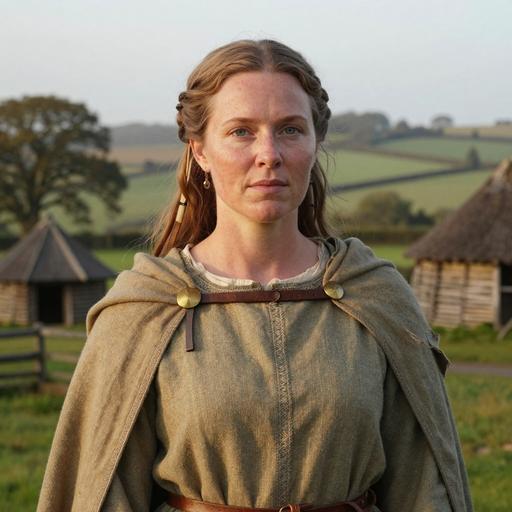
Portrait reconstruction of I14095
Ancient Individual

A woman buried in United Kingdom in the Late Antiquity era

I14095
420 CE - 545 CE
Female
Anglian Scorton, England
United Kingdom
Scroll to begin
Chapter I

Identity

The biological and cultural markers that define this ancient individual

Sample ID

I14095

Date Range

420 CE - 545 CE

Biological Sex

Female

mtDNA Haplogroup

U5b1e1

Cultural Period

Anglian Scorton, England

Chapter II

Place

Where this individual was discovered

Country United Kingdom
Locality England. Scorton. Hollow Banks
Coordinates 54.3955, -1.6140
Chapter III

Time

When this individual lived in the broader context of human history

I14095 420 CE - 545 CE
Chapter IV

Story

The narrative of this ancient life

The Anglian Scorton of Anglo-Saxon England refers to a period and region where the cultural, social, and political influences of the Anglo-Saxons flourished, particularly in what is now modern-day North Yorkshire, around the village of Scorton. This era spans roughly from the 5th century to the Norman Conquest in 1066 AD, marking a significant chapter in England's early medieval history.

Historical Context

The Anglo-Saxon period began as migrants from various Germanic tribes, such as the Angles, Saxons, and Jutes, settled in Britain following the Roman withdrawal. The Angles, from which the name 'England' is derived, were instrumental in establishing various kingdoms across the land, with the region of Scorton being part of the Kingdom of Northumbria.

Society and Culture

Settlement and Structure: The Anglians, like other Anglo-Saxon groups, were primarily agrarian, living in small villages surrounded by farmlands. Scorton would have been characterized by wooden halls, small thatched houses, and communal buildings used for gatherings and administrative functions.

Social Hierarchy: Society was hierarchically structured, with kings and ealdormen at the top, overseeing governance and land distribution. Below them were the thegns, who were land-owning nobles, and at the bottom were the ceorls, or free peasants, who worked the land along with slaves.

Religion and Beliefs: Initially pagan, the Anglo-Saxons worshipped a pantheon of gods akin to Norse deities. However, the Christianization of the Anglo-Saxon kingdoms, which began in the 7th century, led to the establishment of churches and monasteries, heavily influencing cultural practices and art.

Law and Order: The legal system was based on customary laws and a concept known as “wergild,” a system of compensatory fines for different wrongs. This era saw the advent of written codes such as the Laws of Ine and Ethelbert.

Language and Literature

Old English, a Germanic language, was the spoken and written language, characterized by a rich oral tradition. Epic poems like \Beowulf," even if not originating from Scorton specifically, were part of the shared cultural and literary heritage.

Economy

The economy was mainly agricultural, with crops such as wheat, barley, and oats. Animal husbandry was important for dairy and meat. Trade networks, both local and long-distance, were facilitated by settlements like York, drawing goods from as far as the Mediterranean. Craftsmen produced pottery, textiles, and metalwork that were highly regarded.

Art and Craftsmanship

Anglian artistry was renowned for intricate metalwork, particularly in jewelry and weaponry. Decorative styles included interlacing patterns, stylized animal motifs, and runic inscriptions, often seen in artifacts like the famous Sutton Hoo treasures.

Warfare and Defense

Frequent conflicts, both internal and with Viking invaders from the late 8th century onwards, shaped the military landscape. The use of shield walls and the construction of fortified sites like burhs provided defense strategies. Warriors were equipped with spears, swords, and shields, signifying their status and skill.

Legacy

The Anglian Scorton culture left a lasting imprint on England’s landscape, heritage, and identity. Place names, linguistic roots in the English language, and archaeological evidence contribute to our understanding of this formative period in British history. This era laid the foundation for the complex social and political structures that would evolve post-Norman conquest.

In conclusion, Anglian Scorton, like many communities of its time, reflected the broader cultural narratives of transformation, adaptation, and resilience that characterized Anglo-Saxon England. Its people contributed significantly to the tapestry of English history through their innovations yet remained rooted in the traditions of their Germanic origins."

Chapter V

Genetics

The genetic ancestry of this ancient individual

Ancient Genetic Admixture

This analysis compares the DNA profile of I14095 with ancient reference populations, showing the genetic composition in terms of prehistoric ancestral groups.

Western Steppe Pastoralists 38.6%
European Hunter-Gatherers 36.6%
Neolithic Farmers 22.6%
Ancient Asians 2.2%

Modern Genetic Admixture

This analysis compares the DNA profile with present-day reference populations, showing what percentage of genetic makeup resembles modern populations from different regions.

Europe 98.3%
Northwestern European 95.1%
English 39.5%
Scandinavian 25.5%
Northwestern European 21.6%
Finnish 8.5%
Southern European 3.2%
Iberian 3.2%
Asia 1.7%
Central Asian, Northern Indian & Pakistani 1.7%
Indian 1.7%

Closest Modern Populations

These are the modern populations showing the closest statistical alignment to A woman buried in United Kingdom in the Late Antiquity era, ranked by genetic distance. Lower distance values indicate closer statistical similarity.

1
Orcadian
1.7911
2
Scottish
1.9714
3
Irish
2.2453
4
English
2.3312
5
Shetlandic
2.3609
6
English Cornwall
2.4148
7
Icelandic
2.4602
8
Norwegian
2.4905
9
Dutch
2.5048
10
Welsh
2.5767
Chapter VI

Context

Other ancient individuals connected to this sample

Sources

References

Scientific publications and genetic data

Scientific Publication

The Anglo-Saxon migration and the formation of the early English gene pool

Authors Gretzinger J, Sayer D, Justeau P
Abstract

The history of the British Isles and Ireland is characterized by multiple periods of major cultural change, including the influential transformation after the end of Roman rule, which precipitated shifts in language, settlement patterns and material culture1. The extent to which migration from continental Europe mediated these transitions is a matter of long-standing debate2-4. Here we study genome-wide ancient DNA from 460 medieval northwestern Europeans-including 278 individuals from England-alongside archaeological data, to infer contemporary population dynamics. We identify a substantial increase of continental northern European ancestry in early medieval England, which is closely related to the early medieval and present-day inhabitants of Germany and Denmark, implying large-scale substantial migration across the North Sea into Britain during the Early Middle Ages. As a result, the individuals who we analysed from eastern England derived up to 76% of their ancestry from the continental North Sea zone, albeit with substantial regional variation and heterogeneity within sites. We show that women with immigrant ancestry were more often furnished with grave goods than women with local ancestry, whereas men with weapons were as likely not to be of immigrant ancestry. A comparison with present-day Britain indicates that subsequent demographic events reduced the fraction of continental northern European ancestry while introducing further ancestry components into the English gene pool, including substantial southwestern European ancestry most closely related to that seen in Iron Age France5,6.

G25 Coordinates

The G25 coordinates for sample I14095 can be used for detailed admixture analysis in our G25 Studio tool.

I14095,0.12738622,0.12769324,0.06322956,0.04846372,0.04046046,0.01932586,8.712E-05,0.00184756,0.00537084,-0.00228474,-0.0064479,0.00429822,-0.01229832,-0.00757756,0.02190728,-0.00676134,-0.02141736,0.00220036,0.00045952,-0.0033794,0.00416592,0.00244528,-0.00446656,0.01471182,-0.00064106
Analyze in G25 Studio
Use code for 40% off Expires Feb 27