Menu
Store
Blog
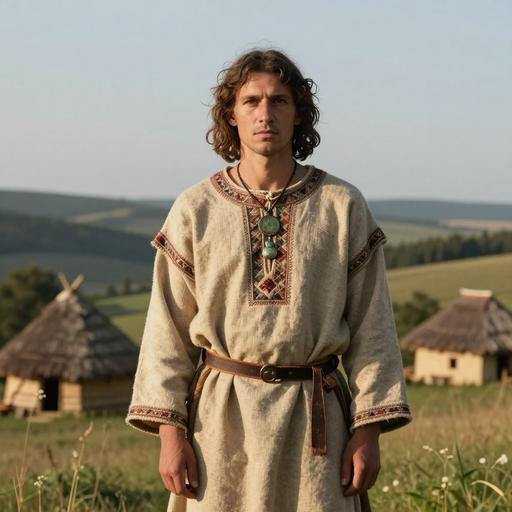
Portrait reconstruction of I1504
Ancient Individual

A man buried in Hungary in the Late Bronze Age era

I1504
987 BCE - 833 BCE
Male
Late Bronze Age Kyjatice Culture, Hungary
Hungary
Scroll to begin
Chapter I

Identity

The biological and cultural markers that define this ancient individual

Sample ID

I1504

Date Range

987 BCE - 833 BCE

Biological Sex

Male

mtDNA Haplogroup

K1a1a

Y-DNA Haplogroup

J2a1

Cultural Period

Late Bronze Age Kyjatice Culture, Hungary

Chapter II

Place

Where this individual was discovered

Country Hungary
Locality Ludas-Varjú dűlő
Coordinates 47.7251, 20.0862
Chapter III

Time

When this individual lived in the broader context of human history

I1504 987 BCE - 833 BCE
Chapter IV

Story

The narrative of this ancient life

The Kyjatice culture, named after the site at Kyjatice in present-day Slovakia, represents a distinct archaeological culture of the Late Bronze Age, typically dated to around 1,200 to 800 BCE in Central Europe. Though the name is derived from a Slovak site, its cultural artifacts and influences were spread across parts of modern-day Hungary, Slovakia, and Poland, among other regions. As a subset of the wider European Bronze Age, the Kyjatice culture contributes significantly to our understanding of social organization, economy, and technological advancement during this period.

Geographic Scope

The Kyjatice culture primarily thrived in the Carpathian Basin, extending into parts of Hungary. Its geographic scope suggests a society adept at navigating and utilizing the diverse landscapes of Central Europe, which include mountains, river valleys, and plains. This aided in their agricultural, hunting, and gathering practices. The expansion into nearby areas is testament to trade networks and cultural exchanges that were prevalent during the era.

Societal Structure

The Kyjatice culture, like many Bronze Age societies, would have been hierarchical. Central to the society was a warrior elite, likely in control of both local power structures and the distribution of wealth, often in the form of bronze tools and ornaments. The presence of fortified settlements indicates a need for defense, suggesting either internal conflicts within the region or threats from outside groups.

Economy and Subsistence

The economic foundation of the Kyjatice culture rested on a balanced economy that combined agriculture, animal husbandry, and metallurgy. Subsistence farming was predominant, with the cultivation of cereals and legumes, augmented by herding cattle, sheep, and goats. The discovery of tools and implements associated with agriculture reflects the importance of farming in daily life.

Metallurgy and Craftsmanship

The era saw significant advancements in bronze metallurgy, which was a hallmark of the Kyjatice culture. Tools, weapons, and ornaments fashioned from bronze not only underscore technical proficiency but also highlight the role of these items in societal status and trade. The presence of ornamented ceramics further illustrates their adeptness in craftsmanship and aesthetic sensibilities.

Settlements and Architecture

Kyjatice culture settlements typically consisted of semi-permanent villages characterized by wooden houses with wattle-and-daub techniques. Fortifications were common, pointing to the need for defensive measures. Excavations often reveal remains of granaries, indicating the storage of surplus produce, which would have been critical for survival and trade.

Burial Practices

Burial customs of the Kyjatice culture exhibit an emphasis on elaborate funerary practices. Inhumations were common, with grave goods often accompanying the deceased, reflecting both the social status of the individual and beliefs in an afterlife. The orientation and contents of graves varied, providing insights into evolving spiritual and cultural practices over time.

Art and Symbolism

Artistic expression in the Kyjatice culture found form in both utilitarian and symbolic objects. Decorations on pottery, textiles, and metalwork showcase geometric designs and motifs that may have held cultural or religious significance. These artistic endeavors are crucial for understanding the symbolic life of the Kyjatice people.

Influence and Legacy

The impact of the Kyjatice culture extends beyond its own geographic and temporal boundaries. Its advancements in metallurgy and ceramics, along with its societal structures, influenced subsequent cultures in the region. By studying this culture, archaeologists gain insight into the broader dynamics of the Late Bronze Age in Central Europe.

In summation, the Kyjatice culture of the Late Bronze Age in Hungary represents a complex society defined by its economic strategies, social hierarchies, technological innovations, and cultural practices. It stands as a testament to the adaptive strategies of human societies in prehistory, as well as their intricate networks of trade, communication, and cultural exchange.

Chapter V

Genetics

The genetic ancestry of this ancient individual

Ancient Genetic Admixture

This analysis compares the DNA profile of I1504 with ancient reference populations, showing the genetic composition in terms of prehistoric ancestral groups.

Western Steppe Pastoralists 35.8%
European Hunter-Gatherers 34.5%
Neolithic Farmers 29.8%

Modern Genetic Admixture

This analysis compares the DNA profile with present-day reference populations, showing what percentage of genetic makeup resembles modern populations from different regions.

Europe 100.0%
Southern European 92.2%
Balkan 91.4%
Sardinian 0.8%
Northwestern European 7.8%

Closest Modern Populations

These are the modern populations showing the closest statistical alignment to A man buried in Hungary in the Late Bronze Age era, ranked by genetic distance. Lower distance values indicate closer statistical similarity.

1
French Alsace
1.7627
2
French Nord
1.7901
3
Belgianc
1.9169
4
Belgianb
2.0300
5
French Pas De Calais
2.0354
6
Swiss German
2.1639
7
Belgiana
2.2575
8
French Paris
2.2858
9
German
2.3452
10
Austrian
2.4390
Chapter VI

Context

Other ancient individuals connected to this sample

Sources

References

Scientific publications and genetic data

Scientific Publication

Genome flux and stasis in a five millennium transect of European prehistory

Authors Gamba C, Jones ER, Teasdale MD
Abstract

The Great Hungarian Plain was a crossroads of cultural transformations that have shaped European prehistory. Here we analyse a 5,000-year transect of human genomes, sampled from petrous bones giving consistently excellent endogenous DNA yields, from 13 Hungarian Neolithic, Copper, Bronze and Iron Age burials including two to high (~22 × ) and seven to ~1 × coverage, to investigate the impact of these on Europe's genetic landscape. These data suggest genomic shifts with the advent of the Neolithic, Bronze and Iron Ages, with interleaved periods of genome stability. The earliest Neolithic context genome shows a European hunter-gatherer genetic signature and a restricted ancestral population size, suggesting direct contact between cultures after the arrival of the first farmers into Europe. The latest, Iron Age, sample reveals an eastern genomic influence concordant with introduced Steppe burial rites. We observe transition towards lighter pigmentation and surprisingly, no Neolithic presence of lactase persistence.

G25 Coordinates

The G25 coordinates for sample I1504 can be used for detailed admixture analysis in our G25 Studio tool.

I1504,0.12650414,0.13637672,0.05472684,0.02664606,0.04485252,0.01083986,0.00263346,0.00710388,0.01479124,0.011115,-0.00453182,0.00374632,-0.00282424,-0.00639916,0.00639898,0.00192994,-0.00217786,-0.00014212,-0.00014514,0.0003246,0.00362022,0.00079912,-0.0017929,-0.00050892,-0.00016969
Analyze in G25 Studio
Use code for 40% off Expires Feb 26