Menu
Store
Blog
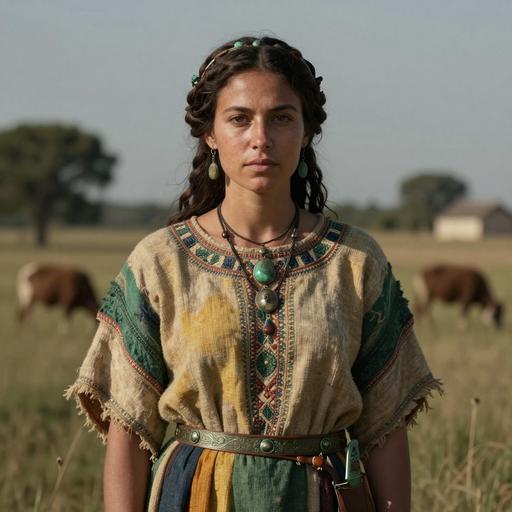
Portrait reconstruction of I16792
Ancient Individual

A woman buried in France in the Bronze Age era

I16792
1950 BCE - 1650 BCE
Female
Protohistoric Bronze Age France
France
Scroll to begin
Chapter I

Identity

The biological and cultural markers that define this ancient individual

Sample ID

I16792

Date Range

1950 BCE - 1650 BCE

Biological Sex

Female

mtDNA Haplogroup

R1a1a

Cultural Period

Protohistoric Bronze Age France

Chapter II

Place

Where this individual was discovered

Country France
Locality Morbihan. Quiberon. Beg-er-Vil
Coordinates 47.5307, -3.1383
Chapter III

Time

When this individual lived in the broader context of human history

I16792 1950 BCE - 1650 BCE
Chapter IV

Story

The narrative of this ancient life

The Protohistoric Bronze Age in France, particularly relating to Celtic culture, represents a transformative period marked by advancements in metallurgy, societal organization, and cultural development. This era roughly spans from around 2300 BCE to 800 BCE, a period that serves as a bridge between prehistoric and recorded history, setting the stage for the Iron Age and the eventual rise of Celtic civilization.

Overview

Geographical Context: Protohistoric Bronze Age France refers to the regions encompassing modern-day France, which were inhabited by a variety of tribal communities. These groups were primarily located in areas with access to raw materials like tin and copper, essential for bronze production. Regions of notable activity included Brittany, the Paris Basin, and the Rhône Valley.

Bronze Metallurgy: The hallmark of this era was the development of bronze - an alloy of copper and tin. The ability to create harder and more durable tools and weapons marked a significant technological advancement over the previously used stone and copper. This innovation allowed for more efficient agricultural practices, leading to increased food production and supporting population growth.

Societal Developments

Agriculture and Settlement: The Protohistoric Bronze Age saw significant advancements in agriculture, including improved plow designs and the introduction of crop rotation techniques. These developments enabled more stable and permanent settlements. Archaeological evidence suggests the emergence of small villages, characterized by roundhouses constructed with wattle and daub.

Trade and Economy: Trade routes became increasingly sophisticated, facilitating the exchange of goods, ideas, and technology. Key commodities included bronze tools, weapons, pottery, and ornamental items. Evidence of trade networks extends across Europe, indicating interaction with other contemporary cultures such as those in the British Isles and the Iberian Peninsula.

Social Hierarchy and Leadership: Society became more stratified during this period, with emerging social hierarchies evidenced by burial practices and the distribution of goods. Elite individuals or chieftains often controlled trade and resources, and their status was often reflected in richly furnished graves containing weapons, jewelry, and imported goods.

Cultural Characteristics

Art and Symbolism: Art from this period is characterized by simple yet meaningful motifs, often found on pottery and metalwork. Recurring symbols include spirals, circles, and geometric patterns, which hold cultural and possibly religious significance. Additionally, the production of elaborate metalwork items, such as torcs and brooches, illustrates both artistic skill and the social importance of display and ornamentation.

Rituals and Religion: The Protohistoric Bronze Age likely featured complex belief systems centered around nature worship and the reverence of ancestors. Archaeological sites, such as burial mounds and ritualistic deposits in rivers or wetlands, suggest ceremonies that likely involved offerings to deities or spirits believed to inhabit natural elements and landscapes.

Language and Identity: Though concrete evidence of language from this period is scarce, it is hypothesized that the precursors to Celtic languages began developing during this time. The cultural identity that would later flourish into full-fledged Celtic society can trace its roots back to the social and linguistic developments of the Protohistoric Bronze Age.

Legacy and Transition

The Protohistoric Bronze Age set the foundation for the cultural and technological advancements that would define the Celtic tribes in the subsequent Iron Age. The developments in metallurgy, agriculture, and social organization during this era facilitated the growth of more complex societies and laid the groundwork for the rich tapestry of Celtic culture that would become influential across much of Europe.

As the period came to a close around 800 BCE, the region witnessed the gradual introduction of ironworking technology, leading to further societal changes and the emergence of the Hallstatt culture, which is widely regarded as the earliest recognized Celtic culture in Europe. The Protohistoric Bronze Age in France thus represents a critical juncture in European prehistory, marked by innovation and the seeds of cultural identity that would flourish in the millennia to follow.

Chapter V

Genetics

The genetic ancestry of this ancient individual

Ancient Genetic Admixture

This analysis compares the DNA profile of I16792 with ancient reference populations, showing the genetic composition in terms of prehistoric ancestral groups.

Neolithic Farmers 35.6%
Western Steppe Pastoralists 27.8%
European Hunter-Gatherers 27.4%
Ancient Africans 9.2%

Modern Genetic Admixture

This analysis compares the DNA profile with present-day reference populations, showing what percentage of genetic makeup resembles modern populations from different regions.

Europe 89.9%
Northwestern European 65.3%
English 31.9%
Scandinavian 23.1%
Northwestern European 10.3%
Southern European 24.6%
Italian 23.4%
Balkan 1.3%
Africa 10.1%
Northern East African 5.3%
Eastern African 5.3%
North African 4.6%
Egyptian 4.6%

Closest Modern Populations

These are the modern populations showing the closest statistical alignment to A woman buried in France in the Bronze Age era, ranked by genetic distance. Lower distance values indicate closer statistical similarity.

1
Afrikaner
4.5627
2
German Erlangen
4.9577
3
Hungarian
4.9946
4
Austrian
5.0130
5
Slovenian
5.1467
6
German
5.2099
7
Croatian
5.2214
8
German East
5.2503
9
French Alsace
5.2673
10
German Hamburg
5.2761
Chapter VI

Context

Other ancient individuals connected to this sample

Sources

References

Scientific publications and genetic data

Scientific Publication

Large-scale migration into Britain during the Middle to Late Bronze Age

Authors Patterson N, Isakov M, Booth T
Abstract

Present-day people from England and Wales have more ancestry derived from early European farmers (EEF) than did people of the Early Bronze Age1. To understand this, here we generated genome-wide data from 793 individuals, increasing data from the Middle to the Late Bronze Age and Iron Age in Britain by 12-fold, and western and central Europe by 3.5-fold. Between 1000 and 875 BC, EEF ancestry increased in southern Britain (England and Wales) but not northern Britain (Scotland) due to incorporation of migrants who arrived at this time and over previous centuries, and who were genetically most similar to ancient individuals from France. These migrants contributed about half the ancestry of people of England and Wales from the Iron Age, thereby creating a plausible vector for the spread of early Celtic languages into Britain. These patterns are part of a broader trend of EEF ancestry becoming more similar across central and western Europe in the Middle to the Late Bronze Age, coincident with archaeological evidence of intensified cultural exchange2-6. There was comparatively less gene flow from continental Europe during the Iron Age, and the independent genetic trajectory in Britain is also reflected in the rise of the allele conferring lactase persistence to approximately 50% by this time compared to approximately 7% in central Europe where it rose rapidly in frequency only a millennium later. This suggests that dairy products were used in qualitatively different ways in Britain and in central Europe over this period.

G25 Coordinates

The G25 coordinates for sample I16792 can be used for detailed admixture analysis in our G25 Studio tool.

I16792,0.0858567,0.13485816,0.06117768,0.0350873,0.04476642,0.01358752,0.00197104,0.01154876,0.01097524,0.0079914,-0.00771582,0.00188712,-0.00246916,0.0101845,-0.00089278,-0.0017604,-0.0094453,-0.00021008,-0.0010802,-0.00115864,0.0034919,0.00115426,-0.00074228,-0.0059989,-9.121E-05
Analyze in G25 Studio
Use code for 40% off Expires Feb 27