Menu
Store
Blog
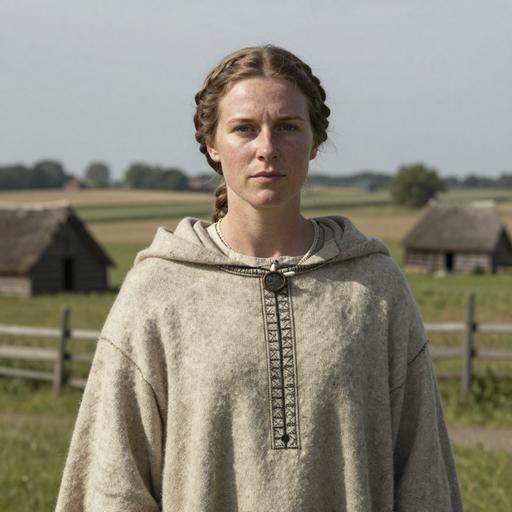
Portrait reconstruction of I17750
Ancient Individual

A woman buried in Netherlands in the Late Iron Age era

I17750
169 BCE - 9 BCE
Female
Late Iron Age Netherlands
Netherlands
Scroll to begin
Chapter I

Identity

The biological and cultural markers that define this ancient individual

Sample ID

I17750

Date Range

169 BCE - 9 BCE

Biological Sex

Female

mtDNA Haplogroup

H86

Cultural Period

Late Iron Age Netherlands

Chapter II

Place

Where this individual was discovered

Country Netherlands
Locality Noord-Holland. Velsen-Hoogoventerrein
Coordinates 52.4700, 4.6400
Chapter III

Time

When this individual lived in the broader context of human history

I17750 169 BCE - 9 BCE
Chapter IV

Story

The narrative of this ancient life

The Late Iron Age in the region now known as the Netherlands was a period that stretched roughly from 250 BCE to the Roman conquest, beginning around 12 BCE. During this era, the area was inhabited primarily by various Germanic tribes and some Celtic influences, playing a pivotal role in the transition from the prehistoric to the historic period as these communities gradually encountered the Roman Empire.

Geography and Environment:

The geography of the Late Iron Age Netherlands was characterized by a variety of landscapes, including coastal dunes, sandy plains, river valleys, and peat bogs. The environment was relatively flat, with numerous waterways that would become crucial for transportation and trade. The North Sea to the west shaped much of the lifestyle, along with the Rhine, Meuse, and Scheldt rivers flowing through the region.

The North Sea provided both opportunities and challenges. Coastal areas experienced frequent flooding, shaping the development of early water management techniques. People in the area constructed terpen (artificial dwelling mounds) to protect their homes from rising tides, a precursor to the advanced dike systems seen today.

Social Structure and Economy:

The society of this era was primarily agrarian, with people living in small settlements or hamlets. These were often clustered around fertile areas suitable for agriculture. The economy was based on subsistence farming, with communities growing grains like barley and wheat, and keeping livestock such as cattle, pigs, sheep, and goats.

Trading networks were well-established by this period, with archaeological evidence suggesting exchanges of goods not only within tribes but also with neighboring regions and beyond. Items such as pottery, metals, amber, glassware, and even Roman goods have been found in settlements, indicating a complex web of trade routes.

Societal organization was tribal, with chieftains or kings at the helm of communal life. Power dynamics were heavily influenced by family lineage, martial prowess, and the ability to control trade and resources. The social hierarchy was also reflected in the burial practices, where more elaborate rites were reserved for the elite.

Cultural Aspects:

Culturally, the Late Iron Age was marked by the gradual fusion of indigenous traditions with influences brought by contact with the Celts and Romans. Religious practices were predominantly pagan and polytheistic, with a pantheon of deities connected to natural elements and ancestors. Rituals often took place in natural sites considered sacred, such as groves and bodies of water, although evidence of constructed religious sites has also been discovered.

Material culture, particularly in terms of artistry and craftsmanship, thrived. Artifacts from this period reveal a proficiency in metalwork, textiles, and ceramics. The weapons, tools, and jewelry made by the Germanic tribes were both practical and decorative, indicating a deep appreciation for artisanship.

Interactions with the Romans:

The Late Iron Age Netherlands eventually came into contact with the expanding Roman Empire. This interaction brought significant changes, as Roman military expeditions, trade, and settlement extended into the region. The Batavi, a Germanic tribe, became particularly known for their alliance with Rome, providing troops that were highly valued by the Roman military. In return, the Batavi—and other tribes—benefited from the technological and cultural influences of the Romans, which included advanced agricultural techniques, urban planning, and literacy.

In summary, the Late Iron Age in the Netherlands was a dynamic period marked by tribal cohesion, agricultural advancement, and burgeoning trade, set against the backdrop of natural challenges and external cultural influences. The arrival of the Romans set the stage for significant socio-political transformation, which laid the groundwork for the future development of the region.

Chapter V

Genetics

The genetic ancestry of this ancient individual

Ancient Genetic Admixture

This analysis compares the DNA profile of I17750 with ancient reference populations, showing the genetic composition in terms of prehistoric ancestral groups.

Western Steppe Pastoralists 38.5%
European Hunter-Gatherers 35.1%
Neolithic Farmers 21.6%
Ancient Native Americans 2.8%
Ancient Asians 2.1%

Modern Genetic Admixture

This analysis compares the DNA profile with present-day reference populations, showing what percentage of genetic makeup resembles modern populations from different regions.

Europe 98.1%
Northwestern European 66.2%
English 34.4%
Scandinavian 18.9%
Northwestern European 12.5%
Eastern European 17.8%
Southern European 14.1%
Italian 7.1%
Balkan 7.0%
Asia 1.9%
Northern West Asian 1.7%
Anatolian 1.7%

Closest Modern Populations

These are the modern populations showing the closest statistical alignment to A woman buried in Netherlands in the Late Iron Age era, ranked by genetic distance. Lower distance values indicate closer statistical similarity.

1
Orcadian
2.1932
2
Norwegian
2.2322
3
Shetlandic
2.2339
4
Scottish
2.2673
5
Icelandic
2.3467
6
Danish
2.3573
7
Dutch
2.4071
8
Irish
2.4797
9
German Hamburg
2.4910
10
Swedish
2.5326
Chapter VI

Context

Other ancient individuals connected to this sample

Sources

References

Scientific publications and genetic data

Scientific Publication

Large-scale migration into Britain during the Middle to Late Bronze Age

Authors Patterson N, Isakov M, Booth T
Abstract

Present-day people from England and Wales have more ancestry derived from early European farmers (EEF) than did people of the Early Bronze Age1. To understand this, here we generated genome-wide data from 793 individuals, increasing data from the Middle to the Late Bronze Age and Iron Age in Britain by 12-fold, and western and central Europe by 3.5-fold. Between 1000 and 875 BC, EEF ancestry increased in southern Britain (England and Wales) but not northern Britain (Scotland) due to incorporation of migrants who arrived at this time and over previous centuries, and who were genetically most similar to ancient individuals from France. These migrants contributed about half the ancestry of people of England and Wales from the Iron Age, thereby creating a plausible vector for the spread of early Celtic languages into Britain. These patterns are part of a broader trend of EEF ancestry becoming more similar across central and western Europe in the Middle to the Late Bronze Age, coincident with archaeological evidence of intensified cultural exchange2-6. There was comparatively less gene flow from continental Europe during the Iron Age, and the independent genetic trajectory in Britain is also reflected in the rise of the allele conferring lactase persistence to approximately 50% by this time compared to approximately 7% in central Europe where it rose rapidly in frequency only a millennium later. This suggests that dairy products were used in qualitatively different ways in Britain and in central Europe over this period.

G25 Coordinates

The G25 coordinates for sample I17750 can be used for detailed admixture analysis in our G25 Studio tool.

I17750,0.13154356,0.12095078,0.05766306,0.0497209,0.03524424,0.02204924,0.00190802,0.00610618,0.00190364,-0.00654408,-0.00557028,0.00400364,-0.00543138,-0.00590346,0.0165556,-0.00098486,-0.01500178,0.00246042,-0.00095182,-0.00165852,0.00428584,0.00355782,-0.00028452,0.01228076,0.00121497
Analyze in G25 Studio
Use code for 40% off Expires Feb 26