Menu
Store
Blog
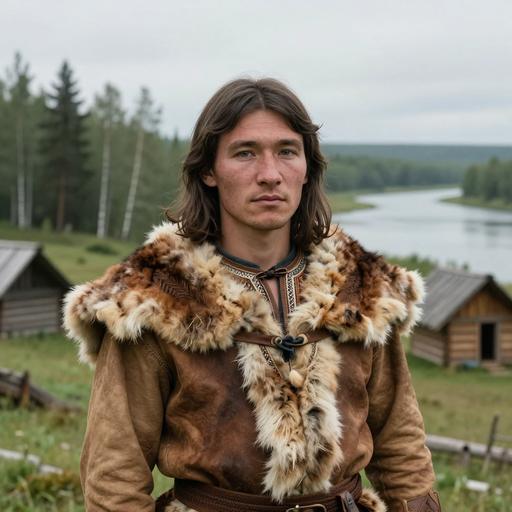
Portrait reconstruction of I1961
Ancient Individual

A man buried in Russia in the Bronze Age era

I1961
4239 BCE - 4002 BCE
Male
Northern Irkutsk
Russia
Scroll to begin
Chapter I

Identity

The biological and cultural markers that define this ancient individual

Sample ID

I1961

Date Range

4239 BCE - 4002 BCE

Biological Sex

Male

mtDNA Haplogroup

A10

Y-DNA Haplogroup

N-L708

Cultural Period

Northern Irkutsk

Chapter II

Place

Where this individual was discovered

Country Russia
Locality Sosnovy-Mys (Irkutsk Oblast, Ust-Ilimsky District, Kata, Sosnovy Island)
Chapter III

Time

When this individual lived in the broader context of human history

I1961 4239 BCE - 4002 BCE
Chapter IV

Story

The narrative of this ancient life

The Northern region of Irkutsk in Siberia represents a unique cultural and ecological area, shaped by its harsh climate, diverse ethnic composition, and rich historical tapestry. This area is characterized by its remote location, expansive natural landscapes, and heritage of indigenous communities. Here is a detailed description of the cultural and ecological aspects of Northern Irkutsk:

Geography and Climate

Northern Irkutsk is part of Siberia, known for its vast, rugged terrain and extreme climate conditions. The region is dominated by taiga, a dense forest biome characterized by coniferous trees such as larch, pine, and spruce, and is interspersed with rivers, lakes, and expansive plains. The climate here is subarctic, with long, severe winters where temperatures can plummet below -40°C and short, cool summers.

Ecological Significance

The region is ecologically significant due to its biodiversity and pristine wilderness areas. It is home to numerous animal species such as Siberian tigers, wolves, bears, and reindeer, along with a wide range of bird species. The area is a crucial carbon sink, with the taiga playing a vital role in global carbon cycles.

Historical Context

The history of Northern Irkutsk is intertwined with the movement of nomadic tribes and the influence of the Russian Empire. The indigenous Evenki and Buryat people, among others, have traditionally inhabited the area. During the 17th and 18th centuries, Russian explorers and settlers moved into Siberia, integrating it into the Russian Empire and later the Soviet Union. This period saw the gradual integration of indigenous cultures with Russian customs and governance.

Indigenous Cultures

The Evenki:

  • Lifestyle: Traditionally nomadic reindeer herders, the Evenki adapted to the harsh Siberian environment with their extensive knowledge of the land. Their lifestyle revolves around migration patterns in tune with the environment, using reindeer for transportation, food, and clothing.
  • Spirituality: Shamanism plays a central role in Evenki culture, with shamans acting as mediators between the human and spirit worlds, conducting rituals to heal and guide their communities.

The Buryat:

  • Culture: As the largest indigenous group in Siberia, the Buryat people have a rich cultural heritage influenced by Mongolian, Tibetan, and Russian elements. They are known for their traditional crafts, music, and dance.
  • Religion: Tibetan Buddhism along with shamanistic practices define Buryat spiritual life, with Buddhist monasteries known as \datsans" being found in the region.

Language

The linguistic landscape in Northern Irkutsk is diverse, including the Evenki language, Buryat, and Russian. Each of these languages reflects the histories and interactions of the people in the region.

Economy

The economy of Northern Irkutsk has historically been rooted in natural resource extraction, including timber, oil, and minerals. While industrial activities have brought economic opportunities, they have also posed environmental challenges. Traditional economies based on hunting, fishing, and reindeer herding still hold cultural significance and provide subsistence for many indigenous communities.

Modern Developments

Despite its remoteness, Northern Irkutsk is slowly experiencing modernization, with improved infrastructure and connectivity. However, this development raises concerns about the preservation of traditional cultures and environmental sustainability. Balancing economic development with cultural preservation and environmental protection is a significant challenge facing the region.

Cultural Preservation

Efforts are being made to preserve the unique cultural identities of the indigenous peoples through language revitalization programs, cultural festivals, and traditional crafts promotion. These efforts aim to strengthen community bonds and cultural pride amidst external pressures and changes.

Conclusion

Northern Irkutsk of Siberia stands as a testament to human resilience and cultural diversity. The region's ability to maintain its heritage while navigating modern challenges highlights the dynamic interplay between tradition and progress in the face of an ever-evolving world."

Chapter V

Context

Other ancient individuals connected to this sample

Sources

References

Scientific publications and genetic data

Scientific Publication

Three assays for in-solution enrichment of ancient human DNA at more than a million SNPs

Authors Rohland N, Mallick S, Mah M
Abstract

The strategy of in-solution enrichment for hundreds of thousands of single-nucleotide polymorphisms (SNPs) has been used to analyze >70% of individuals with genome-scale ancient DNA published to date. This approach makes it economical to study ancient samples with low proportions of human DNA and increases the rate of conversion of sampled remains into interpretable data. So far, nearly all such data have been generated using a set of bait sequences targeting about 1.24 million SNPs (the "1240k reagent"), but synthesis of the reagent has been cost-effective for only a few laboratories. In 2021, two companies, Daicel Arbor Biosciences and Twist Bioscience, made available assays that target the same core set of SNPs along with supplementary content. We test all three assays on a common set of 27 ancient DNA libraries and show that all three are effective at enriching many hundreds of thousands of SNPs. For all assays, one round of enrichment produces data that are as useful as two. In our testing, the "Twist Ancient DNA" assay produces the highest coverages, greatest uniformity on targeted positions, and almost no bias toward enriching one allele more than another relative to shotgun sequencing. We also identify hundreds of thousands of targeted SNPs for which there is minimal allelic bias when comparing 1240k data to either shotgun or Twist data. This facilitates coanalysis of the large data sets that have been generated using 1240k and Twist capture, as well as shotgun sequencing approaches.

Use code for 40% off Expires Mar 01