Menu
Currency
Main
Store
Blog

Loading Report

Preparing your ancestry journey

Connecting to ancient matches...

Preparing your report

Skip to main content
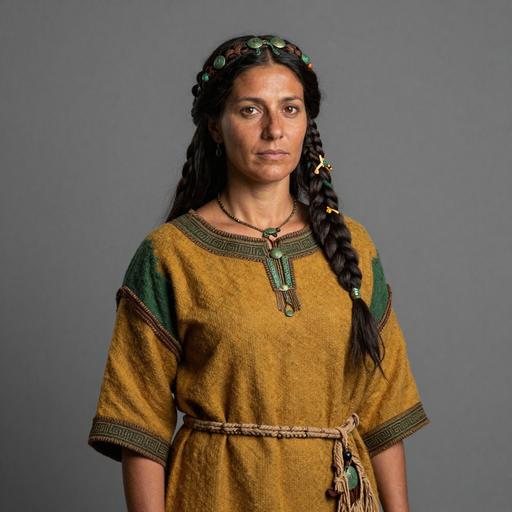
Portrait reconstruction of A woman buried in Hungary in the Late Bronze Age to Early Iron Age era
Ancient Individual

A woman buried in Hungary in the Late Bronze Age to Early Iron Age era

A woman buried in Hungary during the Late Bronze Age to Early Iron Age Hungary

A fragment of the ancient world, preserved across millennia in strands of DNA.

I20770
1700 BCE - 500 BCE
Female
Hungary
Scroll to begin
Chapter I

Identity

The biological and cultural markers that define this ancient individual

Sample ID

I20770

Date Range

1700 BCE - 500 BCE

Cultural Period

Late Bronze Age to Early Iron Age Hungary

Biological Sex

Female

mtDNA Haplogroup

Not available

Y-DNA Haplogroup

N/A (Female)

Social Role

Pastoralist (AI estimate, era-typical)

Chapter II

Place

Where this individual was discovered

Country Hungary
Locality Mezőkeresztes-Cethalom. M3-10 lelőhely; Great Hungarian Plain. Borsodi-Mezőség
Coordinates 47.8150, 20.6841
Chapter III

Time

When this individual lived in the broader context of human history

I20770 1700 BCE - 500 BCE
Chapter IV

Story

The narrative of this ancient life

Region & Environment

This era unfolded across Hungary’s Carpathian Basin landscapes, including fertile lowlands and upland margins where farming and herding could be organized seasonally. River corridors supported both subsistence and interaction with neighboring regions.

Historical Context

Between the 2nd and early 1st millennia BCE, Central Europe moved through major transitions from Late Bronze Age social networks toward Early Iron Age developments. In the Carpathian Basin, the Urnfield tradition provides a broad framework for understanding changing burial and material patterns.

Populations & Lifeways

Populations were primarily sedentary agriculturalists and pastoralists, with households managing crops and animals. Over generations, people also engaged in craft production—particularly pottery and metalworking—while adapting to new technologies and changing regional ties.

Archaeology & Material Culture

Archaeology for this timeframe often focuses on ceramics and metal objects, including indicators of the “bronze-to-iron” shift. The Urnfield cultural framework is associated with particular regional artifact patterns and, in many contexts, urnfield-related burial practices (where securely documented).

Culture & Society

Cultural identity is visible through repeated stylistic choices in everyday goods and through mortuary practices associated with Urnfield tradition in Central Europe. These patterns suggest community norms and shared understandings of identity and status, while the variety of assemblages implies differences between households or local groups.

Legacy & Transition

As this period progressed, the increasing presence of iron and modifications in ceramic and metalworking traditions helped set the stage for later Iron Age communities. The Late Bronze Age–Early Iron Age horizon in Hungary therefore captures the material groundwork for subsequent social and cultural changes in the region.

Context

Related Samples

This individual exists within a broader network of ancient samples. No ancient genome stands alone.

Sample ID Culture/Period Date Location Action
I11912 Glavanesti Culture of Romania 3500 BCE Glăvăneşti, Romania View
I11902 The Bodrogkeresztur Culture 4500 BCE Urziceni, Romania View
I11906 The Bodrogkeresztur Culture 4500 BCE Urziceni, Romania View
I11929 Middle Neolithic Alföld Linear Pottery Culture, Hungary 4300 BCE Polgár-Ferenci hát. M3-31, Hungary View
I11933 Middle Neolithic Alföld Linear Pottery Culture, Hungary 4300 BCE Polgár-Ferenci hát. M3-31, Hungary View
I20767 Iron Age Scythian Culture, Hungary 4000 BCE Kesznyéten-Szérűskert; Great Hungarian Plain. Borsodi-Mezőség, Hungary View
I20766 Iron Age Scythian Culture, Hungary 400 BCE Kesznyéten-Szérűskert, Hungary View
I20770 Late Bronze Age to Early Iron Age Hungary 1700 BCE Mezőkeresztes-Cethalom. M3-10 lelőhely; Great Hungarian Plain. Borsodi-Mezőség, Hungary View
I20773 Late Bronze Age Hungary 1700 BCE Besenyszög Berek-ér partja, Hungary View
I11683 Late Bronze Age to Early Iron Age Hungary 1700 BCE Mezőkeresztes-Cethalom. M3-10 lelőhely; Great Hungarian Plain. Borsodi-Mezőség, Hungary View
I20747 Iron Age Scythian Culture, Hungary 400 BCE Kesznyéten-Szérűskert, Hungary View
I20749 Late Bronze Age Halomsíros (Tumulus) Culture, Hungary 1700 BCE Hajdudorog-Szallasfold, Hungary View
I20750 Middle Bronze Age Füzesabony Culture, Hungary 2300 BCE Polgar Kenderfold, Hungary View
I20751 Late Bronze Age Hungary 1500 BCE Besenyszög Berek-ér partja. Köröm-Kápolnadomb, Hungary View
I20752 The La Tene Culture in Hungary 500 BCE Besenyszög Berek-ér partja. Köröm-Kápolnadomb, Hungary View
I20756 Old Bering Sea Culture Ekven, Russia 970 CE Chukotka. Bering Strait. Ekven, Russia View
I4112 5500 BCE Dereivka I, Ukraine View
Sample ID Culture/Period Date Location Action
I20770 Late Bronze Age to Early Iron Age Hungary 1700 BCE Mezőkeresztes-Cethalom. M3-10 lelőhely; Great Hungarian Plain. Borsodi-Mezőség, Hungary View
I11683 Late Bronze Age to Early Iron Age Hungary 1700 BCE Mezőkeresztes-Cethalom. M3-10 lelőhely; Great Hungarian Plain. Borsodi-Mezőség, Hungary View
Sources

References

Scientific publications and genetic data that inform this profile.

Scientific Publication

A minimally destructive protocol for DNA extraction from ancient teeth

Authors Harney É, Cheronet O, Fernandes DM, Sirak K, Mah M et al.
Abstract

Ancient DNA sampling methods-although optimized for efficient DNA extraction-are destructive, relying on drilling or cutting and powdering (parts of) bones and teeth. As the field of ancient DNA has grown, so have concerns about the impact of destructive sampling of the skeletal remains from which ancient DNA is obtained. Due to a particularly high concentration of endogenous DNA, the cementum of tooth roots is often targeted for ancient DNA sampling, but destructive sampling methods of the cementum often result in the loss of at least one entire root. Here, we present a minimally destructive method for extracting ancient DNA from dental cementum present on the surface of tooth roots. This method does not require destructive drilling or grinding, and, following extraction, the tooth remains safe to handle and suitable for most morphological studies, as well as other biochemical studies, such as radiocarbon dating. We extracted and sequenced ancient DNA from 30 teeth (and nine corresponding petrous bones) using this minimally destructive extraction method in addition to a typical tooth sampling method. We find that the minimally destructive method can provide ancient DNA that is of comparable quality to extracts produced from teeth that have undergone destructive sampling processes. Further, we find that a rigorous cleaning of the tooth surface combining diluted bleach and UV light irradiation seems sufficient to minimize external contaminants usually removed through the physical removal of a superficial layer when sampling through regular powdering methods.

Use code for 25% off Expires Jul 27