Menu
Store
Blog
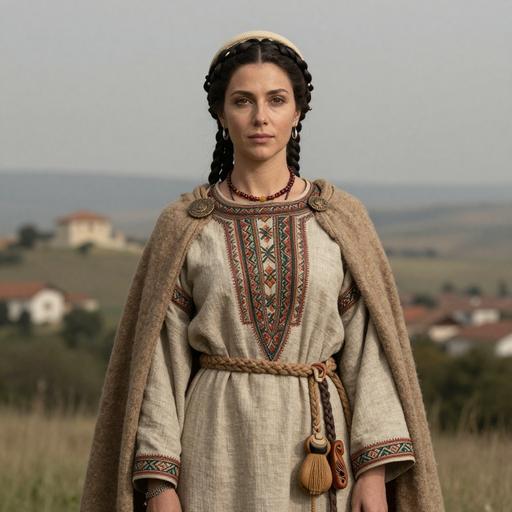
Portrait reconstruction of I2530
Ancient Individual

A woman buried in North Macedonia in the Middle Ages era

I2530
992 CE - 1121 CE
Female
Medieval Macedonia
North Macedonia
Scroll to begin
Chapter I

Identity

The biological and cultural markers that define this ancient individual

Sample ID

I2530

Date Range

992 CE - 1121 CE

Biological Sex

Female

mtDNA Haplogroup

H1

Cultural Period

Medieval Macedonia

Chapter II

Place

Where this individual was discovered

Country North Macedonia
Locality Tumba S. Opticari. Bitola
Coordinates 41.0300, 21.3300
Chapter III

Time

When this individual lived in the broader context of human history

I2530 992 CE - 1121 CE
Chapter IV

Story

The narrative of this ancient life

The period of Medieval Macedonia within the Byzantine Empire is a fascinating era characterized by cultural diversity, political intrigue, and significant historical developments. This period roughly spans from the early Middle Ages following the decline of the Roman Empire until the fall of the Byzantine Empire in 1453. It is important to note that \Macedonia" can refer to different geographic and political entities over time, but in the context of the Byzantine Empire, it typically refers to the region located in the southern Balkans, which included parts of modern-day Greece, North Macedonia, Bulgaria, and Albania.

Historical Context

  1. Early Byzantine Macedonia:

    • In the 4th century, Thessalonica served as a provincial capital and a critical administrative, military, and trade center, benefiting from its strategic location near the Via Egnatia.
    • Christianity played a crucial role with the early spread of the faith in Macedonia. The archbishopric of Thessalonica held considerable influence over ecclesiastical matters.
  2. Slavic Invasions and Settlements:

    • From the 6th and 7th centuries, Slavic tribes began to invade and settle in the Balkans, including Macedonia. The Byzantines adopted both military and diplomatic measures, including alliances and settlements, to manage these new populations.
    • The cultural influence was mutual, with Slavic languages and traditions permeating daily life.
  3. The Macedonian Dynasty (867–1056):

    • The rise of the Macedonian Dynasty, although having roots in the theme of Macedonia, saw the elevation of Byzantine power, culture, and territorial expansion.
    • The dynasty's most notable emperor, Basil II, known as the "Bulgar Slayer," expanded Byzantine borders and consolidated power in the Balkans.
    • This period was marked by economic prosperity and cultural revival, often termed the "Macedonian Renaissance," characterized by advances in art, literature, and learning.
  4. Cultural and Religious Developments:

    • Byzantine Macedonia was a nexus of cultural and artistic production. Byzantine art and architecture flourished, with notable examples including frescoes, iconography, and ecclesiastical architecture.
    • Churches such as the Rotunda of Galerius and the Hagia Sophia in Thessalonica are prime examples of the era’s architectural achievements.
    • The Macedonian region contributed to Orthodoxy's development, especially as Cyril and Methodius, the Byzantine missionaries, originated from here and created the Glagolitic alphabet, which laid the foundation for the Cyrillic script.
  5. Economic Activity:

    • Macedonia's economy was largely agrarian but also benefitted from trade routes like the Via Egnatia which facilitated trade between the Adriatic and the Aegean.
    • Thessalonica's port was critical in sustaining economic prosperity, serving as a gateway for goods, people, and ideas between East and West.
  6. Decline and External Threats:

    • From the late 11th century, Macedonia and the broader Byzantine Empire faced increased threats from Normans, Pechenegs, and later the Seljuk Turks.
    • The Crusades also significantly impacted the region; notably, the capture and sack of Thessalonica by the Normans in 1185 and the Fourth Crusade's establishment of the Latin Empire significantly weakened Byzantine control.
  7. Legacy of the Medieval Macedonian Era:

    • Despite eventual decline, the medieval period in Macedonia left a lasting legacy on religious, cultural, and linguistic development in the Balkans.
    • The region's complex history of interaction between Greeks, Slavs, and later Ottoman Turks laid a mosaic of cultural and ethnic diversity that continued into modern times.

In conclusion, Medieval Macedonia under the Byzantine Empire was a dynamic and complex region that played a crucial role in the empire's broader history. Its strategic location, cultural contributions, and the interaction of diverse groups shaped its historical trajectory significantly. This era witnessed profound transformations that affected not only the Byzantine Empire but also the surrounding regions and left a multifaceted legacy felt even today."

Chapter V

Genetics

The genetic ancestry of this ancient individual

Ancient Genetic Admixture

This analysis compares the DNA profile of I2530 with ancient reference populations, showing the genetic composition in terms of prehistoric ancestral groups.

Neolithic Farmers 35.6%
European Hunter-Gatherers 30.8%
Western Steppe Pastoralists 28.8%
Ancient Asians 4.8%

Modern Genetic Admixture

This analysis compares the DNA profile with present-day reference populations, showing what percentage of genetic makeup resembles modern populations from different regions.

Europe 88.3%
Southern European 44.1%
Balkan 33.8%
Sardinian 5.7%
Italian 4.6%
Northwestern European 32.2%
English 18.1%
Scandinavian 10.2%
Northwestern European 3.9%
Eastern European 12.1%
Asia 9.4%
Northern West Asian 9.4%
Caucasian 8.2%
Anatolian 1.2%
Africa 2.3%
Northern East African 1.5%
Ethiopian 1.5%
Congolese & Southern East African 0.6%
South East African 0.6%

Closest Modern Populations

These are the modern populations showing the closest statistical alignment to A woman buried in North Macedonia in the Middle Ages era, ranked by genetic distance. Lower distance values indicate closer statistical similarity.

1
Moldovan
1.6603
2
Montenegrin
1.8540
3
Romanian
1.8685
4
Serbian
1.8799
5
Bosnian
2.3642
6
Croatian
2.7257
7
Bulgarian
2.7284
8
Macedonian
2.8421
9
Austrian
3.0176
10
Hungarian
3.0897
Chapter VI

Context

Other ancient individuals connected to this sample

Sources

References

Scientific publications and genetic data

Scientific Publication

The genetic history of the Southern Arc: A bridge between West Asia and Europe | Science

Authors Lazaridis I, Alpaslan-Roodenberg S, Acar A
Abstract

The period from the Copper Age to the Bronze Age marked major social and economic transformations in West Eurasia. To better understand these changes and their genetic impacts, we generated genome-wide data from 727 individuals who lived between 5000 and 1000 BCE in southeastern Europe and southwestern Asia.

G25 Coordinates

The G25 coordinates for sample I2530 can be used for detailed admixture analysis in our G25 Studio tool.

I2530,0.12140128,0.12551116,0.04300406,0.01602286,0.0318003,0.00427186,0.00622388,0.00754902,0.00188538,0.00146488,-0.00431706,0.0009581,0.00090118,0.00559368,-0.01156078,0.0015415,0.00711494,-0.00098046,-0.00146644,0.0014152,-0.00516384,-0.00196636,0.0012073,-0.00097858,-0.00085345
Analyze in G25 Studio
Use code for 40% off Expires Feb 27