Menu
Store
Blog
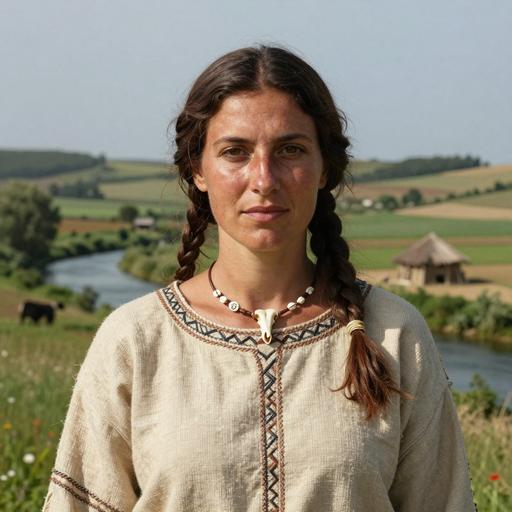
Portrait reconstruction of I26738
Ancient Individual

A woman buried in Croatia in the Middle Neolithic era

I26738
5450 BCE - 4900 BCE
Female
Middle Neolithic Croatia
Croatia
Scroll to begin
Chapter I

Identity

The biological and cultural markers that define this ancient individual

Sample ID

I26738

Date Range

5450 BCE - 4900 BCE

Biological Sex

Female

mtDNA Haplogroup

T2b

Cultural Period

Middle Neolithic Croatia

Chapter II

Place

Where this individual was discovered

Country Croatia
Locality Gornja Vrba-Savsko polje
Coordinates 45.1459, 18.0613
Chapter III

Time

When this individual lived in the broader context of human history

I26738 5450 BCE - 4900 BCE
Chapter IV

Story

The narrative of this ancient life

The Middle Neolithic period in Croatia, a region located along the northeastern coast of the Adriatic Sea in southeastern Europe, is marked by significant cultural developments that contributed to the broader scope of Neolithic European culture. This roughly spans from approximately 5000 to 4000 BCE, and during this time, the region saw a variety of cultural influences and technological advancements.

Geographic and Climatic Context

Croatia's geographic position as a crossroads between Central Europe and the Mediterranean had a profound impact on its Neolithic cultures. The region includes a diverse range of environments, from the fertile plains of Slavonia to the rocky coastlines of Dalmatia and the mountainous areas in the interior. The climate during the Neolithic was relatively stable and conducive to farming activities, which played a crucial role in the way of life for Neolithic societies.

Cultural Influences and Interactions

The Middle Neolithic period in Croatia is characterized by increased interaction among various Neolithic cultures throughout Europe. The region was inhabited by several distinct archaeological cultures, including the Starčevo, Sopot, and the earlier phases of the Danilo and Hvar cultures. These cultures engaged in trade and exchanged technological and cultural innovations.

  1. Starčevo Culture: Predominantly found in the inland areas of Croatia, particularly in the northern plains, was mainly agrarian, with communities practicing advanced forms of farming and animal husbandry. Settlements during this phase were typically small and consisted of pit houses and other semi-subterranean structures.

  2. Sopot Culture: This culture succeeded the Starčevo culture and continued many of its traditions while also introducing new pottery styles characterized by fine linear decorations. The Sopot culture expanded farming activities, and their settlements grew in size and complexity.

  3. Danilo Culture: Predominantly coastal, the Danilo culture is known for its pottery, especially the distinctive Danilo ware, which featured intricate geometric patterns. The Danilo people were also engaged in fishing and trade, given their strategic position along the Adriatic coast.

  4. Hvar Culture: Appearing towards the later part of the Middle Neolithic, closely associated with the island of Hvar. It is recognized for its distinctive ceramic styles and played a role in maritime trade routes.

Technological and Agricultural Developments

The technological advancements during the Middle Neolithic in Croatia were significant. The introduction of polished stone tools and the development of better pottery technologies improved everyday life. Agriculture remained the backbone of society with the cultivation of wheat, barley, and legumes, alongside the raising of domesticated animals such as cattle, sheep, goats, and pigs. The development of agriculture allowed for more permanent settlements and supported larger communities.

Social Structure and Community Life

The social structure of Neolithic societies in the region was likely based on extended family units or clans. The emergence of more complex social hierarchies became evident as communities grew larger and more interconnected. Artifacts such as figurines and decorated pottery suggest a society with spiritual or religious beliefs, although the specifics of these beliefs remain largely speculative.

Artistic Expression and Cultural Legacy

The artistic expression of this era is best exemplified by the pottery, which was often richly decorated and used for both practical and ceremonial purposes. These artistic endeavors highlight the cultural sophistication of Middle Neolithic societies in Croatia. Additionally, burial practices included grave goods, which suggest beliefs in an afterlife and the importance of status in death as well as in life.

Overall, the Middle Neolithic in Croatia represents a period of dynamic cultural activity characterized by the growth of agriculture, advancements in technology, increasing social complexity, and rich artistic expression, laying foundational aspects for subsequent developments in European prehistory.

Chapter V

Genetics

The genetic ancestry of this ancient individual

Ancient Genetic Admixture

This analysis compares the DNA profile of I26738 with ancient reference populations, showing the genetic composition in terms of prehistoric ancestral groups.

Neolithic Farmers 76.2%
European Hunter-Gatherers 17.7%
Western Steppe Pastoralists 6.1%

Modern Genetic Admixture

This analysis compares the DNA profile with present-day reference populations, showing what percentage of genetic makeup resembles modern populations from different regions.

Europe 90.5%
Southern European 90.5%
Italian 46.2%
Sardinian 25.5%
Iberian 10.0%
Balkan 8.8%
Asia 9.5%
Arab, Egyptian & Levantine 7.5%
Levantine 7.5%
Northern West Asian 2.0%
Cypriot 2.0%

Closest Modern Populations

These are the modern populations showing the closest statistical alignment to A woman buried in Croatia in the Middle Neolithic era, ranked by genetic distance. Lower distance values indicate closer statistical similarity.

1
Sardinian
5.0740
2
Belmonte Jew
5.6742
3
French Corsica
6.1259
4
Italian Lazio
6.4363
5
Sicilian West
6.5756
6
Italian Campania
6.6966
7
Italian Calabria
6.7395
8
Sicilian East
6.7664
9
Italian Umbria
6.7883
10
Maltese
6.8356
Chapter VI

Context

Other ancient individuals connected to this sample

Sources

References

Scientific publications and genetic data

Scientific Publication

Large-scale migration into Britain during the Middle to Late Bronze Age

Authors Patterson N, Isakov M, Booth T
Abstract

Present-day people from England and Wales have more ancestry derived from early European farmers (EEF) than did people of the Early Bronze Age1. To understand this, here we generated genome-wide data from 793 individuals, increasing data from the Middle to the Late Bronze Age and Iron Age in Britain by 12-fold, and western and central Europe by 3.5-fold. Between 1000 and 875 BC, EEF ancestry increased in southern Britain (England and Wales) but not northern Britain (Scotland) due to incorporation of migrants who arrived at this time and over previous centuries, and who were genetically most similar to ancient individuals from France. These migrants contributed about half the ancestry of people of England and Wales from the Iron Age, thereby creating a plausible vector for the spread of early Celtic languages into Britain. These patterns are part of a broader trend of EEF ancestry becoming more similar across central and western Europe in the Middle to the Late Bronze Age, coincident with archaeological evidence of intensified cultural exchange2-6. There was comparatively less gene flow from continental Europe during the Iron Age, and the independent genetic trajectory in Britain is also reflected in the rise of the allele conferring lactase persistence to approximately 50% by this time compared to approximately 7% in central Europe where it rose rapidly in frequency only a millennium later. This suggests that dairy products were used in qualitatively different ways in Britain and in central Europe over this period.

G25 Coordinates

The G25 coordinates for sample I26738 can be used for detailed admixture analysis in our G25 Studio tool.

I26738,0.1066629,0.15761994,0.00195924,-0.06014504,0.04048532,-0.02805298,-0.0036254,0.0024802,0.03640884,0.05785802,-0.0005136,0.0081042,-0.0138551,-0.0109652,-0.01188866,0.00669016,0.01053198,0.00069394,0.0014287,-0.0012789,0.00092314,0.00528806,-0.01164538,-0.0149411,0.00213117
Analyze in G25 Studio
Use code for 40% off Expires Feb 27