Menu
Store
Blog
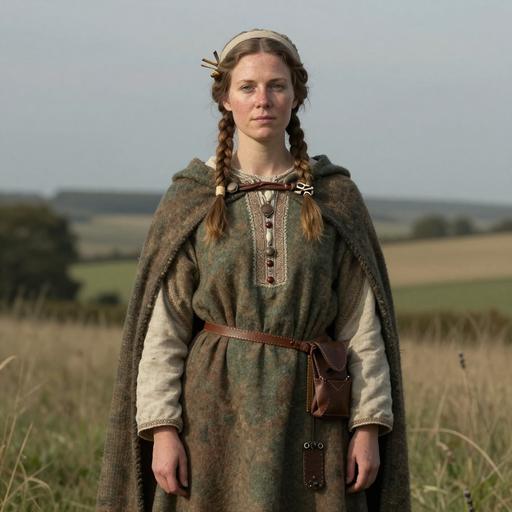
Portrait reconstruction of I5504
Ancient Individual

A woman buried in United Kingdom in the Late Antiquity era

I5504
400 CE - 800 CE
Female
Anglian Period East Yorkshire, England
United Kingdom
Scroll to begin
Chapter I

Identity

The biological and cultural markers that define this ancient individual

Sample ID

I5504

Date Range

400 CE - 800 CE

Biological Sex

Female

mtDNA Haplogroup

T1a1

Cultural Period

Anglian Period East Yorkshire, England

Chapter II

Place

Where this individual was discovered

Country United Kingdom
Locality England. East Riding of Yorkshire. Pocklington (Burnby Lane)
Coordinates 53.9194, -0.7666
Chapter III

Time

When this individual lived in the broader context of human history

I5504 400 CE - 800 CE
Chapter IV

Story

The narrative of this ancient life

The Anglian period in East Yorkshire, England, represents a fascinating chapter in the timeline of the Anglo-Saxon era, typified by the migration, settlement, and cultural evolution of Anglian groups from the continent to the British Isles. Their arrival and assimilation into the landscape of East Yorkshire marked a significant transformation in the social, political, and cultural fabric of the region.

Historical Context

The Anglian settlement of East Yorkshire, part of the larger Anglo-Saxon immigration, occurred during the early medieval period, following the decline of Roman rule in Britain in the 5th century. The Angles, a Germanic people from the regions that are now parts of Denmark and Germany, were among the main groups, alongside the Saxons, Jutes, and Frisians, who crossed the North Sea to settle in Britain. By the 6th century, the Angles established dominance in what is now East Yorkshire, contributing to the area's name and cultural heritage.

Settlement and Society

In this period, East Yorkshire evolved from scattered rural communities into more structured and hierarchically organized societies. Settlements typically consisted of small villages with timber-built homes, using local materials like wattle and daub, with thatched roofs. Archaeological discoveries, such as those at the site of West Heslerton, reveal communal activities and early agricultural practices. The family was the basic unit, with kinship networks playing crucial roles in social dynamics.

The Anglian people brought with them distinct social structures, characterized by a hierarchy of kings and nobles, freemen, and the occasional presence of slaves. Leadership often fell to local chieftains or kings, who wielded power over territories or ‘kingdoms,’ establishing early forms of governance that laid the groundwork for future English statehood.

Culture and Religion

The Anglian cultural influence in East Yorkshire was substantial, marked by their art, mythology, and later, their conversion to Christianity. Initially pagan, the Anglian people worshipped a pantheon of deities similar to those in Norse mythology, such as Woden (Odin) and Thunor (Thor). Burial practices during this time reflect their beliefs, with grave goods indicating a high regard for warriors and leaders.

Over time, the Christianization of the Anglian inhabitants left a lasting legacy, with local monasteries and churches becoming centers of learning and culture. The introduction of Christianity around the 7th century by missionaries, notably from the Celtic Church and the Roman Church, led to significant religious and social changes, including the establishment of ecclesiastical sites.

Art and Craftsmanship

Anglian art in East Yorkshire was rich and diverse, often seen in intricate metalwork, jewelry, and weaponry. Items like brooches, buckles, and swords were crafted with great skill and decorated with interlacing, animal motifs, and runic inscriptions. The artistic expression of the Anglian period was both a testament to their craftsmanship and a reflection of their cultural identity.

Linguistic Contributions

The Anglian settlers contributed significantly to the development of the English language. Old English, the language spoken during this period, was heavily influenced by the Angles, with East Yorkshire playing a role in the development of the Northumbrian dialect. This linguistic heritage is an integral part of modern English, with many place names and common words tracing back to Anglian origins.

Economic Practices

Economically, the Anglian period in East Yorkshire saw the establishment of agricultural bases, utilizing the fertile lands of the region for farming and animal husbandry. Trade with other parts of Britain and continental Europe was prevalent, with evidence of imported goods like pottery and luxury items, indicating connections with wider trade networks.

Conclusion

The Anglian period in East Yorkshire was a transformative era that laid important foundations for the historical and cultural development of the region. With their unique blend of Germanic traditions and adaptation to the local environment, the Anglian settlers not only shaped the early medieval landscape of East Yorkshire but also contributed enduring elements to English heritage in language, art, and societal organization. Today, the legacy of the Anglian period is evident in the archaeological finds, linguistic roots, and cultural landscape of East Yorkshire, providing a vital link to understanding the broader history of Anglo-Saxon England.

Chapter V

Genetics

The genetic ancestry of this ancient individual

Ancient Genetic Admixture

This analysis compares the DNA profile of I5504 with ancient reference populations, showing the genetic composition in terms of prehistoric ancestral groups.

European Hunter-Gatherers 36.2%
Neolithic Farmers 34.3%
Western Steppe Pastoralists 27.0%
Ancient Native Americans 2.4%

Modern Genetic Admixture

This analysis compares the DNA profile with present-day reference populations, showing what percentage of genetic makeup resembles modern populations from different regions.

Europe 97.1%
Northwestern European 85.1%
Northwestern European 33.7%
English 30.9%
Finnish 11.7%
Scandinavian 8.9%
Southern European 12.0%
Italian 12.0%
Asia 2.9%
Chinese & Southeast Asian 2.0%
Chinese 2.0%
Northern West Asian 1.0%
Cypriot 1.0%

Closest Modern Populations

These are the modern populations showing the closest statistical alignment to A woman buried in United Kingdom in the Late Antiquity era, ranked by genetic distance. Lower distance values indicate closer statistical similarity.

1
German Hamburg
2.5125
2
Shetlandic
2.5349
3
Danish
2.6054
4
Norwegian
2.6484
5
Dutch
2.6645
6
Orcadian
2.6831
7
Icelandic
2.6934
8
Scottish
2.7081
9
Swedish
2.8055
10
German
2.8568
Chapter VI

Context

Other ancient individuals connected to this sample

Sources

References

Scientific publications and genetic data

Scientific Publication

Large-scale migration into Britain during the Middle to Late Bronze Age

Authors Patterson N, Isakov M, Booth T
Abstract

Present-day people from England and Wales have more ancestry derived from early European farmers (EEF) than did people of the Early Bronze Age1. To understand this, here we generated genome-wide data from 793 individuals, increasing data from the Middle to the Late Bronze Age and Iron Age in Britain by 12-fold, and western and central Europe by 3.5-fold. Between 1000 and 875 BC, EEF ancestry increased in southern Britain (England and Wales) but not northern Britain (Scotland) due to incorporation of migrants who arrived at this time and over previous centuries, and who were genetically most similar to ancient individuals from France. These migrants contributed about half the ancestry of people of England and Wales from the Iron Age, thereby creating a plausible vector for the spread of early Celtic languages into Britain. These patterns are part of a broader trend of EEF ancestry becoming more similar across central and western Europe in the Middle to the Late Bronze Age, coincident with archaeological evidence of intensified cultural exchange2-6. There was comparatively less gene flow from continental Europe during the Iron Age, and the independent genetic trajectory in Britain is also reflected in the rise of the allele conferring lactase persistence to approximately 50% by this time compared to approximately 7% in central Europe where it rose rapidly in frequency only a millennium later. This suggests that dairy products were used in qualitatively different ways in Britain and in central Europe over this period.

G25 Coordinates

The G25 coordinates for sample I5504 can be used for detailed admixture analysis in our G25 Studio tool.

I5504,0.13398708,0.12478266,0.0522167,0.05009092,0.03373542,0.0240837,0.00417484,0.00541734,-0.00064652,-0.00926422,-0.00772694,0.00684428,-0.00038224,-0.00778762,0.01399872,0.00028388,-0.0097805,0.00109502,-0.00155826,-0.0001736,0.00602416,0.00376814,0.00125694,0.00987928,-0.00142146
Analyze in G25 Studio
Use code for 40% off Expires Feb 27