Menu
Store
Blog
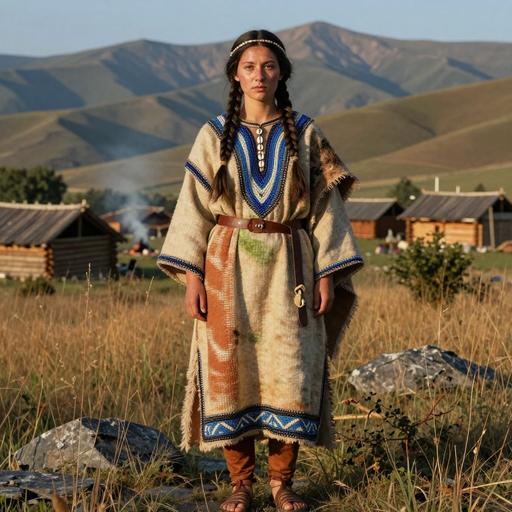
Portrait reconstruction of I6267
Ancient Individual

A woman buried in Russia in the Copper Age era

I6267
3625 BCE - 3372 BCE
Female
Maikop-Novosvobodnaya Culture, Caucasus, Russia
Russia
Scroll to begin
Chapter I

Identity

The biological and cultural markers that define this ancient individual

Sample ID

I6267

Date Range

3625 BCE - 3372 BCE

Biological Sex

Female

mtDNA Haplogroup

T2c1

Cultural Period

Maikop-Novosvobodnaya Culture, Caucasus, Russia

Chapter II

Place

Where this individual was discovered

Country Russia
Locality Klady. Dlinnaya Polyana
Coordinates 44.3850, 40.3946
Chapter III

Time

When this individual lived in the broader context of human history

I6267 3625 BCE - 3372 BCE
Chapter IV

Story

The narrative of this ancient life

The Maikop-Novosvobodnaya culture, existing during the Early Bronze Age approximately from 3700 to 3000 BCE, is a noteworthy archaeological and cultural phenomenon located in the northwestern Caucasus region of present-day Russia. This culture coincides with the broader horizon of the Proto-Indo-European expansions and interactions, contributing to our understanding of early Indo-European cultural formations and their wide-reaching influences.

Geographical and Environmental Context

The Maikop-Novosvobodnaya culture primarily spans the fertile steppe and lowland areas of the northwestern Caucasus, encompassing present-day regions like Adygea, Krasnodar Krai, and parts of Stavropol Krai. This region provided a unique environment characterized by its diverse landscape ranging from mountainous zones to open plains. Such diversity likely supported a mixed economy of pastoralism, agriculture, and perhaps even some early forms of trade and craft specialization.

Archaeological Evidence

Settlements and Architecture: The evidence for Maikop-Novosvobodnaya settlements is relatively sparse but indicates semi-permanent or seasonal camps likely involving both nomadic and sedentary components. Domestic structures when identified were simple, likely constructed from wood or perishable materials, congruent with the seminomadic lifestyle suggested by some scholars.

Burials and Kurgans: The Maikop-Novosvobodnaya culture is predominantly recognized for its burial practices, featuring prominent kurgan (burial mound) constructions. These kurgans vary in size but often contain single or multiple burials and are rich in grave goods, suggesting a society with hierarchical social structures. The presence of metal weapons, ornaments, and utilitarian objects within these graves denotes early metallurgy skills and a stratified society with emerging \chieftain-like" elites.

Art and Artifacts: One of the culture's distinct facets is its sophisticated metalwork, particularly in copper and gold. Artifacts such as daggers, axes, jewelry, and small statuettes exhibit advanced metallurgical techniques and aesthetic sensibilities, indicating connections or parallels with other contemporary cultures of the early Bronze Age world, possibly including the Maykop's southern contacts with Transcaucasian and more distant Mesopotamian spheres.

Socio-Economic Aspects

Economy: The Maikop-Novosvobodnaya economy was likely blended, consisting of settled agricultural communities and mobile pastoralism. The fertile lands of the Kuban steppe and adjacent areas would have supported grain cultivation, while the extensive pastures were well-suited for livestock, including cattle, sheep, and goats.

Trade and Interaction: Trade and exchange networks were vital to the Maikop-Novosvobodnaya culture. The material evidence suggests the movement of both raw material and finished goods over significant distances, and the culture's advanced metallurgy hints at knowledge exchanges with technologically advanced neighbors, perhaps facilitating the spread of metallurgical expertise throughout the region.

Cultural and Linguistic Context

While direct linguistic evidence is lacking, the Maikop-Novosvobodnaya culture is often discussed within the context of Proto-Indo-European studies, particularly given its chronological and geographical setting. Some theories propose that the Maikop interactions with neighboring cultures could reflect early language and cultural exchanges that eventually spread Indo-European languages across vast areas.

The Maikop-Novosvobodnaya culture's importance lies not only in its distinctive archaeological features but also in its role as a cultural bridge between the steppe traditions and the ancient civilizations to the south and west. Through its advanced metallurgy, elaborate burials, and potential trade links, the culture represents a pivotal point in the prehistoric landscape of Eurasia, influencing and interacting with the formative societies that paved the path for the historical Indo-European world.

In conclusion, the Maikop-Novosvobodnaya culture remains a crucial area of study for understanding the transition from Neolithic societies to the complexities of early Bronze Age stratified societies and the intricate mosaic of Proto-Indo-European cultural dynamics."

Chapter V

Genetics

The genetic ancestry of this ancient individual

Ancient Genetic Admixture

This analysis compares the DNA profile of I6267 with ancient reference populations, showing the genetic composition in terms of prehistoric ancestral groups.

Neolithic Farmers 61.7%
European Hunter-Gatherers 19.9%
Western Steppe Pastoralists 13.4%
Ancient Asians 5.1%

Modern Genetic Admixture

This analysis compares the DNA profile with present-day reference populations, showing what percentage of genetic makeup resembles modern populations from different regions.

Asia 91.1%
Northern West Asian 80.7%
Mesopotamian 49.0%
Caucasian 24.4%
Cypriot 6.8%
Anatolian 0.5%
Central Asian, Northern Indian & Pakistani 10.5%
Pakistan 6.6%
Indian 3.9%
Europe 8.9%
Southern European 8.9%
Italian 8.9%

Closest Modern Populations

These are the modern populations showing the closest statistical alignment to A woman buried in Russia in the Copper Age era, ranked by genetic distance. Lower distance values indicate closer statistical similarity.

1
Ossetian
3.0295
2
North Ossetian
3.4665
3
Adygei
3.4959
4
Abkhasian
3.5309
5
Georgian Svaneti
3.6385
6
Ingushian
3.7285
7
Georgian Khevs
3.7725
8
Georgian Tush
3.9200
9
Abkhasian Gudauta
4.0065
10
Karachay
4.0891
Chapter VI

Context

Other ancient individuals connected to this sample

Sources

References

Scientific publications and genetic data

Scientific Publication

Ancient human genome-wide data from a 3000-year interval in the Caucasus corresponds with eco-geographic regions

Authors Wang CC, Reinhold S, Kalmykov A
Abstract

Archaeogenetic studies have described the formation of Eurasian 'steppe ancestry' as a mixture of Eastern and Caucasus hunter-gatherers. However, it remains unclear when and where this ancestry arose and whether it was related to a horizon of cultural innovations in the 4th millennium BCE that subsequently facilitated the advance of pastoral societies in Eurasia. Here we generated genome-wide SNP data from 45 prehistoric individuals along a 3000-year temporal transect in the North Caucasus. We observe a genetic separation between the groups of the Caucasus and those of the adjacent steppe. The northern Caucasus groups are genetically similar to contemporaneous populations south of it, suggesting human movement across the mountain range during the Bronze Age. The steppe groups from Yamnaya and subsequent pastoralist cultures show evidence for previously undetected farmer-related ancestry from different contact zones, while Steppe Maykop individuals harbour additional Upper Palaeolithic Siberian and Native American related ancestry.

G25 Coordinates

The G25 coordinates for sample I6267 can be used for detailed admixture analysis in our G25 Studio tool.

I6267,0.1036141,0.09862938,-0.05253844,-0.0235979,-0.05093678,-0.00275768,0.01113136,-0.0046161,-0.05838224,-0.02934038,-0.00430362,0.0065088,-0.0176807,0.00358982,0.00989912,-0.01524898,0.01588424,-0.0070134,-0.0091796,0.0127706,0.00998656,-0.0007525,0.00662564,-0.00797804,-0.00590973
Analyze in G25 Studio
Use code for 40% off Expires Feb 27