Menu
Store
Blog
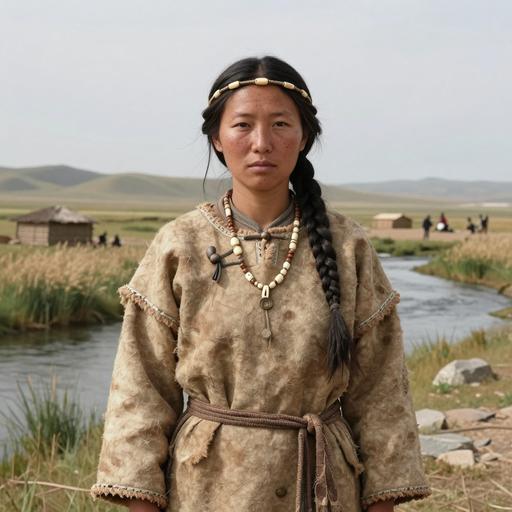
Portrait reconstruction of I6358
Ancient Individual

A woman buried in Mongolia in the Neolithic era

I6358
5973 BCE - 4461 BCE
Female
Neolithic Mongolia
Mongolia
Scroll to begin
Chapter I

Identity

The biological and cultural markers that define this ancient individual

Sample ID

I6358

Date Range

5973 BCE - 4461 BCE

Biological Sex

Female

mtDNA Haplogroup

F1b1-a

Cultural Period

Neolithic Mongolia

Chapter II

Place

Where this individual was discovered

Country Mongolia
Locality Dornod aimag. Bayantumen sum. Kherlen River South bank nearby Choibalsan town
Chapter III

Time

When this individual lived in the broader context of human history

I6358 5973 BCE - 4461 BCE
Chapter IV

Story

The narrative of this ancient life

The Neolithic era in Mongolia, which spans approximately from 7000 to 3000 BCE, marks a significant period in the region's prehistory, characterized by the gradual transition from hunting and gathering to more sedentary forms of subsistence based on pastoralism and agriculture. Although the Neolithic period in Mongolia is not as widely studied or understood as in some other parts of the world, it is nonetheless a fascinating era that laid the groundwork for the development of Mongolian nomadic pastoralist culture.

Geographical Context

Mongolia is a landlocked country in East Asia, bordered by Russia to the north and China to the south. Its geography is characterized by vast steppes, rugged mountains, and expansive deserts, such as the Gobi. These diverse landscapes have traditionally supported various forms of subsistence, with the steppe regions particularly suitable for pastoralism due to their extensive grasslands.

Archaeological Evidence

Archaeological findings from the Neolithic period in Mongolia are relatively sparse, but they provide critical insights into the lifestyles and cultures of the time. Excavations at sites like Tamsagbulag, Borkh Uul, and others have uncovered stone tools, pottery, and the remains of dwellings, which suggest semi-sedentary communities.

  • Tools and Implements: Stone tools from this period include various blades, scrapers, and projectile points, indicating that hunting continued to play a significant role in subsistence practices. The presence of grinding stones also suggests the processing of plant materials.

  • Pottery: Neolithic pottery found in Mongolia is often simple and unadorned, but it reflects the development of technological skills necessary for food storage and preparation.

  • Settlement Patterns: Early settlements were likely seasonal, with groups moving between winter and summer pastures. Circular and oval dwelling structures suggest the development of family-based units.

Subsistence Practice

The transition to pastoralism is perhaps the most defining feature of Neolithic Mongolia. Over time, communities began to domesticate animals, leading to the rise of nomadic pastoralism as a dominant lifestyle. This process likely involved the domestication of sheep, goats, cattle, and later horses, which became crucial to Mongolian culture.

  • Animal Husbandry: Evidence suggests that the domestication of sheep and goats occurred first, providing meat, milk, and materials like wool and hides. The eventual domestication of horses revolutionized mobility, trade, and warfare.

  • Agriculture: While less prominent than pastoralism, there is some evidence of rudimentary agricultural practices, such as small-scale cultivation of grains.

Social and Cultural Aspects

The social structure of Neolithic Mongolian communities likely revolved around kinship networks and clan affiliations. These communities were egalitarian, with social roles often dictated by age and gender. The development of pastoralism may have introduced new social dynamics, with wealth increasingly measured in terms of livestock ownership.

Spiritual and Ritual Significance

Spiritual and ritual life in Neolithic Mongolia remains a subject of speculation, but it likely included elements of animism and ancestor worship. The natural environment and the animals upon which people relied would have played central roles in their cosmology.

Legacy and Influence

The Neolithic period in Mongolia set the stage for the later development of the characteristic nomadic cultures of the Central Asian steppes, most famously exemplified by the rise of the Mongol Empire under Genghis Khan. The skills and lifestyles developed during this era—emphasizing mobility, adaptation, and resilience—have remained integral to Mongolian identity.

In summary, Neolithic Mongolia represents a transformative era that saw the emergence of pastoralism as a dominant lifestyle, introducing changes in social structure, economy, and culture that would shape the region's history for millennia. Understanding this period provides valuable insights into the adaptability and innovations of early human societies in challenging environments.

Chapter V

Genetics

The genetic ancestry of this ancient individual

Ancient Genetic Admixture

This analysis compares the DNA profile of I6358 with ancient reference populations, showing the genetic composition in terms of prehistoric ancestral groups.

Ancient Asians 100.0%

Modern Genetic Admixture

This analysis compares the DNA profile with present-day reference populations, showing what percentage of genetic makeup resembles modern populations from different regions.

Asia 99.7%
Northern Asian 62.6%
Siberian 34.5%
Mongolian 28.1%
Japanese & Korean 24.9%
Japanese 24.9%
Chinese & Southeast Asian 12.2%
Tibetan 11.4%
Chinese 0.8%

Closest Modern Populations

These are the modern populations showing the closest statistical alignment to A woman buried in Mongolia in the Neolithic era, ranked by genetic distance. Lower distance values indicate closer statistical similarity.

1
Nanai
3.2961
2
Negidal
3.8220
3
Ulchi
3.8868
Chapter VI

Context

Other ancient individuals connected to this sample

Sources

References

Scientific publications and genetic data

Scientific Publication

Genomic insights into the formation of human populations in East Asia

Authors Wang CC, Yeh HY, Popov AN
Abstract

The deep population history of East Asia remains poorly understood owing to a lack of ancient DNA data and sparse sampling of present-day people1,2. Here we report genome-wide data from 166 East Asian individuals dating to between 6000 BC and AD 1000 and 46 present-day groups. Hunter-gatherers from Japan, the Amur River Basin, and people of Neolithic and Iron Age Taiwan and the Tibetan Plateau are linked by a deeply splitting lineage that probably reflects a coastal migration during the Late Pleistocene epoch. We also follow expansions during the subsequent Holocene epoch from four regions. First, hunter-gatherers from Mongolia and the Amur River Basin have ancestry shared by individuals who speak Mongolic and Tungusic languages, but do not carry ancestry characteristic of farmers from the West Liao River region (around 3000 BC), which contradicts theories that the expansion of these farmers spread the Mongolic and Tungusic proto-languages. Second, farmers from the Yellow River Basin (around 3000 BC) probably spread Sino-Tibetan languages, as their ancestry dispersed both to Tibet-where it forms approximately 84% of the gene pool in some groups-and to the Central Plain, where it has contributed around 59-84% to modern Han Chinese groups. Third, people from Taiwan from around 1300 BC to AD 800 derived approximately 75% of their ancestry from a lineage that is widespread in modern individuals who speak Austronesian, Tai-Kadai and Austroasiatic languages, and that we hypothesize derives from farmers of the Yangtze River Valley. Ancient people from Taiwan also derived about 25% of their ancestry from a northern lineage that is related to, but different from, farmers of the Yellow River Basin, which suggests an additional north-to-south expansion. Fourth, ancestry from Yamnaya Steppe pastoralists arrived in western Mongolia after around 3000 BC but was displaced by previously established lineages even while it persisted in western China, as would be expected if this ancestry was associated with the spread of proto-Tocharian Indo-European languages. Two later gene flows affected western Mongolia: migrants after around 2000 BC with Yamnaya and European farmer ancestry, and episodic influences of later groups with ancestry from Turan.

G25 Coordinates

The G25 coordinates for sample I6358 can be used for detailed admixture analysis in our G25 Studio tool.

I6358,0.03171548,-0.43849228,0.08643418,-0.03354598,-0.06706912,-0.05167608,0.02135832,0.02428484,0.01015694,0.01527216,-0.00483622,0.00233944,-0.00010728,0.00331032,-0.01106574,-0.01342728,-0.00728296,0.00979006,0.01730396,0.00961462,0.02093048,-0.02265196,-0.00065868,0.00245806,0.00984763
Analyze in G25 Studio
Use code for 40% off Expires Feb 27