Menu
Store
Blog
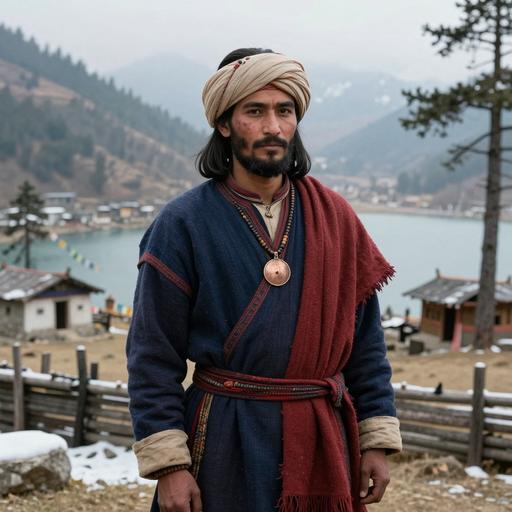
Portrait reconstruction of I6940
Ancient Individual

A man buried in India in the Modern era

I6940
1653 CE - 1950 CE
Male
Roopkund Skeletons C
India
Scroll to begin
Chapter I

Identity

The biological and cultural markers that define this ancient individual

Sample ID

I6940

Date Range

1653 CE - 1950 CE

Biological Sex

Male

mtDNA Haplogroup

M24a

Y-DNA Haplogroup

O-F2028

Cultural Period

Roopkund Skeletons C

Chapter II

Place

Where this individual was discovered

Country India
Locality Uttaranchal. Himalaya. Roopkund
Coordinates 30.2472, 79.7374
Chapter III

Time

When this individual lived in the broader context of human history

I6940 1653 CE - 1950 CE
Chapter IV

Story

The narrative of this ancient life

The Roopkund Skeletons, often referred to as the \Skeleton Lake" mystery, pertain to an enigmatic site located in the Indian state of Uttarakhand, high up in the Himalayas at an altitude of about 5,029 meters (16,499 feet). This lake, known locally as Roopkund, was discovered to contain hundreds of ancient human skeletons, visible when the snow melts. The Roopkund Skeletons, hence labeled as Roopkund C by researchers and scholars, offer a fascinating glimpse into the past and have puzzled archaeologists, anthropologists, and historians alike due to the mystery surrounding their origin, time period, and circumstances of death.

Geographical and Historical Context

Roopkund is nestled in the Trishul massif, sitting within the Nanda Devi National Park, an area characterized by its rugged terrain, treacherous weather conditions, and remoteness. The high-altitude setting not only contributes to the difficulty in accessing the lake but also to the preservation of the remains. The site is not only significant for its archaeological intrigue but also holds cultural and religious importance, being on a pilgrimage route of the Nanda Devi Raj Jat, a festival dedicated to the Goddess Nanda.

Historically, the Roopkund site might have been intersected by trade and pilgrimage routes, connecting the Indian plains with the Tibetan plateau, which could explain the diverse origin of some of the individuals found at the lake.

Discovery and Initial Study

The skeletons were first brought to wider attention during the British colonial period in the 19th century, with increased examination in subsequent decades. Initial studies speculated various causes for the death of these individuals, ranging from catastrophic events, epidemics, or ritualistic undertakings. The sheer number of skeletons, estimated to be over 200, adds complexity to this ancient mystery.

Anthropological and Archaeological Analysis

More recent studies, particularly those utilizing modern techniques like radiocarbon dating and DNA analysis, have provided deeper insight into the provenance and timeline of the Roopkund Skeletons. The analyses have revealed that the skeletons came from two distinct groups of individuals who died during two different time periods, around the 9th century and in the 19th century.

  1. Genetic Diversity: DNA analysis has indicated that one group of skeletons traces its lineage to South Asia, while another, surprisingly, has genetic markers more closely associated with the Mediterranean region, particularly the eastern Mediterranean.

  2. Cause of Death: The predominant hypothesis regarding the skeletons’ demise involves a sudden and severe hailstorm that caught these travelers while they were amid their journey through the high mountain pass. The injuries on the skeletons, consistent with head trauma, align with this theory.

  3. Cultural and Ritual Significance: Alongside the bones, artifacts such as wooden artifacts, iron spearheads, leather slippers, and rings have been found, hinting at the lifestyle and social status of these individuals. The items suggest that this was a large group of people, potentially including pilgrims, traders, or a ceremonial entourage.

Modern Interpretations and Cultural Legacy

The enigma of Roopkund has entered both academic discourse and popular culture, often portrayed as one of India's greatest archaeological mysteries. Forensics, archaeology, and folklore combine here to provide insights into ancient human migratory patterns and the interaction of cultures across this challenging terrain.

The skeletons of Roopkund continue to spark scientific curiosity and cultural story-telling, providing clues to climatic conditions, human interactions, and trade practices of the past. This site emphasizes the complexity of human history in the region, standing as a testament to the perils inherent in ancient trans-Himalayan travel and the enduring spirit of exploration and devotion that characterized those who undertook such journeys.

Through ongoing research, the Roopkund Skeletons of India remain an open chapter, inviting further exploration and discovery into South Asian history and prehistoric life in extreme environments."

Chapter V

Genetics

The genetic ancestry of this ancient individual

Ancient Genetic Admixture

This analysis compares the DNA profile of I6940 with ancient reference populations, showing the genetic composition in terms of prehistoric ancestral groups.

Ancient Asians 87.4%
Ancient Oceanians 6.6%
Western Steppe Pastoralists 3.9%
Ancient Africans 2.2%

Modern Genetic Admixture

This analysis compares the DNA profile with present-day reference populations, showing what percentage of genetic makeup resembles modern populations from different regions.

Asia 90.7%
Chinese & Southeast Asian 89.1%
Chinese 37.1%
Vietnamese 32.1%
Indonesian Khmer Thai Myanma 19.9%
Central Asian, Northern Indian & Pakistani 1.6%
Indian 1.6%
Oceania 4.0%
Melanesian 4.0%
Papuan 4.0%
Europe 3.5%
Northwestern European 3.5%
English 1.9%
Scandinavian 1.0%
Finnish 0.7%
Africa 1.8%
North African 1.4%
Egyptian 1.4%

Closest Modern Populations

These are the modern populations showing the closest statistical alignment to A man buried in India in the Modern era, ranked by genetic distance. Lower distance values indicate closer statistical similarity.

1
Malay
2.8318
2
Mala
42.4743
Chapter VI

Context

Other ancient individuals connected to this sample

Sources

References

Scientific publications and genetic data

Scientific Publication

Ancient DNA from the skeletons of Roopkund Lake reveals Mediterranean migrants in India

Authors Harney É, Nayak A, Patterson N
Abstract

Situated at over 5,000 meters above sea level in the Himalayan Mountains, Roopkund Lake is home to the scattered skeletal remains of several hundred individuals of unknown origin. We report genome-wide ancient DNA for 38 skeletons from Roopkund Lake, and find that they cluster into three distinct groups. A group of 23 individuals have ancestry that falls within the range of variation of present-day South Asians. A further 14 have ancestry typical of the eastern Mediterranean. We also identify one individual with Southeast Asian-related ancestry. Radiocarbon dating indicates that these remains were not deposited simultaneously. Instead, all of the individuals with South Asian-related ancestry date to ~800 CE (but with evidence of being deposited in more than one event), while all other individuals date to ~1800 CE. These differences are also reflected in stable isotope measurements, which reveal a distinct dietary profile for the two main groups.

G25 Coordinates

The G25 coordinates for sample I6940 can be used for detailed admixture analysis in our G25 Studio tool.

I6940,0.01621012,-0.40195664,-0.06260064,-0.03694158,0.12697082,0.05986186,-0.00304366,-0.00737386,-0.01476496,-0.01522924,0.04923816,0.00517662,-0.00458444,-0.00056674,0.00629848,-9.654E-05,-0.00256512,-0.00115532,-0.00064666,-0.00216174,-0.00138086,-0.0016012,-0.00242034,-0.0011439,0.00556401
Analyze in G25 Studio
Use code for 40% off Expires Mar 01