Menu
Store
Blog
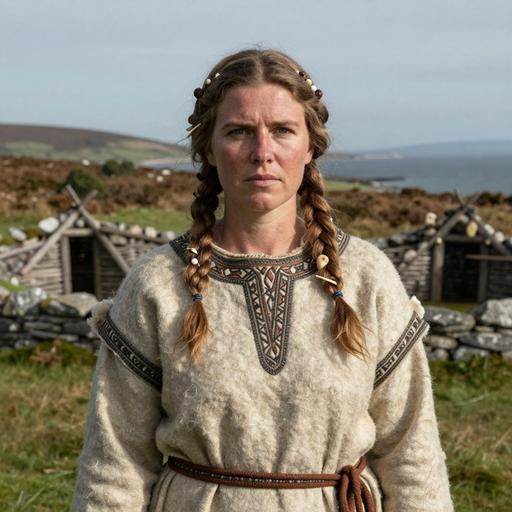
Portrait reconstruction of I8582
Ancient Individual

A woman buried in Isle of Man in the Early Bronze Age era

I8582
2195 BCE - 1973 BCE
Female
Early Bronze Age Low Steppe Isle of Man
Isle of Man
Scroll to begin
Chapter I

Identity

The biological and cultural markers that define this ancient individual

Sample ID

I8582

Date Range

2195 BCE - 1973 BCE

Biological Sex

Female

mtDNA Haplogroup

H2a1e1

Cultural Period

Early Bronze Age Low Steppe Isle of Man

Chapter II

Place

Where this individual was discovered

Country Isle of Man
Locality Isle of Man. Rushen. Strandhall
Coordinates 54.0800, -4.7000
Chapter III

Time

When this individual lived in the broader context of human history

I8582 2195 BCE - 1973 BCE
Chapter IV

Story

The narrative of this ancient life

The Early Bronze Age (EBA) on the Isle of Man, specifically in the context of the Low Steppe, represents a significant period in the island’s prehistory characterized by unique cultural developments. During this era, which spanned approximately from 2500 to 1500 BCE, communities on the Isle of Man experienced a transformation in their social structure, technological advancements, and interactions with neighboring regions. Although direct evidence of Celtic culture on the Isle of Man is generally associated with later periods, the foundations for such cultural influences were likely laid during the Bronze Age.

Geography and Environmental Context

The Isle of Man, situated in the heart of the British Isles, has a diverse landscape featuring rugged coastlines, rolling plains, and elevated steppes. The Low Steppe region, located more toward the central parts of the island, played a crucial role due to its fertile lands and proximity to resources. The geography of the Isle provided natural defenses and an abundance of raw materials, which were advantageous for early settlers.

Archaeological Evidence

Archaeological findings from this period on the Isle of Man include burial mounds, pottery, and metal artifacts. Burial practices during the EBA on the Isle typically involved pit graves and cairn burials, often accompanied by grave goods such as pottery and, occasionally, metal objects. Notably, the movement from stone to metal characterized a pivotal shift in tool and weapon manufacturing.

Society and Culture

  1. Social Structure:

    • The society during the EBA on the Isle of Man was likely composed of small, kin-based groups or tribes. Leadership roles were likely hereditary or based on warrior prowess and control of resources.
    • Community life was centered around agricultural practices, with herding and farming forming the backbone of sustenance.
  2. Housing and Settlements:

    • Settlements in the Low Steppe were likely composed of roundhouses constructed from wattle and daub, with thatched roofs. These dwellings were strategically situated to exploit agricultural land and maintain access to water sources.
  3. Crafts and Technology:

    • The introduction of metallurgy heralded the beginning of the Bronze Age on the Isle of Man. Islanders began to fashion tools and ornaments from bronze, marking an improvement over the previously dominant stone tools.
    • Pottery from this era was typically handmade, with characteristic designs potentially influenced by interactions with other cultures from mainland Britain or Ireland.

Trade and Interaction

The strategic location of the Isle of Man in the Irish Sea facilitated contact and trade with surrounding regions. Exchange of goods and ideas intensified during the Bronze Age, as indicated by the presence of non-local materials such as jet, gold, and amber. This connectivity suggests that the Isle of Man was part of broader trade networks that spanned across the British Isles and even into continental Europe.

Religion and Rituals

Religious beliefs during this time were likely animistic, with a focus on the worship of natural elements and ancestors. Evidence of ritualistic practices can be discerned from burial sites, which often contained offerings that indicate a belief in an afterlife. Ceremonial structures, such as stone circles or alignments, may have played a role in community gatherings and religious ceremonies.

Legacy and Influence

The Early Bronze Age Low Steppe culture on the Isle of Man laid the groundwork for subsequent cultural developments. The skills in metallurgy, burial rites, and social organization during this period would influence later Celtic traditions, which became more pronounced in subsequent eras.

In conclusion, the Early Bronze Age Low Steppe culture on the Isle of Man was a vibrant and dynamic society marked by significant technological, social, and cultural changes. The island's unique position facilitated an exchange of ideas and goods that would contribute to shaping its Early Bronze Age civilization and pave the way for later historical developments, including Celtic influences.

Chapter V

Genetics

The genetic ancestry of this ancient individual

Ancient Genetic Admixture

This analysis compares the DNA profile of I8582 with ancient reference populations, showing the genetic composition in terms of prehistoric ancestral groups.

European Hunter-Gatherers 36.8%
Western Steppe Pastoralists 34.0%
Neolithic Farmers 26.8%
Ancient Asians 2.4%

Modern Genetic Admixture

This analysis compares the DNA profile with present-day reference populations, showing what percentage of genetic makeup resembles modern populations from different regions.

Europe 95.1%
Northwestern European 66.2%
English 32.4%
Northwestern European 23.1%
Finnish 8.2%
Scandinavian 2.6%
Southern European 28.9%
Iberian 18.5%
Balkan 7.5%
Sardinian 2.9%
Asia 2.8%
Chinese & Southeast Asian 1.7%
Chinese 1.7%
Central Asian, Northern Indian & Pakistani 1.1%
Indian 1.1%
Africa 2.1%
North African 2.1%
Egyptian 2.1%

Closest Modern Populations

These are the modern populations showing the closest statistical alignment to A woman buried in Isle of Man in the Early Bronze Age era, ranked by genetic distance. Lower distance values indicate closer statistical similarity.

1
German
1.5348
2
German Erlangen
1.8034
3
Belgiana
2.0556
4
French Seine Maritime
2.0774
5
Austrian
2.1797
6
Belgianb
2.3221
7
French Brittany
2.3333
8
Dutch
2.3339
9
Afrikaner
2.3687
10
French Nord
2.4185
Chapter VI

Context

Other ancient individuals connected to this sample

Sources

References

Scientific publications and genetic data

Scientific Publication

Large-scale migration into Britain during the Middle to Late Bronze Age

Authors Patterson N, Isakov M, Booth T
Abstract

Present-day people from England and Wales have more ancestry derived from early European farmers (EEF) than did people of the Early Bronze Age1. To understand this, here we generated genome-wide data from 793 individuals, increasing data from the Middle to the Late Bronze Age and Iron Age in Britain by 12-fold, and western and central Europe by 3.5-fold. Between 1000 and 875 BC, EEF ancestry increased in southern Britain (England and Wales) but not northern Britain (Scotland) due to incorporation of migrants who arrived at this time and over previous centuries, and who were genetically most similar to ancient individuals from France. These migrants contributed about half the ancestry of people of England and Wales from the Iron Age, thereby creating a plausible vector for the spread of early Celtic languages into Britain. These patterns are part of a broader trend of EEF ancestry becoming more similar across central and western Europe in the Middle to the Late Bronze Age, coincident with archaeological evidence of intensified cultural exchange2-6. There was comparatively less gene flow from continental Europe during the Iron Age, and the independent genetic trajectory in Britain is also reflected in the rise of the allele conferring lactase persistence to approximately 50% by this time compared to approximately 7% in central Europe where it rose rapidly in frequency only a millennium later. This suggests that dairy products were used in qualitatively different ways in Britain and in central Europe over this period.

G25 Coordinates

The G25 coordinates for sample I8582 can be used for detailed admixture analysis in our G25 Studio tool.

I8582,0.13348314,0.13145578,0.0524154,0.03727688,0.04223212,0.01783402,0.00299774,0.00666002,0.00894516,0.00465462,-0.00715218,0.00708656,-0.00177362,-0.00612826,0.00676892,0.00193652,-0.00421012,0.00066388,-0.00074236,-0.00065808,0.00418544,0.00321644,-0.00027936,0.0041209,-0.00077388
Analyze in G25 Studio
Use code for 40% off Expires Feb 27