Menu
Store
Blog
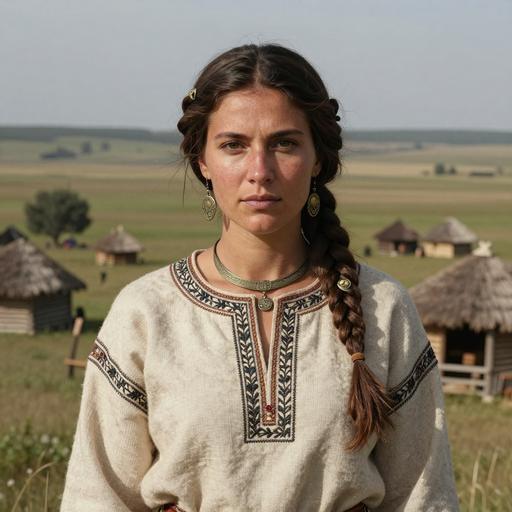
Portrait reconstruction of KD-29_OBH-52_twinmerge
Ancient Individual

A woman buried in Hungary in the Medieval era

KD-29_OBH-52_twinmerge
700 CE - 800 CE
Female
Avar Period (Middle to Late Early Phase)
Hungary
Scroll to begin
Chapter I

Identity

The biological and cultural markers that define this ancient individual

Sample ID

KD-29_OBH-52_twinmerge

Date Range

700 CE - 800 CE

Biological Sex

Female

mtDNA Haplogroup

Not available

Cultural Period

Avar Period (Middle to Late Early Phase)

Chapter II

Place

Where this individual was discovered

Country Hungary
Locality Orosháza-Béketsz-Homokbánya (Békés County, Orosháza)
Coordinates 46.5999, 20.7384
Chapter III

Time

When this individual lived in the broader context of human history

KD-29_OBH-52_twinmerge 700 CE - 800 CE
Chapter IV

Story

The narrative of this ancient life

The Avar Period, particularly the Middle to Late Early Phase, is a fascinating era in the history of Central and Eastern Europe, encapsulating a complex cultural and socio-political tapestry woven from various ethnic and cultural threads. The Avars were a nomadic Turkic group that emerged prominently on the European scene in the 6th century and established the Avar Khaganate, which lasted until the 9th century. Let's delve into a comprehensive exploration of this period:

Historical Background

The Avars are believed to have originated from the Eurasian steppes, possibly related to the Rouran Khaganate, and migrated westward following disruptions in their territories. The 6th century was marked by significant movements of people and tribes across Europe, influenced by the collapsing Western Roman Empire and the continuing dominance of the Byzantine Empire. The Avars appeared in Central Europe around 567 AD, quickly wielding influence by subjugating existing populations like the Gepids and forming an alliance with the Lombards against common enemies.

Political Structure and Organization

The Avar Khaganate was organized in a hierarchical fashion, led by the Khagan, a supreme leader believed to possess spiritual and temporal authority. The Khaganate extended over vast territories in Central and Eastern Europe, including present-day Hungary, Austria, Slovakia, and parts of the Balkans. Underneath the Khagan were local chieftains and nobles who managed smaller territories and reported back to the central government. The power dynamics within the Khaganate were often volatile, with frequent shifts in alliances and power struggles both within the Avar elite and with neighboring groups.

Cultural Synthesis and Society

The Avars, being a nomadic group, managed to create a dynamic and adaptable society that incorporated elements from various cultures they interacted with. This period was marked by significant cultural synthesis, with influences drawn from the Slavic, Germanic, and Byzantine populations. The Avars were skilled horsemen, and their society had a strong equestrian culture, which is evident in their art and burial practices.

Religion and Beliefs

The spiritual life of the Avars was diverse, incorporating shamanistic practices alongside influences from Christianity due to contact with Byzantium and other Christian areas. Archaeological evidence reveals burials that mix traditional steppe customs with elements indicative of burgeoning Christian practices, suggesting a society that was in religious transition during this period.

Economy and Trade

The Avar economy was multifaceted, involving agriculture, animal husbandry, and extensive trade networks. They engaged in both pastoral and sedentary agricultural practices, depending on the region. Trade was a thriving aspect of Avar life, with the Khaganate sitting on important trade routes between the Byzantine Empire and the rest of Europe. Crafts and metalwork, particularly in gold and silver, were highly developed, reflecting both local production and the acquisition of foreign luxuries.

Military and Conflicts

The Avar military was formidable, renowned for its cavalry units that could execute swift and decisive campaigns. This period saw the Khaganate engage in numerous conflicts with the Byzantine Empire, the Franks, and other neighboring tribes. The Avars often conducted raids into the Byzantine territories, accumulating wealth through plunder and tribute. However, these confrontations also led to eventual tensions with other emerging powers, such as the Carolingians under Charlemagne.

Decline and Legacy

By the late 8th century, the Avar Khaganate began to experience decline, partly due to internal strife and partly due to external pressures, notably from the Carolingian Empire. The defeat of Avar forces by Charlemagne's armies in the late 8th and early 9th century marked the beginning of the end for the Avar political dominance. The eventual assimilation of the Avars into surrounding cultures left lasting impacts, particularly influencing the subsequent rise of Slavic states in the region.

In sum, the Middle to Late Early Phase of the Avar Period was an era of great complexity, marked by cultural fusion, military prowess, and dynamic political structures. The Avars played a crucial role as both aggressors and integrators in early medieval Europe and contributed to the shaping of Central and Eastern European history. Their legacy is seen in the archaeological remains and cultural influences that persisted long after their political dominance waned.

Chapter V

Context

Other ancient individuals connected to this sample

Sources

References

Scientific publications and genetic data

Scientific Publication

The genetic origin of Huns, Avars, and conquering Hungarians

Authors Maróti Z, Neparáczki E, Schütz O
Abstract

Huns, Avars, and conquering Hungarians were migration-period nomadic tribal confederations that arrived in three successive waves in the Carpathian Basin between the 5th and 9th centuries. Based on the historical data, each of these groups are thought to have arrived from Asia, although their exact origin and relation to other ancient and modern populations have been debated. Recently, hundreds of ancient genomes were analyzed from Central Asia, Mongolia, and China, from which we aimed to identify putative source populations for the above-mentioned groups. In this study, we have sequenced 9 Hun, 143 Avar, and 113 Hungarian conquest period samples and identified three core populations, representing immigrants from each period with no recent European ancestry. Our results reveal that this "immigrant core" of both Huns and Avars likely originated in present day Mongolia, and their origin can be traced back to Xiongnus (Asian Huns), as suggested by several historians. On the other hand, the "immigrant core" of the conquering Hungarians derived from an earlier admixture of Mansis, early Sarmatians, and descendants of late Xiongnus. We have also shown that a common "proto-Ugric" gene pool appeared in the Bronze Age from the admixture of Mezhovskaya and Nganasan people, supporting genetic and linguistic data. In addition, we detected shared Hun-related ancestry in numerous Avar and Hungarian conquest period genetic outliers, indicating a genetic link between these successive nomadic groups. Aside from the immigrant core groups, we identified that the majority of the individuals from each period were local residents harboring "native European" ancestry.

Use code for 40% off Expires Feb 26