Menu
Store
Blog
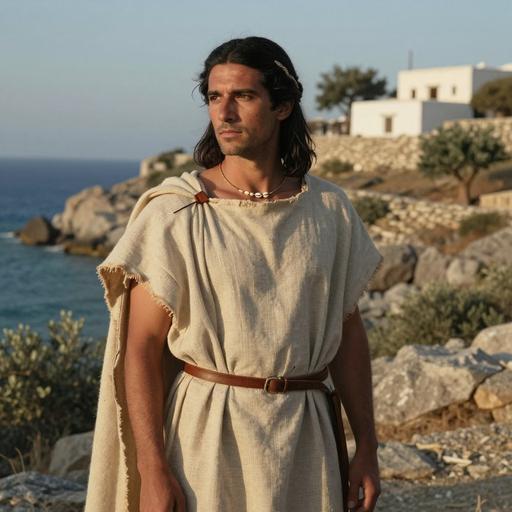
Portrait reconstruction of Kou01
Ancient Individual

An individual buried in Greece in the Early Bronze Age era

Kou01
2600 BCE - 2000 BCE
Not known
Early Bronze Age Cycladic Koufonisi, Greece
Greece
Scroll to begin
Chapter I

Identity

The biological and cultural markers that define this ancient individual

Sample ID

Kou01

Date Range

2600 BCE - 2000 BCE

Biological Sex

Not known

mtDNA Haplogroup

K1a2c*

Cultural Period

Early Bronze Age Cycladic Koufonisi, Greece

Chapter II

Place

Where this individual was discovered

Country Greece
Locality Cyclades islands. Koufonisi
Coordinates 36.9375, 25.6065
Chapter III

Time

When this individual lived in the broader context of human history

Kou01 2600 BCE - 2000 BCE
Chapter IV

Story

The narrative of this ancient life

The Early Bronze Age (EBA) in the Cycladic Islands, including Koufonisi, is a fascinating period within the broader tapestry of Aegean civilization. This era, roughly spanning 3200 to 2000 BCE, is defined by significant advances in social organization, art, and technology among these islands, which lie in the Aegean Sea between mainland Greece and Crete.

Geography and Settlements

Koufonisi is part of the Lesser Cyclades, situated southeast of Naxos. The Cycladic archipelago, with its rugged terrain and limited arable land, influenced the development of small, dispersed communities. Koufonisi, like its neighboring islands, was likely home to small settlements that engaged in subsistence agriculture, supplemented by fishing and trading activities. The settlements on Koufonisi and the Cyclades in this period were typically coastal, exploiting the sea for resources and connection to other communities.

Architecture and Urban Development

During the EBA, the Cycladic settlements began to exhibit more organized forms of urban planning. Buildings were constructed using local stone with mud-brick or clay for insulation and roofing. The architecture was simple yet functional, with rectangular or oval-shaped structures serving as dwellings and storage. Evidence suggests the presence of communal or public buildings, indicating some level of social organization and communal life.

Economy and Trade

Early Bronze Age Cycladic culture was characterized by an economy that revolved around agriculture, animal husbandry, and the exploitation of maritime resources. The Cycladic islands were pivotal nodes within the Aegean trade networks, connecting Anatolia, Crete, and mainland Greece. The exchange of goods such as obsidian, metals, pottery, and crafted objects facilitated cultural interaction and technological diffusion. The obsidian from the nearby island of Melos is particularly notable, as it was a crucial material for tool-making and has been found in many Cycladic and other Aegean sites.

Art and Craftsmanship

The art of the Cyclades, especially its marble figurines, is among the most distinctive and famous representations of EBA Aegean art. These figurines, often referred to as Cycladic idols, are typically stylized representations of the human form, with folded arms and a minimalistic approach that emphasizes geometric forms. Found in burial contexts, these figures likely played a role in the religious or ceremonial life. Beyond figurines, Cycladic artisans produced pottery, tools, and jewelry, showcasing advanced skills in working with various materials, including metals like bronze, gold, and silver.

Society and Culture

The society in the Cycladic islands during the EBA was likely organized into small, kinship-based communities. The presence of larger buildings, such as those found on other Cycladic islands like Akrotiri on Thera, suggests the emergence of some form of social stratification and communal management systems. While specific details about their religious practices remain elusive due to the lack of written records, the material evidence suggests the existence of rituals and beliefs centered around fertility, nature, and possibly ancestor worship.

Maritime Connectivity

The strategic location of the Cyclades, including Koufonisi, positioned them as critical players in the maritime networks of the Aegean. The islands acted as stepping stones for seafaring routes, facilitating the exchange of goods, ideas, and cultural practices across regions. This connectivity likely had a profound impact on the development of the Cycladic society, contributing to its prosperity and cultural growth during the Early Bronze Age.

Legacy

The Early Bronze Age Cycladic culture is a cornerstone of ancient Aegean history, offering insights into the development of complex societies during this period. The artistic legacy of this era, particularly the Cycladic figurines, continues to captivate the modern imagination with their simplicity and elegance. Although the Cycladic culture eventually integrated into the Minoan and later Mycenaean civilizations, its contributions to art, trade, and social organization remain integral to understanding the broader Aegean prehistory.

Chapter V

Genetics

The genetic ancestry of this ancient individual

Ancient Genetic Admixture

This analysis compares the DNA profile of Kou01 with ancient reference populations, showing the genetic composition in terms of prehistoric ancestral groups.

Neolithic Farmers 66.9%
European Hunter-Gatherers 31.0%
Western Steppe Pastoralists 2.2%

Modern Genetic Admixture

This analysis compares the DNA profile with present-day reference populations, showing what percentage of genetic makeup resembles modern populations from different regions.

Europe 64.3%
Southern European 64.3%
Italian 35.6%
Sardinian 22.0%
Iberian 6.7%
Asia 35.7%
Arab, Egyptian & Levantine 20.4%
Levantine 18.5%
Arabian 1.9%
Northern West Asian 15.3%
Cypriot 10.7%
Mesopotamian 4.6%

Closest Modern Populations

These are the modern populations showing the closest statistical alignment to An individual buried in Greece in the Early Bronze Age era, ranked by genetic distance. Lower distance values indicate closer statistical similarity.

1
Italian Jew
3.7930
2
Italian Calabria
4.0840
3
Ashkenazi Germany
4.1355
4
Romaniote Jew
4.1623
5
Ashkenazi France
4.1681
6
Italian Campania
4.2176
7
Turkish Jew
4.2452
8
Turkish Sabbatean
4.2819
9
Sephardic Jew
4.4960
10
Greek Kos
4.5464
Chapter VI

Context

Other ancient individuals connected to this sample

Sources

References

Scientific publications and genetic data

Scientific Publication

The genomic history of the Aegean palatial civilizations

Authors Clemente F, Unterländer M, Dolgova O
Abstract

The Cycladic, the Minoan, and the Helladic (Mycenaean) cultures define the Bronze Age (BA) of Greece. Urbanism, complex social structures, craft and agricultural specialization, and the earliest forms of writing characterize this iconic period. We sequenced six Early to Middle BA whole genomes, along with 11 mitochondrial genomes, sampled from the three BA cultures of the Aegean Sea. The Early BA (EBA) genomes are homogeneous and derive most of their ancestry from Neolithic Aegeans, contrary to earlier hypotheses that the Neolithic-EBA cultural transition was due to massive population turnover. EBA Aegeans were shaped by relatively small-scale migration from East of the Aegean, as evidenced by the Caucasus-related ancestry also detected in Anatolians. In contrast, Middle BA (MBA) individuals of northern Greece differ from EBA populations in showing ∼50% Pontic-Caspian Steppe-related ancestry, dated at ca. 2,600-2,000 BCE. Such gene flow events during the MBA contributed toward shaping present-day Greek genomes.

G25 Coordinates

The G25 coordinates for sample Kou01 can be used for detailed admixture analysis in our G25 Studio tool.

Kou01,0.10294922,0.15248812,-0.01928002,-0.06351318,0.01912028,-0.02880664,-0.00200572,-0.00363784,0.01965822,0.041553,0.00088546,0.00316428,-0.01088198,-0.0070019,-0.01321896,0.0080258,0.00823632,0.00089022,0.0008564,-0.00326898,-0.00061024,0.00434332,-0.00679138,-0.00857658,0.00236081
Analyze in G25 Studio
Use code for 40% off Expires Feb 26