Menu
Store
Blog
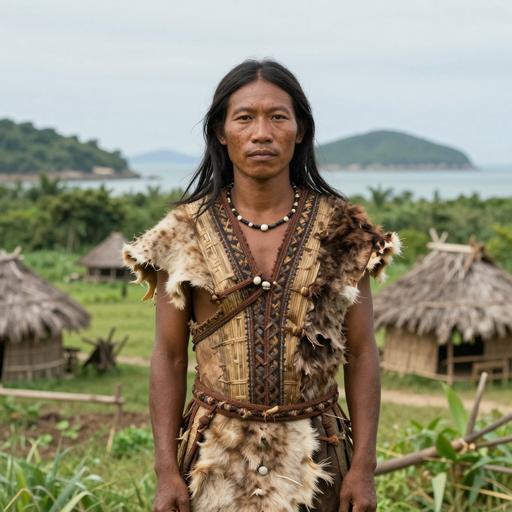
Portrait reconstruction of LD1
Ancient Individual

A man buried in China in the Early Neolithic era

LD1
6370 BCE - 6110 BCE
Male
Early Neolithic Island Southeast Asia, China
China
Scroll to begin
Chapter I

Identity

The biological and cultural markers that define this ancient individual

Sample ID

LD1

Date Range

6370 BCE - 6110 BCE

Biological Sex

Male

mtDNA Haplogroup

E1

Y-DNA Haplogroup

O-M119

Cultural Period

Early Neolithic Island Southeast Asia, China

Chapter II

Place

Where this individual was discovered

Country China
Locality Matsu. Liang Island
Chapter III

Time

When this individual lived in the broader context of human history

LD1 6370 BCE - 6110 BCE
Chapter IV

Story

The narrative of this ancient life

The Early Neolithic period in Island Southeast Asia and parts of Southern China marks a significant epoch in the cultural and technological development of the Austronesian-speaking peoples. This era, roughly spanning from 4000 BCE to 1500 BCE, is characterized by distinct advancements in agriculture, seafaring, and social organization, which collectively laid the foundations for future Austronesian expansions across the vast Pacific and Indian Oceans.

Geographic and Environmental Context

The region comprising Island Southeast Asia and Southern China is a vast and diverse area, encompassing present-day countries like Indonesia, the Philippines, Malaysia, and Taiwan, as well as the coastal areas of Southern China. The climate in this region is predominantly tropical, featuring high humidity, substantial rainfall, and heavily forested areas, interspersed with fertile river valleys and an abundance of coastal and marine resources.

Cultural and Technological Developments

Agriculture and Subsistence

The transition towards agriculture during the Early Neolithic in this region marked a fundamental shift in the lifestyle of Austronesian communities. The domestication of crops such as rice and millet became increasingly prevalent, supported by archaeological evidence of wet-rice cultivation systems. Additionally, root crops like taro and yam were cultivated due to their suitability for the wet climates. Animal domestication during this period typically included pigs, chickens, and dogs, further contributing to the subsistence base.

Pottery and Tool-Making

Pottery production became a quintessential aspect of the Neolithic Austronesian culture, with distinct styles and decorations unique to specific regions. Pottery not only held utilitarian purposes but also served as an indicator of cultural exchange and influence.

Lithic technology also saw significant advances. Tools became more sophisticated, with polished stone adzes and axes being notable for their efficiency in forest clearing, thus facilitating agricultural expansion.

Seafaring and Trade

One of the defining features of the Early Neolithic Austronesians was their unparalleled prowess in seafaring. The development of outrigger canoes and other maritime technologies enabled them to undertake extensive voyaging and trade. This capability facilitated cultural exchanges and gene flow between distant communities, thus promoting a vast network of interconnected island societies.

Social Organization and Settlements

The Neolithic period saw the emergence of more permanent and complex settlements. Villages were often strategically located along coastlines or riverbanks, enabling easy access to both terrestrial and aquatic resources. Social organization began to evolve, with evidence suggesting the development of hierarchical structures and possibly the emergence of chieftainship or clan-based leadership, as indicated by differential burial practices.

Austronesian Expansion

The technological and cultural innovations of this period were instrumental in the Austronesian expansion, as these communities voyaged beyond Island Southeast Asia. They reached as far as Polynesia, Micronesia, and Madagascar over subsequent millennia, disseminating their culture and language widely.

Key Archaeological Sites

  1. Niah Caves (Sarawak, Malaysia): A significant site providing evidence of early human habitation and the transition to agriculture, with findings of stone tools and pottery shards.

  2. Ban Non Wat (Thailand): Further inland, this site showcases one of the earliest signs of rice cultivation and complex societal structures.

  3. Kenting (Taiwan): Reflects early Austronesian culture with its distinctive pottery and implications on seafaring capabilities, linking Taiwan to broader Austronesian migratory patterns.

Conclusion

The Early Neolithic period in Island Southeast Asia and Southern China was a defining era for the Austronesian people, characterized by significant cultural and technological innovations. Through the development of agriculture, advancement in seafaring, and the establishment of complex social structures, these communities laid the groundwork for the subsequent waves of migration and cultural diffusion that shaped much of the southeastern and Pacific regions of Eurasia. This period highlights the remarkable adaptability and ingenuity of the Austronesian peoples, whose influence continues to resonate in contemporary societies across these vast areas.

Chapter V

Genetics

The genetic ancestry of this ancient individual

Ancient Genetic Admixture

This analysis compares the DNA profile of LD1 with ancient reference populations, showing the genetic composition in terms of prehistoric ancestral groups.

Ancient Asians 92.4%
Neolithic Farmers 5.0%
Ancient Oceanians 2.5%

Modern Genetic Admixture

This analysis compares the DNA profile with present-day reference populations, showing what percentage of genetic makeup resembles modern populations from different regions.

Asia 94.4%
Chinese & Southeast Asian 74.2%
Chinese 40.3%
Vietnamese 33.9%
Japanese & Korean 15.4%
Japanese 15.4%
Central Asian, Northern Indian & Pakistani 4.0%
Indian 4.0%
Northern Asian 0.9%
Siberian 0.9%
Oceania 4.3%
Melanesian 4.3%
Papuan 4.3%
Europe 0.8%
Northwestern European 0.8%
Northwestern European 0.7%

Closest Modern Populations

These are the modern populations showing the closest statistical alignment to A man buried in China in the Early Neolithic era, ranked by genetic distance. Lower distance values indicate closer statistical similarity.

1
Lao
4.3639
2
Cambodian
4.4267
3
Kinh Vietnam
4.6764
4
Thai
4.8373
5
Wa
4.9982
6
Tai Lue
5.0812
7
Lahu
5.1228
8
Dai
5.4003
9
Karen Sgaw
5.4192
10
Lawa
5.4468
Chapter VI

Context

Other ancient individuals connected to this sample

Sources

References

Scientific publications and genetic data

Scientific Publication

Ancient DNA indicates human population shifts and admixture in northern and southern China

Authors Yang MA, Fan X, Sun B
Abstract

Human genetic history in East Asia is poorly understood. To clarify population relationships, we obtained genome-wide data from 26 ancient individuals from northern and southern East Asia spanning 9500 to 300 years ago. Genetic differentiation in this region was higher in the past than the present, which reflects a major episode of admixture involving northern East Asian ancestry spreading across southern East Asia after the Neolithic, thereby transforming the genetic ancestry of southern China. Mainland southern East Asian and Taiwan Strait island samples from the Neolithic show clear connections with modern and ancient individuals with Austronesian-related ancestry, which supports an origin in southern China for proto-Austronesians. Connections among Neolithic coastal groups from Siberia and Japan to Vietnam indicate that migration and gene flow played an important role in the prehistory of coastal Asia.

G25 Coordinates

The G25 coordinates for sample LD1 can be used for detailed admixture analysis in our G25 Studio tool.

LD1,0.01076576,-0.40611312,-0.04972994,-0.0372096,0.11344892,0.03677318,-0.00322874,-0.00705598,-0.01580034,-0.0077229,0.01657572,0.00126114,0.00038952,-0.0006115,0.00152596,-7.848E-05,-0.00416888,0.0013673,-0.0036569,-0.0006906,0.00662744,0.00574092,0.00326482,-0.00053046,0.00785281
Analyze in G25 Studio
Use code for 40% off Expires Feb 26