Menu
Store
Blog
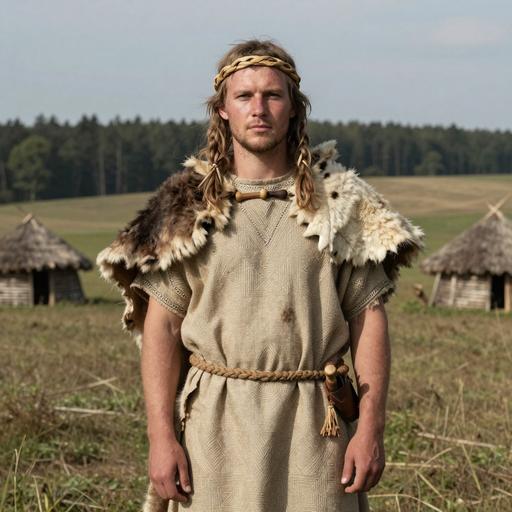
Portrait reconstruction of N47
Ancient Individual

A man buried in Poland in the Bronze Age era

N47
2600 BCE - 2250 BCE
Male
Corded Ware Culture, Poland
Poland
Scroll to begin
Chapter I

Identity

The biological and cultural markers that define this ancient individual

Sample ID

N47

Date Range

2600 BCE - 2250 BCE

Biological Sex

Male

mtDNA Haplogroup

U5b2a2

Y-DNA Haplogroup

I-L801

Cultural Period

Corded Ware Culture, Poland

Chapter II

Place

Where this individual was discovered

Country Poland
Locality Pikutkowo
Coordinates 52.6200, 18.9600
Chapter III

Time

When this individual lived in the broader context of human history

N47 2600 BCE - 2250 BCE
Chapter IV

Story

The narrative of this ancient life

The Corded Ware Culture, also known as the Battle Axe Culture or Single Grave Culture, was a significant prehistoric culture that spanned across much of Northern, Central, and Eastern Europe, with a strong presence in what is today Poland. Flourishing during the late Neolithic and early Bronze Age, approximately between 2900 BCE and 2350 BCE, this culture represents a pivotal period in European prehistory characterized by significant advancements in social, technological, and cultural developments.

Geographic and Temporal Context:

The Corded Ware Culture is named after the characteristic pottery style that is often decorated with cord-like impressions. It extended from the North European Plain through present-day Germany, Poland, and into the Baltic states and parts of Scandinavia, as well as eastward into Russia.

Archaeological Insights:

Settlements:

In Poland, evidence of Corded Ware settlements typically comprises dispersed farmsteads rather than large, dense villages. These communities were likely semi-nomadic, engaging in both agriculture and animal husbandry. Their settlements were not fortified, suggesting a lifestyle that balanced settled agriculture with pastoral nomadism.

Burial Practices:

The Corded Ware Culture is particularly noted for its burial traditions. Graves were typically individual and characterized by the presence of grave goods indicative of the deceased’s status and occupation. Burial mounds (barrows) were common, with bodies often buried in a flexed position, usually on their side, accompanied by tools, weapons (such as stone battle axes), and pottery. These grave goods suggest not only individual status but also a society that valued warriors, hunters, and possibly a form of early social hierarchy.

Pottery and Artifacts:

The pottery is one of the most distinctive aspects of this culture, known for its unique decorative techniques. The typical Corded Ware pottery includes beakers with incised decorations made using a corded impression. Other material artifacts that have been discovered include polished stone tools and bone artifacts, indicating a society skilled in crafting and commerce.

Cultural and Technological Developments:

Social Organization:

There is evidence to suggest that the Corded Ware people had a patriarchal society with social stratifications. The burials of males with weapons and specific artifacts indicate the potential existence of a warrior class.

Economy:

The economy was primarily based on agriculture, with evidence suggesting the cultivation of cereals and legumes. Animal husbandry was also a significant aspect, with cattle and sheep being prevalent. The use of horses, possibly brought over from the steppes, began to gain prominence and likely played a role in both agriculture and mobility.

Technology and Innovations:

One of the technological hallmarks of the Corded Ware Culture was the advancement in the use of metals. While stone tools remained in use, there was an increasing incorporation of copper objects. Moreover, the advent of wheeled vehicles and improved transportation technologies can be traced to this era, promoting trade and cultural exchange over larger distances.

Linguistic and Genetic Implications:

The Corded Ware Culture is often associated with the spread of Indo-European languages in Europe. Genetic studies have shown that this culture likely contributed significantly to the genetic makeup of modern European populations, representing a migration wave that brought both cultural and linguistic changes.

Interaction with Neighboring Cultures:

The Corded Ware Culture interacted with neighboring cultures, such as the Funnelbeaker Culture and later the Bell Beaker Culture. These interactions could be seen in the exchange of goods, technological innovations, and possibly cultural and religious beliefs.

Legacy:

The Corded Ware Culture is considered pivotal in shaping the prehistoric cultural landscape of Europe. Its influence persisted into the subsequent Bronze Age cultures, laying the groundwork for future social and technological developments. This era also marks a significant period of cultural transformations that contributed to shaping the demographic and cultural map of prehistoric Europe.

In summary, the Corded Ware Culture in Poland exemplifies a sophisticated society demonstrating significant advancements in agriculture, technology, and social organization, along with complex burial traditions and linguistic developments indicative of broader Eurasian influences.

Chapter V

Genetics

The genetic ancestry of this ancient individual

Ancient Genetic Admixture

This analysis compares the DNA profile of N47 with ancient reference populations, showing the genetic composition in terms of prehistoric ancestral groups.

Western Steppe Pastoralists 45.7%
European Hunter-Gatherers 38.3%
Neolithic Farmers 16.0%

Modern Genetic Admixture

This analysis compares the DNA profile with present-day reference populations, showing what percentage of genetic makeup resembles modern populations from different regions.

Europe 100.0%
Northwestern European 56.4%
English 29.6%
Northwestern European 10.0%
Finnish 9.0%
Scandinavian 7.9%
Eastern European 34.5%
Southern European 9.2%
Sardinian 5.6%
Iberian 3.6%

Closest Modern Populations

These are the modern populations showing the closest statistical alignment to A man buried in Poland in the Bronze Age era, ranked by genetic distance. Lower distance values indicate closer statistical similarity.

1
Swedish
2.5238
2
Polish Kashubian
3.2486
3
German Hamburg
3.2578
4
Czech
3.2984
5
Polish Silesian
3.3908
6
Polish
3.3966
7
Finnish Southwest
3.4520
8
German East
3.6405
9
Ukrainian Dnipro
3.6421
10
Norwegian
3.7608
Chapter VI

Context

Other ancient individuals connected to this sample

Sources

References

Scientific publications and genetic data

Scientific Publication

A genomic Neolithic time transect of hunter-farmer admixture in central Poland

Authors Fernandes DM, Strapagiel D, Borówka P
Abstract

Ancient DNA genome-wide analyses of Neolithic individuals from central and southern Europe indicate an overall population turnover pattern in which migrating farmers from Anatolia and the Near East largely replaced autochthonous Mesolithic hunter-gatherers. However, the genetic history of the Neolithic transition in areas lying north of the European Neolithic core region involved different levels of admixture with hunter-gatherers. Here we analyse genome-wide data of 17 individuals spanning from the Middle Neolithic to the Early Bronze Age (4300-1900 BCE) in order to assess the Neolithic transition in north-central Poland, and the local impacts of hunter-farmer contacts and Late Neolithic steppe migrations. We evaluate the influence of these on local populations and assess if and how they change through time, reporting evidence of recurrent hunter-farmer admixture over three millennia, and the co-existence of unadmixed hunter-gatherers as late as 4300 BCE. During the Late Neolithic we report the appearance of steppe ancestry, but on a lesser scale than previously described for other central European regions, with evidence of stronger affinities to hunter-gatherers than to steppe pastoralists. These results help understand the Neolithic palaeogenomics of another central European area, Kuyavia, and highlight the complexity of population interactions during those times.

G25 Coordinates

The G25 coordinates for sample N47 can be used for detailed admixture analysis in our G25 Studio tool.

N47,0.12902292,0.11527756,0.07337938,0.06269802,0.03779156,0.02333096,0.00376102,0.01023596,0.00093734,-0.0177366,-0.00027452,-0.00432408,0.00281028,0.00529804,0.00729992,0.00068464,-0.00582894,0.00028182,0.00090904,-0.00111882,0.00037108,-0.00021298,-0.00354348,0.01040316,0.00229135
Analyze in G25 Studio
Use code for 40% off Expires Feb 26