Menu
Store
Blog
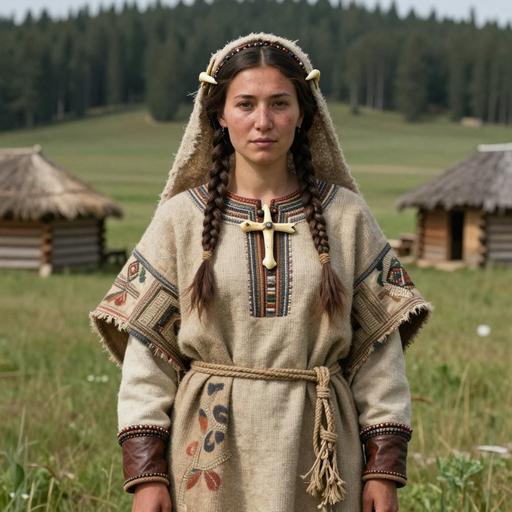
Portrait reconstruction of PTO001
Ancient Individual

A woman buried in Russia in the Early Iron Age era

PTO001
1053 BCE - 912 BCE
Female
Early Iron Age Buryatia, Russia
Russia
Scroll to begin
Chapter I

Identity

The biological and cultural markers that define this ancient individual

Sample ID

PTO001

Date Range

1053 BCE - 912 BCE

Biological Sex

Female

mtDNA Haplogroup

D4j-a

Cultural Period

Early Iron Age Buryatia, Russia

Chapter II

Place

Where this individual was discovered

Country Russia
Locality Buryatia. Pesterevo 82
Chapter III

Time

When this individual lived in the broader context of human history

PTO001 1053 BCE - 912 BCE
Chapter IV

Story

The narrative of this ancient life

The Early Iron Age in Buryatia, a region located in southern Siberia, Russia, represents a fascinating era marked by significant cultural, technological, and social developments. This period, roughly spanning from the 1st millennium BCE to the early centuries CE, is characterized by the transition from Bronze Age societies with their complex chiefdoms to more stratified societies influenced by emerging Iron Age technologies and socio-political structures.

Geography and Environment

Buryatia is situated around Lake Baikal, one of the world’s oldest and deepest freshwater lakes, and is bordered by mountainous regions like the Sayan and Yablonoi ranges. The region features a diverse landscape of taiga forests, steppe grasslands, and rolling hills. This varied environment provided rich resources, influencing the lifestyles and economies of its early inhabitants and promoting diverse subsistence strategies.

Cultural Influences and Interactions

Early Iron Age Buryatia was a cultural melting pot influenced by both indigenous traditions and interactions with neighboring peoples. This period saw increased interaction with the Scythians to the west and various nomadic groups who traveled along the Eurasian steppes, bringing with them innovations such as iron metallurgy, horse breeding, and new forms of pastoralism.

Archaeological Discoveries

The archaeological record of this era reveals significant advancements in metallurgy. The introduction of iron technology had a profound impact on tools and weaponry, enhancing agricultural productivity and military capabilities. Artefacts such as iron spearheads, knives, and ornaments suggest a society that was both martial and aesthetic, with craftsmanship playing a crucial role in daily life.

Economy and Subsistence

The economy of Early Iron Age Buryatia was a blend of pastoralism, hunting, fishing, and limited agriculture. The domestication of horses and the use of iron plows likely allowed for more efficient farming and expanded trade networks. Domesticated animals such as cattle, sheep, and goats were central to the economy, providing food, clothing, and trade goods. Meanwhile, the abundance of natural resources like fish from Lake Baikal and game from the surrounding forests sustained the population.

Social Structure and Organization

The social structure of Early Iron Age communities in Buryatia was likely hierarchical yet flexible, influenced by tribal affiliations and clans. The presence of kurgans (burial mounds), often richly furnished with grave goods, indicates a stratified society with distinctions in status and wealth. Leaders or chieftains likely held significant political and spiritual power, serving as intermediaries between their people and the spiritual world.

Religion and Beliefs

The religious beliefs during this time were deeply animistic, centered around the natural world and its spirits. Shamanism played a critical role, with shamans acting as spiritual leaders and healers. Their practices were deeply intertwined with the community’s understanding of the universe, health, and the cycles of life and death. Rituals and ceremonies, likely held in sacred natural sites like groves or near bodies of water, played a vital role in community cohesion and spiritual practice.

Art and Craftsmanship

Art from this period includes intricate metalwork and ceramics, often decorated with geometric patterns or depictions of animals and mythological creatures. Jewelry made from bronze and iron, sometimes inlaid with semi-precious stones, reflects the importance of personal adornment and status. These artistic endeavors highlight a culture with a sophisticated aesthetic sense and technical skill.

Conclusion

Early Iron Age Buryatia was a dynamic region where technological advances, cultural exchanges, and environmental adaptations combined to form distinctive societies. Its inhabitants were adept at exploiting and managing the diverse ecosystems of southern Siberia, allowing them to thrive in a challenging environment while leaving behind a rich archaeological legacy that continues to intrigue researchers today. Understanding this era provides valuable insights into the early development of Siberian cultures before the rise of state societies and the eventual spread of more dominant external influences in later centuries.

Chapter V

Genetics

The genetic ancestry of this ancient individual

Ancient Genetic Admixture

This analysis compares the DNA profile of PTO001 with ancient reference populations, showing the genetic composition in terms of prehistoric ancestral groups.

Ancient Asians 83.6%
Neolithic Farmers 11.8%
Ancient Oceanians 4.5%

Modern Genetic Admixture

This analysis compares the DNA profile with present-day reference populations, showing what percentage of genetic makeup resembles modern populations from different regions.

Asia 86.3%
Northern Asian 47.3%
Mongolian 26.9%
Siberian 20.4%
Chinese & Southeast Asian 18.1%
Chinese 18.1%
Central Asian, Northern Indian & Pakistani 12.3%
Central Asian 12.3%
Japanese & Korean 8.6%
Japanese 8.6%
Oceania 8.2%
Melanesian 8.2%
Papuan 8.2%
America 5.1%
America 5.1%
Native American 5.1%

Closest Modern Populations

These are the modern populations showing the closest statistical alignment to A woman buried in Russia in the Early Iron Age era, ranked by genetic distance. Lower distance values indicate closer statistical similarity.

1
Khamnegan
6.0058
2
Ulchi
7.3134
3
Nanai
7.5239
4
Oroqen
7.5993
5
Negidal
7.8077
6
Buryat
8.0590
7
Evenk O
8.2029
8
Nivkh
8.7710
9
Tuvinian
9.1567
10
Mongol
9.2947
Chapter VI

Context

Other ancient individuals connected to this sample

Sources

References

Scientific publications and genetic data

Scientific Publication

A Dynamic 6,000-Year Genetic History of Eurasia's Eastern Steppe

Authors Jeong C, Wang K, Wilkin S
Abstract

The Eastern Eurasian Steppe was home to historic empires of nomadic pastoralists, including the Xiongnu and the Mongols. However, little is known about the region's population history. Here, we reveal its dynamic genetic history by analyzing new genome-wide data for 214 ancient individuals spanning 6,000 years. We identify a pastoralist expansion into Mongolia ca. 3000 BCE, and by the Late Bronze Age, Mongolian populations were biogeographically structured into three distinct groups, all practicing dairy pastoralism regardless of ancestry. The Xiongnu emerged from the mixing of these populations and those from surrounding regions. By comparison, the Mongols exhibit much higher eastern Eurasian ancestry, resembling present-day Mongolic-speaking populations. Our results illuminate the complex interplay between genetic, sociopolitical, and cultural changes on the Eastern Steppe.

G25 Coordinates

The G25 coordinates for sample PTO001 can be used for detailed admixture analysis in our G25 Studio tool.

PTO001,0.03143502,-0.39437594,0.08083514,-0.012198,-0.0642097,-0.07231026,0.01316912,0.01615878,0.0116647,0.01446106,0.00331138,0.00393266,-0.00359384,0.0040058,-0.00905838,-0.01477652,-0.00796622,0.01097618,0.01678178,0.00862366,0.02059684,-0.02187984,-0.000217,0.00161666,0.0109967
Analyze in G25 Studio
Use code for 40% off Expires Feb 27