Menu
Store
Blog
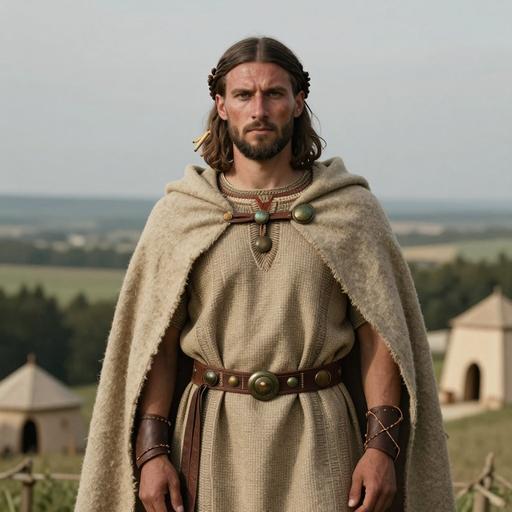
Portrait reconstruction of SZ1
Ancient Individual

A man buried in Hungary in the Bronze Age era

SZ1
3000 BCE - 800 BCE
Male
Bronze Age Hungary
Hungary
Scroll to begin
Chapter I

Identity

The biological and cultural markers that define this ancient individual

Sample ID

SZ1

Date Range

3000 BCE - 800 BCE

Biological Sex

Male

mtDNA Haplogroup

J1b

Y-DNA Haplogroup

R-Y20746

Cultural Period

Bronze Age Hungary

Chapter II

Place

Where this individual was discovered

Country Hungary
Locality Szólád
Coordinates 46.2833, 17.8500
Chapter III

Time

When this individual lived in the broader context of human history

SZ1 3000 BCE - 800 BCE
Chapter IV

Story

The narrative of this ancient life

The Bronze Age in Hungary is a fascinating period that forms an integral part of the broader European Bronze Age. Spanning approximately from 2300 to 800 BCE, the Bronze Age in Hungary saw the development of complex societies, technological advancements, and significant cultural interactions across the Carpathian Basin. This era is characterized by the establishment of significant trade networks, advances in metallurgy, and the emergence of fortified settlements.

Cultural and Technological Developments

  1. Metallurgy and Artifacts:

    • Bronze, an alloy of copper and tin, became the material of choice for tools, weapons, and ornaments. The availability of local copper resources in the Carpathian region facilitated the widespread use of bronze.
    • Skilled craftsmanship is evident in a variety of artifacts including weapons (such as swords and daggers), tools (axes and chisels), and jewelry (torcs and bangles). The discovery of hoards, such as the Hajdúsámson hoard, exemplifies the craftsmanship and aesthetic sensibilities of the period.
  2. Agriculture and Economy:

    • Agriculture thrived with the cultivation of cereals, legumes, and other crops, supported by the Carpathian Basin's fertile soils.
    • Animal husbandry was also significant, as evidenced by remains of cattle, sheep, pigs, and horses, indicating a well-rounded agrarian economy.
    • Trade was vital, with Hungarian societies engaging in extensive exchanges with neighboring regions. Amber from the Baltic, and tin from Central Europe were traded, as indicated by archaeological findings.
  3. Settlement Patterns:

    • The period saw the rise of fortified settlements, such as those at Vatya, and tell settlements like those in the Körös area.
    • These settlements often featured sophisticated defensive structures, such as walls and ditches, indicative of the need for protection and territorial control.

Socio-cultural Aspects

  1. Religious and Funerary Practices:

    • The Bronze Age Hungarians practiced diverse burial rites, including both inhumation and cremation. Burial artifacts like ceramics, weapons, and jewelry provide insights into belief systems and societal structures.
    • Rituals involving animal sacrifices and possibly ceremonial feasting suggest a complex spiritual world tied intricately to everyday life.
  2. Social Structure:

    • The presence of richly endowed burials indicates the emergence of social stratification, with elites wielding power and influence.
    • Leadership roles and social status may have been linked to warfare prowess, control of trade, or ritual functions.
  3. Art and Symbolism:

    • Pottery from this era showcases a variety of forms and intricate designs, often with geometric patterns and representations of human and animal figures.
    • The artistic expressions found in personal adornments and weapon decorations reveal a society with rich symbolic and aesthetic values.

Interconnections and Influence

  1. Cultural Networks:

    • Hungary's position at the crossroads of various major European trade routes facilitated cultural exchanges with other contemporary cultures, like the Mycenaeans, the Thracians, and Central European Urnfield cultures.
    • These interactions likely influenced technological innovations and cultural developments, contributing to the dynamic nature of the Hungarian Bronze Age.
  2. Influence on Subsequent Cultures:

    • The achievements and organization of Bronze Age societies laid foundational aspects for the Iron Age cultures that followed.
    • Advancements in metalworking, social hierarchy models, and religious practices from the Bronze Age continued to influence later cultures in the region.

In conclusion, Bronze Age Hungary represents a period of significant transformation and development marked by technological innovation, complex societal structures, and vibrant cultural interactions. This era laid the groundwork for successive cultural epochs, influencing the trajectory of Central European history.

Chapter V

Genetics

The genetic ancestry of this ancient individual

Ancient Genetic Admixture

This analysis compares the DNA profile of SZ1 with ancient reference populations, showing the genetic composition in terms of prehistoric ancestral groups.

Neolithic Farmers 37.1%
European Hunter-Gatherers 31.3%
Western Steppe Pastoralists 22.7%
Ancient Asians 8.9%

Modern Genetic Admixture

This analysis compares the DNA profile with present-day reference populations, showing what percentage of genetic makeup resembles modern populations from different regions.

Europe 72.1%
Southern European 45.7%
Balkan 22.5%
Italian 10.1%
Iberian 7.6%
Sardinian 5.6%
Northwestern European 26.4%
Northwestern European 16.6%
English 6.9%
Scandinavian 2.9%
Asia 24.4%
Northern West Asian 18.3%
Mesopotamian 14.4%
Cypriot 3.9%
Northern Asian 2.6%
Mongolian 2.6%
Central Asian, Northern Indian & Pakistani 1.9%
Central Asian 1.9%
Chinese & Southeast Asian 1.4%
Chinese 1.4%
Africa 1.8%
North African 1.5%
North African 1.5%
Oceania 1.1%
Melanesian 1.1%
Papuan 1.1%
America 0.6%
America 0.6%
Native American 0.6%

Closest Modern Populations

These are the modern populations showing the closest statistical alignment to A man buried in Hungary in the Bronze Age era, ranked by genetic distance. Lower distance values indicate closer statistical similarity.

1
Turkish Deliorman
3.4441
2
Bulgarian
3.7250
3
Swiss Italian
3.7347
4
Gagauz
3.7905
5
Romanian
3.8653
6
Turkish Rumeli
3.9696
7
Italian Emilia
4.0705
8
Italian Northeast
4.0795
9
Greek Central Macedonia
4.2342
10
Italian Piedmont
4.2407
Chapter VI

Context

Other ancient individuals connected to this sample

Sources

References

Scientific publications and genetic data

Scientific Publication

Understanding 6th-century barbarian social organization and migration through paleogenomics

Authors Amorim CEG, Vai S, Posth C
Abstract

Despite centuries of research, much about the barbarian migrations that took place between the fourth and sixth centuries in Europe remains hotly debated. To better understand this key era that marks the dawn of modern European societies, we obtained ancient genomic DNA from 63 samples from two cemeteries (from Hungary and Northern Italy) that have been previously associated with the Longobards, a barbarian people that ruled large parts of Italy for over 200 years after invading from Pannonia in 568 CE. Our dense cemetery-based sampling revealed that each cemetery was primarily organized around one large pedigree, suggesting that biological relationships played an important role in these early medieval societies. Moreover, we identified genetic structure in each cemetery involving at least two groups with different ancestry that were very distinct in terms of their funerary customs. Finally, our data are consistent with the proposed long-distance migration from Pannonia to Northern Italy.

G25 Coordinates

The G25 coordinates for sample SZ1 can be used for detailed admixture analysis in our G25 Studio tool.

SZ1,0.11378262,0.11038172,0.02776572,-0.00476834,0.02343388,-0.00825088,0.00119112,0.00087132,0.00543754,0.0159412,-0.00297206,0.00503218,-0.00438218,-0.0031126,-0.00408902,-0.00143526,0.00142704,-0.00024172,0.00307548,-0.00095322,-0.0034965,-0.000389,0.00150242,0.00110282,0.00124675
Analyze in G25 Studio
Use code for 40% off Expires Feb 27