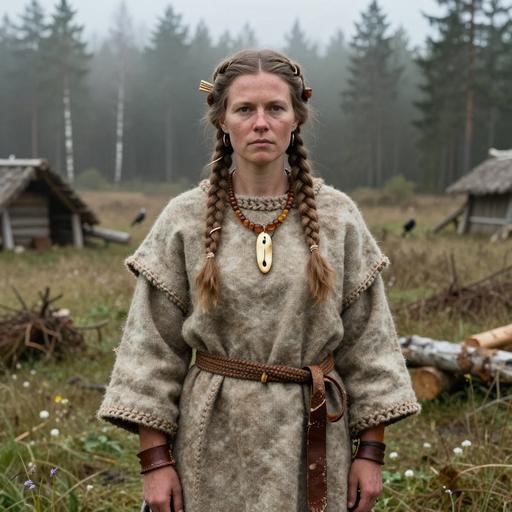
The Corded Ware culture, a notable prehistoric phenomenon, was widespread across much of northern and eastern Europe during the late Neolithic and early Bronze Age, approximately 2900–2350 BCE. In the context of Estonia, the Corded Ware culture represents a critical period during which significant sociocultural and technological transformations occurred. This era is particularly intriguing because it marks the emergence of new burial practices, pottery styles, and possibly even the introduction of Proto-Indo-European language elements, as suggested by some scholars despite ongoing debates over linguistic diffusion.
Geographical Context
In Estonia, as part of the broader Corded Ware horizon, this culture developed in the temperate forest zone, with its spread influenced by the geographical features like the Baltic Sea, forests, and numerous rivers. These natural boundaries contributed to the cultural interaction and exchange with neighboring regions.
Archaeological Evidence
Pottery and Artifacts
One of the defining features of the Corded Ware culture in Estonia is its characteristic pottery. The pottery is distinguished by its cord-impressed decorations, hence the name \Corded Ware." These imprints were possibly made using cord-wrapped sticks or twisted cords pressed into the wet clay. The ceramics were typically beakers, which exhibit a high level of craftsmanship and aesthetic sensitivity.
Additionally, the Corded Ware people in Estonia utilized various stone tools, including battle axes, which are significant markers of the culture. These stone axes suggest both a utilitarian and symbolic role, perhaps indicative of social status or identity.
Burial Practices
Burial customs during the Corded Ware period underwent notable changes compared to preceding cultures. Single inhumation burials became more common, often under small barrows or flat graves. Bodies were usually interred in a flexed position, often accompanied by pottery, tools, and weapons, which points to evolving beliefs in the afterlife and social roles.
Economy and Livelihood
The Corded Ware people in Estonia likely practiced a mixed economy, combining agriculture with animal husbandry. There is evidence of cereal cultivation, particularly wheat and barley, alongside the raising of domesticated animals such as cattle, sheep, pigs, and goats. The use of animal labor, possibly for plowing, indicates advancements in agricultural techniques.
Social Structure
The social organization of the Corded Ware culture in Estonia appears to have been complex. The variation in grave goods and burial styles suggests the presence of social stratification or differentiation. Warrior elites may have emerged during this period, as indicated by the prevalence and prominence of battle axes. Additionally, funerary practices and goods reflect developing gender roles, with certain items more commonly associated with either male or female burials.
Cultural and Linguistic Influence
The Corded Ware culture is often linked to the spread of Proto-Indo-European languages, a hypothesis partly supported by the culture’s widespread geographic range. However, the exact nature of this linguistic influence in Estonia remains a subject of scholarly debate, leaving questions open about the direct or indirect transmission of language through migration or cultural diffusion.
Interaction with Neighboring Cultures
The Corded Ware culture in Estonia did not exist in isolation but rather interacted with adjacent cultures, such as the Narva culture. This interaction likely included the exchange of goods, ideas, and technologies, reflected in the archaeological record by a blend of cultural traits. This period in Estonia represents a dynamic and transformative era, marked by both continuity and change.
Conclusion
The Corded Ware culture in Estonia is a fascinating chapter in Northern European prehistory, involving significant shifts in social organization, technology, and potentially language. While much has been uncovered, ongoing research continues to illuminate the complex interplay of factors that shaped this culture and its influence on subsequent European prehistory. The archaeological narrative constructed from sites across Estonia enriches our understanding of how early societies adapted to their environments and interacted with one another, contributing to the ever-evolving tapestry of human history."