Menu
Store
Blog
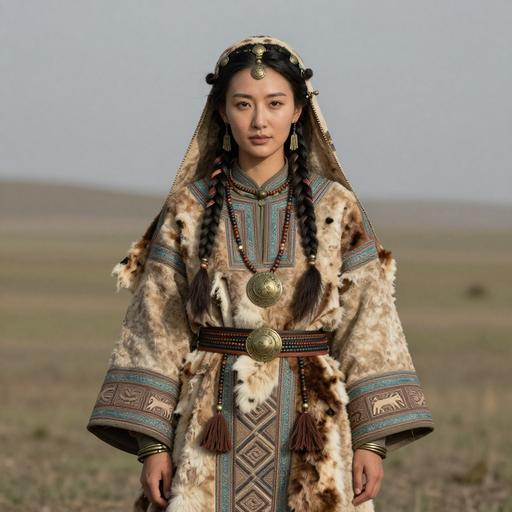
Portrait reconstruction of TAK001
Ancient Individual

A woman buried in Mongolia in the Iron Age era

TAK001
200 BCE - 100 CE
Female
Xiongnu Period Khovd, Mongolia
Mongolia
Scroll to begin
Chapter I

Identity

The biological and cultural markers that define this ancient individual

Sample ID

TAK001

Date Range

200 BCE - 100 CE

Biological Sex

Female

mtDNA Haplogroup

G2a1

Cultural Period

Xiongnu Period Khovd, Mongolia

Chapter II

Place

Where this individual was discovered

Country Mongolia
Locality Khovd. Takhiltyn Khotgor I
Coordinates 47.4031, 92.1049
Chapter III

Time

When this individual lived in the broader context of human history

TAK001 200 BCE - 100 CE
Chapter IV

Story

The narrative of this ancient life

The Xiongnu period in the region of present-day Khovd, Mongolia is a fascinating chapter of Central Asian history, characterized by the emergence and prominence of the Xiongnu Confederation—a formidable nomadic empire and one of the most significant cultural and political entities on the Eurasian steppe from approximately the 3rd century BCE to the late 1st century CE.

The Xiongnu Empire

The Xiongnu were a confederation of nomadic tribes that created a vast empire stretching across what is now Mongolia and parts of northern China, Siberia, eastern Kazakhstan, and beyond. They are often considered one of the earliest powerful, nomadic warrior societies, known for their military prowess, complex societal structures, and influence on neighboring civilizations, particularly the Han Dynasty of China.

Geography and Environment of Khovd

The Khovd region of Mongolia is characterized by its diverse geography, which includes vast steppes, high mountains, and desert areas. This varied landscape would have provided the Xiongnu with rich pastures for their horses and livestock, essential resources that sustained their nomadic lifestyle. The climate, with its harsh winters and relatively warm summers, would have influenced their migratory patterns and settlement decisions.

Social and Political Structure

The Xiongnu society was highly stratified and politically organized into a hierarchical structure. At the top was the \Chanyu," the supreme ruler who wielded significant power over the confederation. Below the Chanyu were noble families and tribal leaders who held sway over different regions and contributed to the empire's military campaigns. This hierarchical society was supported by a vast network of alliances and vassal relationships among various tribes, which included Turkic, Mongolic, and possibly other ethnic groups.

Culture and Lifestyle

The Xiongnu culture was a blend of nomadic traditions and significant external influences from neighboring civilizations. They were predominantly pastoralists, relying on herding sheep, cattle, goats, and horses, which were central to their economy and mobility. The horse was particularly pivotal, not just as a mode of transportation but as a key component of their military strength.

The Xiongnu are known to have engaged in trade and cultural exchange with neighboring peoples. This interaction is evidenced by the presence of Chinese artifacts in Xiongnu archaeological sites, indicating a robust exchange of goods such as silk, metalwork, and other luxury items.

Conflict and Interaction with China

One of the most defining aspects of the Xiongnu period was their complex relationship with the Chinese Han Dynasty. The Xiongnu were both a formidable opponent and a crucial trading partner. This duality is reflected in their history of conflicts, including raids into Chinese territories and the famous Han-Xiongnu Wars, as well as the reciprocal trade relationships established through various treaties.

The construction of the Great Wall of China can be partly attributed to the need to defend against Xiongnu raids, underscoring the significant impact they had on shaping Chinese military and defensive strategies.

Archaeological Insights

Archaeological excavations in regions like Khovd have revealed burial sites and artifacts that provide insights into the Xiongnu way of life. These include kurgans (burial mounds) which contain horse trappings, weapons, pottery, and other grave goods that speak to the wealth and status of the interred and suggest a belief in an afterlife where these items would be deemed necessary.

The discovery of such sites has offered valuable information on the Xiongnu's craftsmanship, trade networks, and cultural practices, contributing significantly to our understanding of their society.

Decline and Legacy

By the late 1st century CE, the Xiongnu confederation began to weaken due to internal strife, pressure from external forces, and assimilation into other emerging powers. Their decline paved the way for subsequent nomadic groups, such as the Rouran, Göktürks, and Mongols, to rise to prominence in the steppe regions.

Despite their decline, the legacy of the Xiongnu period persists in the cultural memory of Central Asia. Their innovations in military tactics, governance, and their role in the early stages of the Silk Road's development have left an indelible mark on the history of the region.

In sum, the Xiongnu period in Khovd, Mongolia, represents a time of great cultural dynamism, strategic military developments, and intricate socio-political networks that influenced not only the immediate region but also the broader historical narratives of ancient Eurasia."

Chapter V

Genetics

The genetic ancestry of this ancient individual

Ancient Genetic Admixture

This analysis compares the DNA profile of TAK001 with ancient reference populations, showing the genetic composition in terms of prehistoric ancestral groups.

Ancient Asians 77.9%
Western Steppe Pastoralists 14.6%
Ancient Native Americans 5.0%
Neolithic Farmers 2.5%

Modern Genetic Admixture

This analysis compares the DNA profile with present-day reference populations, showing what percentage of genetic makeup resembles modern populations from different regions.

Asia 92.6%
Northern Asian 53.1%
Siberian 33.6%
Mongolian 19.5%
Central Asian, Northern Indian & Pakistani 33.3%
Central Asian 33.0%
Chinese & Southeast Asian 6.3%
Chinese 2.5%
Tibetan 2.3%
Indonesian Khmer Thai Myanma 1.4%
America 7.4%
America 7.4%
Native American 7.4%

Closest Modern Populations

These are the modern populations showing the closest statistical alignment to A woman buried in Mongolia in the Iron Age era, ranked by genetic distance. Lower distance values indicate closer statistical similarity.

1
Khakass Kachins
5.7392
2
Altaian
6.3197
3
Khakass
6.3295
4
Teleut O
6.5213
5
Altaian Kizhi
6.5805
6
Teleut
6.7522
7
Mogush
7.8316
8
Kirghiz
8.0998
9
Kazakh China
8.1159
10
Kirghiz China
8.3462
Chapter VI

Context

Other ancient individuals connected to this sample

Sources

References

Scientific publications and genetic data

Scientific Publication

A Dynamic 6,000-Year Genetic History of Eurasia's Eastern Steppe

Authors Jeong C, Wang K, Wilkin S
Abstract

The Eastern Eurasian Steppe was home to historic empires of nomadic pastoralists, including the Xiongnu and the Mongols. However, little is known about the region's population history. Here, we reveal its dynamic genetic history by analyzing new genome-wide data for 214 ancient individuals spanning 6,000 years. We identify a pastoralist expansion into Mongolia ca. 3000 BCE, and by the Late Bronze Age, Mongolian populations were biogeographically structured into three distinct groups, all practicing dairy pastoralism regardless of ancestry. The Xiongnu emerged from the mixing of these populations and those from surrounding regions. By comparison, the Mongols exhibit much higher eastern Eurasian ancestry, resembling present-day Mongolic-speaking populations. Our results illuminate the complex interplay between genetic, sociopolitical, and cultural changes on the Eastern Steppe.

G25 Coordinates

The G25 coordinates for sample TAK001 can be used for detailed admixture analysis in our G25 Studio tool.

TAK001,0.05493986,-0.28308284,0.07063494,0.02114824,-0.06908706,-0.02232758,-0.0085731,-0.00691214,0.00624168,-0.00123484,0.0099075,-0.00507164,0.00596382,-0.01798962,-0.01064966,-0.01151774,-0.00630286,0.00532028,0.01298456,0.00808946,-0.005792,-0.00710386,0.00730938,0.00431508,0.00676642
Analyze in G25 Studio
Use code for 40% off Expires Feb 26