Menu
Store
Blog
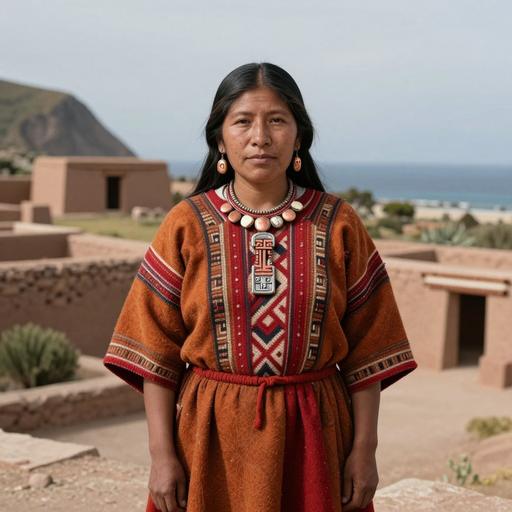
Portrait reconstruction of UC12-25
Ancient Individual

An individual buried in Peru in the Pre-Columbian South America era

UC12-25
1400 CE - 1500 CE
Not known
Late Horizon Chincha Culture, Peru
Peru
Scroll to begin
Chapter I

Identity

The biological and cultural markers that define this ancient individual

Sample ID

UC12-25

Date Range

1400 CE - 1500 CE

Biological Sex

Not known

mtDNA Haplogroup

C1c

Cultural Period

Late Horizon Chincha Culture, Peru

Chapter II

Place

Where this individual was discovered

Country Peru
Locality SouthCoast
Chapter III

Time

When this individual lived in the broader context of human history

UC12-25 1400 CE - 1500 CE
Chapter IV

Story

The narrative of this ancient life

The Late Horizon period in Andean history, approximately from 1470 to 1534 CE, marks an era of significant cultural and political changes following the expansion of the Inca Empire. Within this context, the Chincha culture of the coastal region of Peru stands out as a prominent and influential group with its unique contributions to Andean civilization.

Geographic and Temporal Context

The Chincha culture thrived in the Chincha Valley, located along the southern coast of modern-day Peru. This region was characterized by a fertile desert landscape made arable by complex irrigation systems. The Late Horizon period itself was dominated by the influence of the Inca Empire, which had extended its control over much of the Andean region, including the Chincha Valley.

Political and Economic Systems

Before Inca conquest, the Chincha were an independent coastal kingdom with substantial influence due to their strategic location. They were renowned for their sophisticated trade networks that extended not only along the coast but also into the highlands and possibly as far as Ecuador and Chile. The Chincha people were masterful navigators and traders, utilizing large balsa wood rafts to transport goods across extensive distances. Some scholars suggest they engaged in long-distance maritime trade with regions as distant as Mesoamerica.

The political structure of the Chincha was likely organized along the lines of a confederation of chiefdoms, with a central leader known as the \Chincha Capac" or King of Chincha. This polity maintained a degree of autonomy even under Inca rule, primarily due to its economic importance.

Cultural and Social Organization

Culturally, the Chincha exhibited a fusion of local traditions with those of other coastal and highland cultures, likely due to their extensive trade connections. This is reflected in their art, which often featured distinct iconography and high craftsmanship, especially in ceramics and textiles. Chincha ceramics are characterized by their blackware pottery with incised designs, showing both utilitarian and ceremonial uses.

Socially, the Chincha were likely organized into ayllus, or kinship-based communities, a common structure across the Andean region. These ayllus were integral to the economic and agricultural practices, ensuring the maintenance of the irrigation systems that were essential for the Chincha people’s agricultural productivity.

Religion and Beliefs

The religious practices of the Chincha were deeply integrated with their ecological setting and economy. They worshipped a pantheon of deities, with an emphasis on those related to the sea and commerce, owing to their dependence on maritime trade. Coastal sites indicate the prevalence of religious centers and ceremonial structures, potentially used for rituals to ensure bountiful harvests and successful trade voyages.

Impact of the Inca Conquest

When the Incas expanded into the Chincha Valley, they incorporated the Chincha’s trade network into their empire. The Inca valued the Chincha’s maritime trade capabilities, and according to some chroniclers, allocated a special status to them within the imperial system. While the Chincha maintained some degree of political autonomy, they were integrated into the Inca administrative and mit’a labor systems, contributing to the vast network that sustained the empire.

Legacy

The Chincha culture remains an integral part of the pre-Columbian history of Peru, illustrating the complexity and interconnectedness of Andean civilizations prior to European contact. Their legacy is reflected in the archaeological remains found in the Chincha Valley, from residential structures and irrigation networks to ceremonial centers. These sites provide insight into their advanced understanding of agriculture, trade, and regional politics, which played a significant role in Andean history prior to the Spanish conquest.

In summary, the Late Horizon Chincha culture represents a dynamic and influential society whose economic prowess, strategic geographic positioning, and political structures underscored its significant role in pre-Inca and Inca Peru. Their contributions to trade, art, and culture highlight the interconnectedness of Andean civilizations and their adaptability amidst the sweeping changes brought by the expansion of the Inca Empire."

Chapter V

Genetics

The genetic ancestry of this ancient individual

Ancient Genetic Admixture

This analysis compares the DNA profile of UC12-25 with ancient reference populations, showing the genetic composition in terms of prehistoric ancestral groups.

Ancient Native Americans 76.2%
Ancient Asians 21.5%
Western Steppe Pastoralists 2.3%

Modern Genetic Admixture

This analysis compares the DNA profile with present-day reference populations, showing what percentage of genetic makeup resembles modern populations from different regions.

America 91.1%
America 91.1%
Native American 91.1%
Asia 8.3%
Northern Asian 8.3%
Mongolian 6.9%
Siberian 1.4%
Africa 0.5%
Congolese & Southern East African 0.5%
South East African 0.5%

Closest Modern Populations

These are the modern populations showing the closest statistical alignment to An individual buried in Peru in the Pre-Columbian South America era, ranked by genetic distance. Lower distance values indicate closer statistical similarity.

1
Piapoco
1.7210
2
Aymara
1.9676
3
Wichi
2.0979
4
Yukpa
2.2689
5
Bolivian Lapaz
3.0846
6
Karitiana
3.2409
7
Colla
3.5989
8
Cachi
4.1696
9
Surui
4.2993
10
Mixe
4.3983
Chapter VI

Context

Other ancient individuals connected to this sample

Sources

References

Scientific publications and genetic data

Scientific Publication

Integration of ancient DNA with transdisciplinary dataset finds strong support for Inca resettlement in the south Peruvian coast

Authors Bongers JL, Nakatsuka N, O&#x27
Abstract

Ancient DNA (aDNA) analysis provides a powerful means of investigating human migration, social organization, and a plethora of other crucial questions about humanity's past. Recently, specialists have suggested that the ideal research design involving aDNA would include multiple independent lines of evidence. In this paper, we adopt a transdisciplinary approach integrating aDNA with archaeological, biogeochemical, and historical data to investigate six individuals found in two cemeteries that date to the Late Horizon (1400 to 1532 CE) and Colonial (1532 to 1825 CE) periods in the Chincha Valley of southern Peru. Genomic analyses indicate that these individuals are genetically most similar to ancient and present-day populations from the north Peruvian coast located several hundred kilometers away. These genomic data are consistent with 16th century written records as well as ceramic, textile, and isotopic data. These results provide some of the strongest evidence yet of state-sponsored resettlement in the pre-Colonial Andes. This study highlights the power of transdisciplinary research designs when using aDNA data and sets a methodological standard for investigating ancient mobility in complex societies.

G25 Coordinates

The G25 coordinates for sample UC12-25 can be used for detailed admixture analysis in our G25 Studio tool.

UC12-25,0.05698762,-0.3168968,0.11272888,0.1005265,-0.11526704,-0.01083658,-0.30601192,-0.35951932,-0.01495856,-0.01652562,0.00054402,-0.00114504,-0.00123598,0.02511358,-0.00606496,-0.00082536,0.00621732,0.00278444,0.00065358,-0.00169794,-0.00086132,0.0075172,-0.00237858,-0.00539694,-0.00598004
Analyze in G25 Studio
Use code for 40% off Expires Feb 27