Menu
Store
Blog
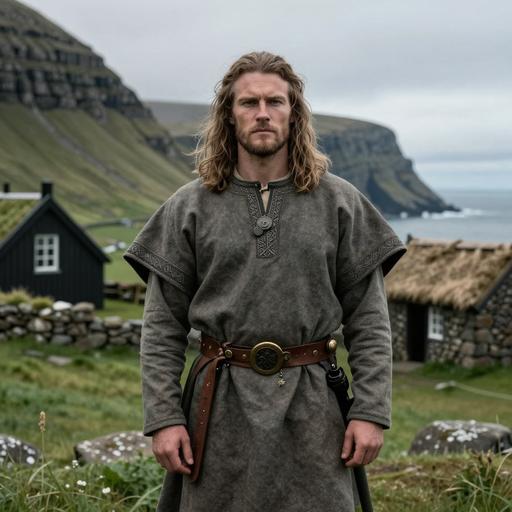
Portrait reconstruction of VK24
Ancient Individual

A man buried in Faroes in the Middle Ages era

VK24
1000 CE - 1100 CE
Male
Viking Age Faroe Islands
Faroes
Scroll to begin
Chapter I

Identity

The biological and cultural markers that define this ancient individual

Sample ID

VK24

Date Range

1000 CE - 1100 CE

Biological Sex

Male

mtDNA Haplogroup

J1b1a1a

Y-DNA Haplogroup

R1b1a1b1a1

Cultural Period

Viking Age Faroe Islands

Chapter II

Place

Where this individual was discovered

Country Faroes
Locality Faroes. Hvalba
Coordinates 61.6000, -6.9550
Chapter III

Time

When this individual lived in the broader context of human history

VK24 1000 CE - 1100 CE
Chapter IV

Story

The narrative of this ancient life

The Viking Age Faroe Islands, part of the broader Norse world during the Viking Age (circa 800 to 1050 AD), represent a fascinating chapter of history marked by exploration, settlement, and unique cultural development. Though smaller in scale compared to the more prominent Viking settlements in Scandinavia, Iceland, and the British Isles, the Faroes played a significant role in the maritime network of the Norse world.

Settlement and Origins

The Faroe Islands were likely first settled by Norse seafarers from Norway in the late 8th or early 9th century. This settlement coincided with the broader Viking expansion across the North Atlantic, motivated by the search for new lands, trade opportunities, and perhaps escaping overpopulation or political pressure in Scandinavia.

Unlike conquerors in other regions, settlers in the Faroes found uninhabited islands, free of the defensive challenges faced by their counterparts in Ireland or England. This allowed them to establish communities relatively unhindered, adapting their lifestyles to the islands' unique environmental conditions.

Geography and Environment

The Faroes, a rugged archipelago situated northwest of Scotland, presented both challenges and opportunities for Norse settlers. The islands are characterized by steep cliffs, rolling hills, and a milder climate due to the North Atlantic Current, enabling sheep farming, which soon became the backbone of the economy. However, agricultural prospects were limited due to the lack of tillable land, encouraging settlers to develop skills in fishing and bird hunting.

Social Structure and Economy

The Faroese society, like other Norse communities, was organized around farming households and extended families. A crucial part of their economy involved sheep farming, which provided wool, meat, and dairy products. The islands’ natural resources, combined with skills in fishing, made the Faroese reasonably self-sufficient, though trade played a role in acquiring goods unavailable locally.

Villages were loosely structured, and governance was likely informal, akin to Norse Thing assemblies seen throughout the Viking world. These gatherings were crucial for decision-making, legal settlements, and maintaining order within communities.

Cultural and Spiritual Life

Though remote, the Faroese maintained cultural and spiritual connections to the wider Norse world. Old Norse was the language spoken, and much of Norse mythology and legends would have been a part of everyday life. The conversion to Christianity likely started in the 10th century, paralleling the Christianization of other Norse regions, though it's reasonable to assume traditional beliefs lingered for some time.

The Faroese developed a rich oral tradition, telling stories and sagas crucial for maintaining their unique identity and passing knowledge from generation to generation. Music and dance, influenced by Norse traditions, were likely vital parts of social and ritual life.

Archaeological Evidence

Archaeological evidence from the Faroe Islands provides insight into how Norse settlers adapted to their environment. Excavations have revealed small settlements, with remains of longhouses analogous to those found in other parts of the Viking world. Tools, artifacts, and occasional remains of boats offer glimpses into the daily life and maritime skills of the Faroese Norse.

Relations with Other Norse Territories

The Faroes served as a stepping stone for further voyages across the North Atlantic, particularly to Iceland and later Greenland. Although not as prominent as other Viking territories, the Faroes were integrated into the Norse trading and cultural network. This integration facilitated the exchange of goods, people, and ideas, ensuring the islands were not isolated despite their remote location.

Conclusion

The Viking Age in the Faroe Islands represents a unique blend of adaptation and continuity within the Norse world. The settlers transformed the rugged landscape into a thriving community while maintaining strong cultural ties to their Norse heritage. The Faroese experience during the Viking Age highlights the adaptability and resilience of Norse settlers, capable of thriving in some of the most remote and challenging environments encountered during their expansive era of exploration and settlement.

Chapter V

Genetics

The genetic ancestry of this ancient individual

Ancient Genetic Admixture

This analysis compares the DNA profile of VK24 with ancient reference populations, showing the genetic composition in terms of prehistoric ancestral groups.

European Hunter-Gatherers 41.9%
Western Steppe Pastoralists 41.4%
Neolithic Farmers 13.6%
Ancient Native Americans 3.1%

Modern Genetic Admixture

This analysis compares the DNA profile with present-day reference populations, showing what percentage of genetic makeup resembles modern populations from different regions.

Europe 96.9%
Northwestern European 83.5%
English 38.4%
Northwestern European 26.2%
Scandinavian 17.5%
Finnish 1.4%
Southern European 12.9%
Balkan 11.5%
Sardinian 1.4%
Asia 2.6%
Central Asian, Northern Indian & Pakistani 2.1%
Indian 2.1%
Africa 0.6%
West African 0.6%
Ghanaian, Liberian, Sierra Leonean 0.6%

Closest Modern Populations

These are the modern populations showing the closest statistical alignment to A man buried in Faroes in the Middle Ages era, ranked by genetic distance. Lower distance values indicate closer statistical similarity.

1
Orcadian
2.1296
2
Norwegian
2.2343
3
Scottish
2.2573
4
Icelandic
2.2935
5
Shetlandic
2.3412
6
Danish
2.4515
7
Irish
2.4569
8
Dutch
2.5923
9
English
2.6766
10
Swedish
2.7194
Chapter VI

Context

Other ancient individuals connected to this sample

Sources

References

Scientific publications and genetic data

Scientific Publication

Population genomics of the Viking world

Authors Margaryan A, Lawson DJ, Sikora M
Abstract

The maritime expansion of Scandinavian populations during the Viking Age (about AD 750-1050) was a far-flung transformation in world history1,2. Here we sequenced the genomes of 442 humans from archaeological sites across Europe and Greenland (to a median depth of about 1×) to understand the global influence of this expansion. We find the Viking period involved gene flow into Scandinavia from the south and east. We observe genetic structure within Scandinavia, with diversity hotspots in the south and restricted gene flow within Scandinavia. We find evidence for a major influx of Danish ancestry into England; a Swedish influx into the Baltic; and Norwegian influx into Ireland, Iceland and Greenland. Additionally, we see substantial ancestry from elsewhere in Europe entering Scandinavia during the Viking Age. Our ancient DNA analysis also revealed that a Viking expedition included close family members. By comparing with modern populations, we find that pigmentation-associated loci have undergone strong population differentiation during the past millennium, and trace positively selected loci-including the lactase-persistence allele of LCT and alleles of ANKA that are associated with the immune response-in detail. We conclude that the Viking diaspora was characterized by substantial transregional engagement: distinct populations influenced the genomic makeup of different regions of Europe, and Scandinavia experienced increased contact with the rest of the continent.

G25 Coordinates

The G25 coordinates for sample VK24 can be used for detailed admixture analysis in our G25 Studio tool.

VK24,0.1296351,0.12256866,0.06070566,0.05314294,0.03878834,0.0227182,-0.00047846,0.00660514,0.00641144,-0.00324518,-0.00451024,0.00096906,-0.00873926,-0.00495566,0.0193373,-0.00103122,-0.0198765,0.0037421,-0.00037758,-0.0036046,0.00170732,0.00429028,-0.00115074,0.01500724,0.00269803
Analyze in G25 Studio
Use code for 40% off Expires Feb 26