


| Sample ID | Culture/Period | Date | Location | Action |
|---|---|---|---|---|
| I6113 | Harappan Civilization | 2800 BCE | Rakhigarhi, India | View |
| I6113 | 2800 BCE | Rakhigarhi, India | View |
| Sample ID | Culture/Period | Date | Location | Action |
|---|---|---|---|---|
| I6113 | Harappan Civilization | 2800 BCE | Rakhigarhi, India | View |


Preparing your ancestry journey
Connecting to ancient matches...
Preparing your report
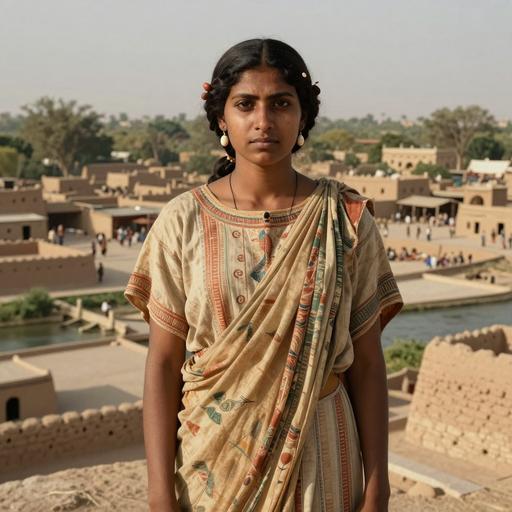
A woman buried in India during the Harappan Civilization
A fragment of the ancient world, preserved across millennia in strands of DNA.
The biological and cultural markers that define this ancient individual
I6113
2800 BCE - 1900 BCE
Harappan Civilization
Female
U2b2
N/A (Female)
Farmer (AI estimate, era-typical)
Where this individual was discovered
When this individual lived in the broader context of human history
The narrative of this ancient life
The Harappan Civilization, also known as the Indus Valley Civilization, was one of the world's earliest urban cultures, emerging around 2600 BCE and flourishing until about 1900 BCE. It was contemporary with the civilizations of Mesopotamia and Ancient Egypt, and it was distinguished by its remarkable urban planning, architectural advancements, and societal organization. The civilization was predominantly located in the northwestern regions of the Indian subcontinent, covering parts of modern-day Pakistan and northwest India along the Indus River and its tributaries.
The Harappan Civilization covered a vast area of approximately 1.25 million square kilometers, extending from present-day northeastern Afghanistan to Pakistan and northwest India. Some of the major urban centers of this civilization include:
Harappa: Located in modern-day Punjab, Pakistan, Harappa was one of the principal cities, which serves as an eponym for the entire civilization.
Mohenjo-daro: Situated in Sindh, Pakistan, Mohenjo-daro is perhaps the most famous site, showcasing advanced civil engineering and urban planning.
Dholavira: In Gujarat, India, Dholavira is known for its unique water conservation system and architectural prowess.
Lothal: An important site for trade, situated in the Indian state of Gujarat, Lothal is noted for its dockyards.
Rakhigarhi: Located in Haryana, India, this is one of the largest Harappan sites in the Indian subcontinent.
The Harappan civilization is renowned for its sophisticated urban planning. Cities were laid out in a grid pattern, demonstrating an early form of municipal administration. The distinguishing features of Harappan urbanism include:
Well-Planned Streets: Streets in Harappan cities were oriented north-south, intersecting at right angles, and varied in width to accommodate traffic.
Advanced Drainage Systems: Featuring covered drains that ran along the streets with connections to individual houses, the drainage systems highlight the sanitary planning of the Harappans.
Standardized Bricks: Buildings were often constructed with uniform, kiln-baked bricks of standardized dimensions, indicating a high level of planning and standardization.
Public Baths: Structures like the Great Bath of Mohenjo-daro, possibly used for religious or social purposes, showcased the architectural and civil engineering skills of the Harappans.
The Harappan economy was predominantly based on agriculture, facilitated by the fertile plains of the Indus River. The civilization thrived on the cultivation of wheat, barley, various legumes, and cotton. Additionally, trade played a crucial role in the prosperity of the Harappan society. There is evidence of extensive trade links with distant regions, including Mesopotamia, indicating long-distance commerce.
Craftsmanship: The Harappans excelled in various crafts, including bead-making, metallurgy (copper, bronze, gold, silver), pottery, and the production of shell and ivory objects.
Trade Networks: Harappans engaged in maritime trade, with Lothal playing a significant role as a port city. Artifacts from Mesopotamia, Oman, and other regions have been found in Harappan sites, attesting to their trade connections.
The social structure of the Harappan Civilization is not entirely understood due to the lack of deciphered written records, but several features can be inferred:
Lack of Monumental Architecture: Unlike contemporary civilizations, the Harappan civilization did not build grand palaces or tombs, suggesting either a less hierarchical society or different social norms.
Standardization and Governance: The uniformity in urban planning and artifacts such as weights and measures point to some level of centralized planning or governance.
Little is concrete about the religious beliefs of the Harappans due to the absence of decipherable textual material. However, some assumptions can be made based on archaeological findings:
Terracotta Figurines and Seals: Numerous terracotta figurines, seals depicting animals and possibly deities, indicate religious or cultural significance. Some seals depict a figure resembling the \proto-Shiva" or "Pashupati," suggesting early forms of Hinduism.
Burial Practices: Harappan burial practices exhibit variations, including skeletal burials and ossuaries, which may suggest belief in an afterlife.
The Harappan script remains undeciphered, posing a significant challenge in understanding their language and textual culture. The script appears on seals, pottery, and other materials, consisting of about 400-600 characters. The purpose and content of these texts are still a matter of research and debate.
The decline of the Harappan Civilization around 1900 BCE is attributed to multiple factors, including climate changes, the decline of trade networks, and possibly socio-political upheaval. The shifting course of the Indus River may have contributed to agricultural decline, prompting urban centers to be abandoned.
In conclusion, the Harappan Civilization was a remarkably advanced culture characterized by significant urban and technological developments. Despite the challenges in understanding certain aspects due to the lack of decipherable texts, it remained influential in laying the groundwork for subsequent cultures in the Indian subcontinent."
This individual exists within a broader network of ancient samples. No ancient genome stands alone.
Scientific publications and genetic data that inform this profile.
We report an ancient genome from the Indus Valley Civilization (IVC). The individual we sequenced fits as a mixture of people related to ancient Iranians (the largest component) and Southeast Asian hunter-gatherers, a unique profile that matches ancient DNA from 11 genetic outliers from sites in Iran and Turkmenistan in cultural communication with the IVC. These individuals had little if any Steppe pastoralist-derived ancestry, showing that it was not ubiquitous in northwest South Asia during the IVC as it is today. The Iranian-related ancestry in the IVC derives from a lineage leading to early Iranian farmers, herders, and hunter-gatherers before their ancestors separated, contradicting the hypothesis that the shared ancestry between early Iranians and South Asians reflects a large-scale spread of western Iranian farmers east. Instead, sampled ancient genomes from the Iranian plateau and IVC descend from different groups of hunter-gatherers who began farming without being connected by substantial movement of people.