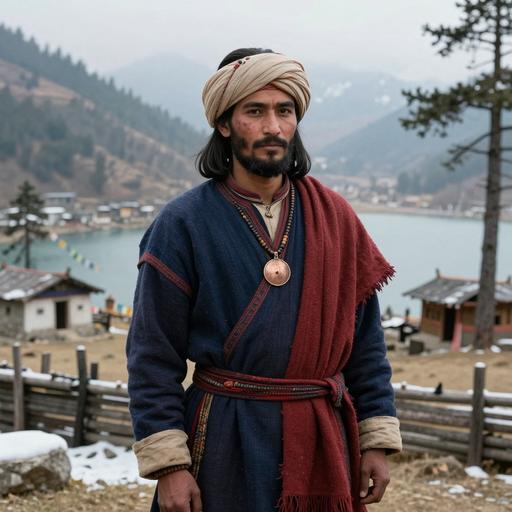
Roopkund lies in Uttarakhand, India, in a high-altitude Himalayan environment where seasonal snow, cold temperatures, and glacial processes influence how organic remains are preserved and later exposed. The immediate landscape is strongly controlled by precipitation, freeze-thaw cycles, and changing ice/snow cover, which can determine when bodies become visible on or near the lake shore.
Historical Context
The Roopkund Group C label refers to human remains assigned to the 1700s (as given here, 1700–1800 CE). While the specific circumstances of deposition are debated in popular accounts, the historical framing relevant to archaeology is the dated association with the 18th-century environment and the fact that remains were accumulated and then uncovered in later periods when ice or snow conditions changed.
Populations & Lifeways
The individuals represented by the Roopkund remains were people who were present in the high Himalayas during the 18th century. Their lifeways cannot be reconstructed in detail from skeletal remains alone; however, the context indicates activity or travel in mountainous terrain where exposure to severe weather is possible.
Archaeology & Material Culture
This context is primarily biological/forensic rather than defined by artifacts. What matters archaeologically is the preservation conditions that protect bone in a cold, glacially influenced setting, and the ability to assign a relative or absolute time frame to the remains. Any associated objects, clothing fragments, or other depositional evidence—if present in excavation reports—are essential for understanding how bodies were deposited, but the core signal here is the human skeletal assemblage itself.
Culture & Society
Because this era label focuses on remains rather than built environments or artifact traditions, “culture” is best understood cautiously. Social inferences should be limited to the fact that these were individuals participating in movements through high-altitude routes during the 18th century, with later discovery and assignment to a group depending on excavation and dating criteria reported by specialists.
Legacy & Transition
The Roopkund remains remain a significant reference point for studying high-altitude preservation and the relationship between ice conditions and the archaeological visibility of organic materials. As climate and snow/ice conditions evolve, similar sites in glaciated Himalayan settings may reveal or conceal organic remains in ways that affect future research and interpretation.