Menu
Store
Blog
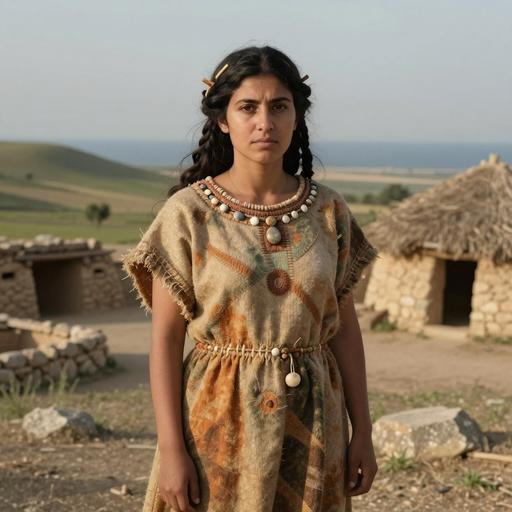
Portrait reconstruction of kum6
Ancient Individual

A woman buried in Turkey in the Neolithic era

kum6
3773 BCE - 3533 BCE
Female
Neolithic Kumtepe, Turkey
Turkey
Scroll to begin
Chapter I

Identity

The biological and cultural markers that define this ancient individual

Sample ID

kum6

Date Range

3773 BCE - 3533 BCE

Biological Sex

Female

mtDNA Haplogroup

Not available

Cultural Period

Neolithic Kumtepe, Turkey

Chapter II

Place

Where this individual was discovered

Country Turkey
Locality Kumtepe
Coordinates 39.9500, 26.2000
Chapter III

Time

When this individual lived in the broader context of human history

kum6 3773 BCE - 3533 BCE
Chapter IV

Story

The narrative of this ancient life

The Neolithic Kumtepe culture is one of the earliest known settlements in Northwestern Anatolia, near the modern-day Dardanelles in Turkey. This site offers critical insights into the Neolithic era in the Ancient Near East, providing evidence of early human life and the development of prehistoric communities.

Archaeological Context

Location and Discovery: Kumtepe is located near the town of Çanakkale, not far from the ancient ruins of Troy. This proximity has drawn significant archaeological interest. The site was first excavated in the early 20th century, but more substantial digs occurred later, revealing a wealth of information about early settlement patterns in this region of Anatolia.

Dates: The Kumtepe settlement dates back to the late Neolithic period, approximately between 5000 and 4000 BCE. Its timeline places it among the earlier Neolithic cultures, acting as a precursor to the more famous settlement of Troy.

Cultural and Societal Aspects

Settlement Patterns: Kumtepe shows evidence of permanent or semi-permanent structures, indicative of a settled community rather than a nomadic lifestyle. The architecture includes simple, rectangular mud-brick or wattle-and-daub houses. The settlement exhibits an organized layout, suggesting a communal effort in its construction and maintenance.

Economy and Subsistence: The economy of Kumtepe was predominantly agrarian. The inhabitants practiced early forms of agriculture, cultivating cereals like wheat and barley, and they may have started the domestication of animals such as sheep, goats, and possibly cattle. This agricultural base was likely supplemented by hunting, fishing, and gathering, as indicated by bone and shell remains at the site.

Material Culture: The Neolithic inhabitants of Kumtepe produced a variety of tools and artifacts. Stone tools, including arrowheads, sickle blades, and grinding stones, were prevalent. Additionally, the discovery of pottery shards demonstrates a developed ceramic technology, with simple, utilitarian designs that suggest a focus on function.

Trade and Interaction: There is evidence suggesting that Kumtepe engaged in trade or exchange networks with neighboring regions. Obsidian tools found at Kumtepe indicate long-distance trade, as the nearest sources of obsidian were located in Central Anatolia and the Aegean islands, other thriving cultural areas of the time.

Sociocultural Developments

Community and Social Structure: The community at Kumtepe likely operated on a cooperative basis, as indicated by the shared construction efforts and communal spaces. The lack of fortified structures suggests that, during the Neolithic period, external threats were minimal, or alliances may have been strong enough to deter aggression.

Rituals and Beliefs: Although direct evidence of religious or ceremonial life is sparse, typical Neolithic practices suggest that the people of Kumtepe may have shared common spiritual beliefs centered around agriculture and fertility. Burial practices, which often provide insights into belief systems, were still primarily simple, though some differentiation in grave goods might indicate emerging social stratification.

Contribution to Neolithic Studies

Kumtepe holds a significant place in the study of the Neolithic period in the Ancient Near East. Its findings help fill the gaps in understanding the spread of agricultural practices and permanent settlements from the Levant and eastern Anatolia towards the northern Aegean and European regions. The site's temporal and geographical location provides a critical link between the earliest agrarian societies and the more complex civilizations that would later arise in the area, such as those that built Troy and other Bronze Age cultures.

Conclusion

In summary, Neolithic Kumtepe represents an essential chapter in human prehistory. Through its architecture, economy, and artifacts, it provides invaluable insights into the lifestyle of one of the earliest known settler communities in Northwestern Anatolia. As archaeological techniques advance, continued exploration of Kumtepe promises to enhance our understanding of early human civilization dynamics in the region and their broader implications for the evolution of complex societies.

Chapter V

Genetics

The genetic ancestry of this ancient individual

Ancient Genetic Admixture

This analysis compares the DNA profile of kum6 with ancient reference populations, showing the genetic composition in terms of prehistoric ancestral groups.

Neolithic Farmers 72.2%
European Hunter-Gatherers 22.0%
Western Steppe Pastoralists 5.8%

Modern Genetic Admixture

This analysis compares the DNA profile with present-day reference populations, showing what percentage of genetic makeup resembles modern populations from different regions.

Europe 60.3%
Southern European 60.3%
Italian 31.7%
Balkan 14.3%
Sardinian 9.5%
Iberian 4.9%
Asia 31.7%
Northern West Asian 18.8%
Cypriot 16.0%
Mesopotamian 2.1%
Anatolian 0.7%
Arab, Egyptian & Levantine 12.9%
Arabian 10.2%
Levantine 2.7%
Africa 7.1%
North African 7.1%
Egyptian 7.1%
Oceania 0.9%
Melanesian 0.9%
Papuan 0.9%

Closest Modern Populations

These are the modern populations showing the closest statistical alignment to A woman buried in Turkey in the Neolithic era, ranked by genetic distance. Lower distance values indicate closer statistical similarity.

1
Italian Jew
3.2190
2
Romaniote Jew
3.3721
3
Italian Calabria
3.3890
4
Greek Kos
3.4018
5
Greek Dodecanese
3.4168
6
Greek Dodecanese Rhodes
3.4396
7
Turkish Jew
3.5110
8
Ashkenazi France
3.5406
9
Ashkenazi Germany
3.5484
10
Italian Campania
3.5500
Chapter VI

Context

Other ancient individuals connected to this sample

Sources

References

Scientific publications and genetic data

Scientific Publication

Genomic Evidence Establishes Anatolia as the Source of the European Neolithic Gene Pool

Authors Omrak A, Günther T, Valdiosera C
Abstract

Anatolia and the Near East have long been recognized as the epicenter of the Neolithic expansion through archaeological evidence. Recent archaeogenetic studies on Neolithic European human remains have shown that the Neolithic expansion in Europe was driven westward and northward by migration from a supposed Near Eastern origin [1-5]. However, this expansion and the establishment of numerous culture complexes in the Aegean and Balkans did not occur until 8,500 before present (BP), over 2,000 years after the initial settlements in the Neolithic core area [6-9]. We present ancient genome-wide sequence data from 6,700-year-old human remains excavated from a Neolithic context in Kumtepe, located in northwestern Anatolia near the well-known (and younger) site Troy [10]. Kumtepe is one of the settlements that emerged around 7,000 BP, after the initial expansion wave brought Neolithic practices to Europe. We show that this individual displays genetic similarities to the early European Neolithic gene pool and modern-day Sardinians, as well as a genetic affinity to modern-day populations from the Near East and the Caucasus. Furthermore, modern-day Anatolians carry signatures of several admixture events from different populations that have diluted this early Neolithic farmer component, explaining why modern-day Sardinian populations, instead of modern-day Anatolian populations, are genetically more similar to the people that drove the Neolithic expansion into Europe. Anatolia's central geographic location appears to have served as a connecting point, allowing a complex contact network with other areas of the Near East and Europe throughout, and after, the Neolithic.

G25 Coordinates

The G25 coordinates for sample kum6 can be used for detailed admixture analysis in our G25 Studio tool.

kum6,0.10613812,0.14918138,-0.0240992,-0.06238468,0.0133736,-0.02655142,-0.00041702,-0.00366318,0.01129814,0.0348367,-5.766E-05,0.00504356,-0.0117545,-0.00510394,-0.01215996,0.00446454,0.00505572,0.00053448,0.00079612,-0.0038502,0.0006789,0.00430552,-0.00425316,-0.00939222,0.00378482
Analyze in G25 Studio
Use code for 40% off Expires Feb 27