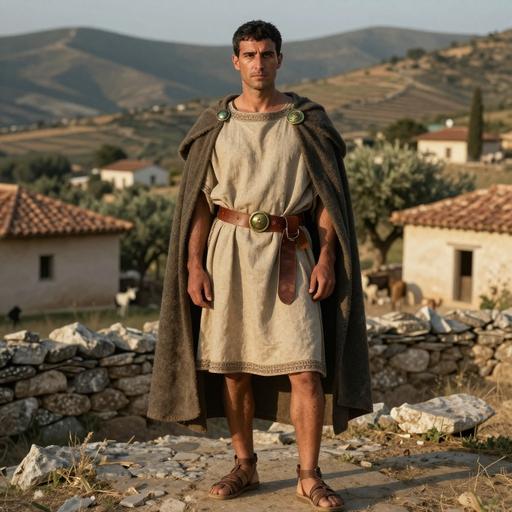
The Middle Bronze Age (circa 2000-1600 BCE) in the Aegean region, particularly in Greece, presents a fascinating tapestry of cultural development and interaction. The site of Logkas, located in Northern Greece, provides valuable insights into this period, which is characterized by significant advancements in social, economic, and cultural domains. This era, falling under the broader timeline of Aegean Civilization, is marked by the mingling of indigenous traditions with influences from other contemporary cultures, leading to distinct regional identities.
Geographical and Environmental Context:
Logkas, situated in Northern Greece, benefits from its strategic position in a rugged landscape, comprising mountainous terrains, fertile plains, and proximity to the Aegean Sea. Such geographical diversity allowed for a mixed economy, integrating agriculture, animal husbandry, and trade. This ensured a stable subsistence base, fostering societal development during the Middle Bronze Age.
Sociopolitical Structure:
The Middle Bronze Age in Logkas features a transition from small, loosely organized communities to more complex societal structures with emerging hierarchies. Although direct evidence of centralized political institutions akin to those in Minoan Crete or Mycenaean Mainland Greece might be limited, Logkas demonstrates a progression toward increased social stratification. This is observed in burial practices, housing patterns, and artifact distribution, reflecting differential status and wealth among inhabitants.
Economy and Trade:
Logkas was part of a broader trade network that connected it with other Aegean islands, the Balkans, and Anatolia. Economic activities were diversified, with local agriculture producing grains, olives, and vines, while animal husbandry provided meat, wool, and leather. Artisans produced pottery, textiles, and metal goods. The presence of Cycladic and Minoan artifacts at Logkas indicates active maritime trade, enabling the steady flow of goods, ideas, and technologies across the Aegean. Such exchanges facilitated technological advancements, as seen in the adoption of new metallurgical techniques and pottery styles.
Cultural Aspects:
Culturally, the Middle Bronze Age in Logkas is characterized by a blend of local traditions and external influences. Pottery from this era, found at Logkas, reveals both stylistic diversity and technological innovation, including the introduction of the potter's wheel. The decorative motifs suggest connections with Minoan Crete, such as spirals and marine themes, yet there are unique elements that signify local artistic expression.
Religious and spiritual practices during this period likely played a crucial role in community life. While specific details about rituals and deities in Logkas remain sparse, parallels with broader Aegean religious customs suggest the worship of nature deities associated with fertility, the sea, and celestial phenomena. These beliefs may have been articulated through communal gatherings, rites, and possibly the use of sanctuaries or sacred spaces.
Architectural Developments:
Architectural remains from Middle Bronze Age Logkas illustrate a transition from simple, one-room structures to more complex multi-room buildings. This architectural evolution reflects not only growing technical capabilities but also changing social needs, such as storage facilities for surplus production and spaces for social or administrative gatherings. Defensive structures or settlement planning indicate concerns for community protection, possibly due to increasing competition for resources.
Conclusion:
The Middle Bronze Age of Logkas in Greece epitomizes a period of profound transformation and interaction within the Aegean Civilization framework. This era witnessed advancements in social organization, economic integration, cultural expression, and technological innovation. As such, Logkas serves as a microcosm of the broader dynamics that shaped the Aegean world, illustrating the complexities of cultural convergence and adaptation that characterized this vibrant period in prehistoric Greece.