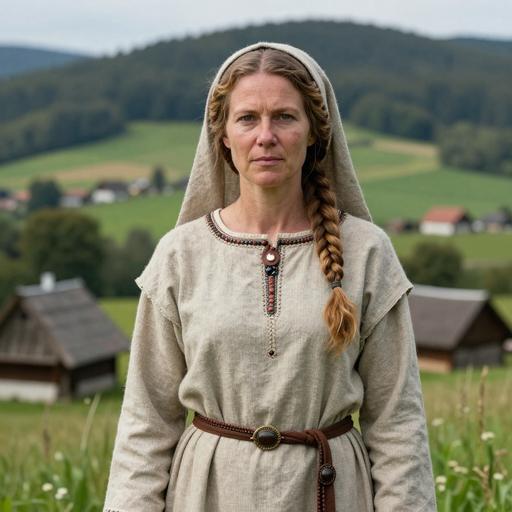
The Early Medieval period in what is now Germany spans roughly from the 5th to the 10th century, following the decline of the Roman Empire and preceding the High Middle Ages. This era was marked by significant cultural, political, and social transformations influenced by the migration of Germanic tribes, the spread of Christianity, and the foundation of political entities that would later contribute to the development of the Holy Roman Empire.
Cultural Overview
Germanic Tribes and Settlement:
During the early medieval period, what is now Germany was inhabited by various Germanic tribes, such as the Franks, Saxons, Alemanni, Thuringians, and Bavarians. These groups played a crucial role in the shaping of early medieval Europe, both through their interactions with the remnants of Roman rule and the eventual political structures they formed. The tribes settled throughout the region, establishing villages and small scale communities that were mostly agrarian.
Social Structure:
The social structure of early medieval Germanic society was hierarchical and clan-based, with a nobility that included kings or chieftains at its head. Below them were the freemen, who were typically warriors or landholders, and the non-free or serfs, bound to the land they worked. Society was patriarchal, although women could hold significant influence within certain aspects of domestic and economic life.
Language and Literature:
The early medieval period in Germany saw the use of various Germanic languages, the most widespread of which was Old High German. Literature from this period, primarily oral, included epic poetry such as \The Song of Hildebrand," and was later transcribed by monks. Christianity's spread introduced Latin as both a liturgical and scholarly language, slowly combining with Germanic dialects to influence later literary traditions.
Art and Craftsmanship:
Art in early medieval Germany is mostly represented by illuminated manuscripts, metalwork, and stone carvings. Religious and cultural influences from the Celtic and Roman worlds are evident in artistic creations. The Carolingian Renaissance, during the late 8th and 9th centuries, marked a revival of art and learning centered around the court of Charlemagne.
Political Developments
Roman Influence and Tribal Kingdoms:
As the Western Roman Empire crumbled, Germanic tribes established their own kingdoms. Among these, the Merovingian dynasty of the Franks was especially significant. The Merovingians expanded their control through military conquest and strategic alliances across the former Roman territories.
The Carolingian Empire:
The Frankish realm reached its zenith under the Carolingian dynasty, particularly with Charlemagne (Charles the Great), who was crowned Emperor in 800 AD by Pope Leo III. The Carolingian Empire spanned much of Western and Central Europe. Charlemagne's reign marked efforts to consolidate his power, standardize law, and promote Christianity and learning.
Feudal Systems:
As centralized power waned post-Charlemagne, feudalism began to evolve, characterized by the granting of lands (fiefs) in exchange for military service. Local lords gained power, which fragmented central authority but also established a system of mutual obligations that helped stabilize regional governance.
Religious Influence
Christianization:
Christian missionary activity was crucial in shaping early medieval German society. Figures like Saint Boniface played a pivotal role in converting the Germanic peoples from their pagan religions to Christianity, which became intertwined with the governance and cultural framework of the region.
Monastic Life:
Monasteries became centers of spiritual life, cultural preservation, and learning. They played a crucial role in the Carolingian Renaissance and helped to preserve classical texts, provide education, and serve as administrative centers.
Church and State:
The relationship between the Christian Church and political entities was deeply intertwined, with rulers using religious sanction to legitimize their authority and the Church leveraging political support to expand its influence.
Economic and Technological Aspects
Agriculture and Economy:
Agrarian practices dominated the economy, with innovations such as the heavy plow and three-field system improving yields. The land was a central economic asset, and wealth generally derived from its control and cultivation.
Trade and Commerce:
Throughout the early medieval period, trade networks began to revive, linking northern Europe to the broader Mediterranean and eastern trade routes. This included the exchange of goods like furs, slaves, textiles, and metalwork.
Urban Development:
While most of the population lived in rural settings, towns began to emerge around castles, monasteries, and trade routes, laying the groundwork for future urbanization during the High Middle Ages.
In summary, Early Medieval Germany was a land of transformation, marked by a convergence of Germanic traditions, Roman legacies, and Christian influence. These centuries laid the foundational socio-political and cultural structures that would shape the trajectory of German and European history in the centuries to come."