Menu
Store
Blog
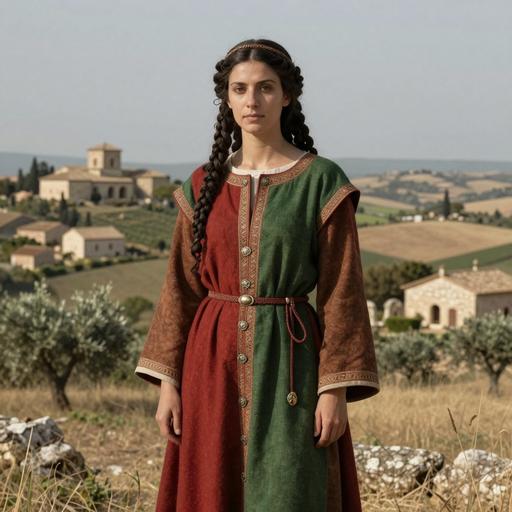
Portrait reconstruction of ORD010
Ancient Individual

A woman buried in Italy in the Medieval era

ORD010
995 CE - 1156 CE
Female
Medieval Ordona, Italy
Italy
Scroll to begin
Chapter I

Identity

The biological and cultural markers that define this ancient individual

Sample ID

ORD010

Date Range

995 CE - 1156 CE

Biological Sex

Female

mtDNA Haplogroup

X2i

Cultural Period

Medieval Ordona, Italy

Chapter II

Place

Where this individual was discovered

Country Italy
Locality Apulia. Ordona. Herdonia
Coordinates 41.3167, 15.6330
Chapter III

Time

When this individual lived in the broader context of human history

ORD010 995 CE - 1156 CE
Chapter IV

Story

The narrative of this ancient life

Medieval Ordona, located in present-day southern Italy, offers a fascinating glimpse into a period shaped significantly by the Byzantine Empire’s influence. Nestled within the region of Apulia, Ordona—historically known as Herdonia—evolved considerably during the Middle Ages, resulting in a unique blend of cultural and architectural features that distinguish it from other areas of Italy.

Historical Context

During the early medieval period, Ordona, like much of southern Italy, found itself within the sphere of the Byzantine Empire. This era marked a shift from the earlier Roman influences, asserting Orthodox Christianity and Byzantine culture as dominant features in the community's daily life. The strategic location of Ordona made it a pivotal point for administrative and military control, further imbuing the town with Eastern influences as Byzantine rule sought to maintain dominance over the Italian peninsula amidst the encroachments of Lombard and later Norman forces.

Social and Cultural Life

The culture of Byzantine Ordona was characterized by a profound blending of Roman traditions and Byzantine customs. Greek was widely spoken alongside Latin, highlighting the cultural amalgamation that occurred. The adherence to the Orthodox Christianity introduced by the Byzantines was evident in the religious practices and ecclesiastical architecture of the region, with the construction of churches that bore the hallmark of Byzantine artistry, including intricate mosaics and icons.

Art and literature flourished, mirroring the aesthetic qualities of Byzantine works, with illuminated manuscripts and religious texts playing a central role in intellectual life. Monasteries and religious communities became centers of learning and scholarship, preserving classical works and advancing theological studies.

Architecture and Urban Development

Architectural development in Ordona during the medieval period reflected the Byzantine influence through the construction of religious buildings and fortifications. Churches often featured domes and extensive mosaics, showcasing the rich iconographic traditions of Byzantine artisans. The urban layout retained elements of Roman design, characterized by comprehensive road networks, but gradually adapted to the needs of a society focused on defense, with fortified walls and strategically located watchtowers providing security against invasions.

Residential structures blended Roman practicality with Byzantine aesthetics, utilizing local materials such as limestone and incorporating courtyard designs that facilitated local climate conditions. In many cases, these buildings were adorned with frescoes and other decorative elements that depicted both religious and secular themes.

Economic Life

Economically, Ordona was a hub for agricultural production, benefiting from the fertile plains of the Tavoliere delle Puglie. The town's economy during the Byzantine period was largely agrarian, with cereals, olives, and grapes among the primary products. Ordona participated in regional trade networks, its economy bolstered by the exchange of local goods such as textiles and ceramics with neighboring regions and beyond.

The influence of Byzantine trade practices and monetary systems introduced new methods of commerce and taxation, integrating the region more closely with the wider Byzantine economy.

Decline and Legacy

Despite the flourishing of Byzantine presence, the later medieval period saw Ordona and much of Southern Italy come under Norman control, which integrated the Eastern influences with Western feudal practices. The Byzantine legacy, however, left an indelible mark on the art, architecture, and cultural practices of the area.

Today, the remnants of medieval Ordona provide crucial insights into the Byzantine period in Italy. Archeological findings have unearthed the foundations of Byzantine churches and remnants of murals, offering a window into the past lives and traditions that once dominated the region. The enduring interplay of Eastern and Western influences continues to shape the local cultural landscape, offering a unique historical narrative that underscores the complexity of medieval southern Italy.

Chapter V

Context

Other ancient individuals connected to this sample

Sources

References

Scientific publications and genetic data

Scientific Publication

The Genetic Origin of Daunians and the Pan-Mediterranean Southern Italian Iron Age Context

Authors Aneli S, Saupe T, Montinaro F
Abstract

The geographical location and shape of Apulia, a narrow land stretching out in the sea at the South of Italy, made this region a Mediterranean crossroads connecting Western Europe and the Balkans. Such movements culminated at the beginning of the Iron Age with the Iapygian civilization which consisted of three cultures: Peucetians, Messapians, and Daunians. Among them, the Daunians left a peculiar cultural heritage, with one-of-a-kind stelae and pottery, but, despite the extensive archaeological literature, their origin has been lost to time. In order to shed light on this and to provide a genetic picture of Iron Age Southern Italy, we collected and sequenced human remains from three archaeological sites geographically located in Northern Apulia (the area historically inhabited by Daunians) and radiocarbon dated between 1157 and 275 calBCE. We find that Iron Age Apulian samples are still distant from the genetic variability of modern-day Apulians, they show a degree of genetic heterogeneity comparable with the cosmopolitan Republican and Imperial Roman civilization, even though a few kilometers and centuries separate them, and they are well inserted into the Iron Age Pan-Mediterranean genetic landscape. Our study provides for the first time a window on the genetic make-up of pre-Roman Apulia, whose increasing connectivity within the Mediterranean landscape, would have contributed to laying the foundation for modern genetic variability. In this light, the genetic profile of Daunians may be compatible with an at least partial autochthonous origin, with plausible contributions from the Balkan peninsula.

Use code for 35% off Expires Apr 19