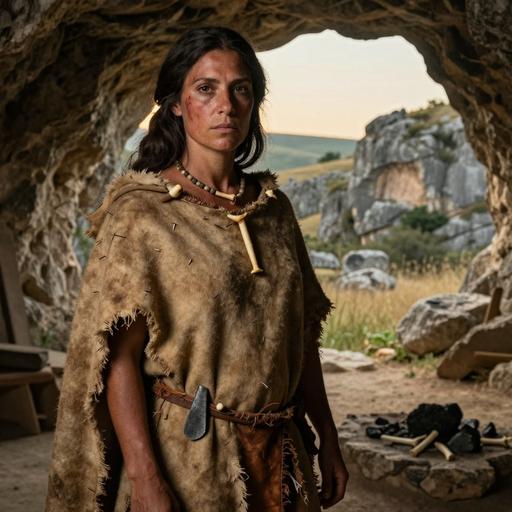
Region & Environment
Vindija Cave lies in a karstic setting in what is today northwestern Croatia. The cave preserves deposits formed during Late Pleistocene environmental conditions typical of glacial-interglacial fluctuations in central and southeastern Europe, with varied local habitats including open steppe and wooded zones.
Historical Context
The site records human use during the Late Pleistocene, a period when Neanderthal populations and later anatomically modern humans occupied parts of Europe. Vindija is part of broader research into the timing, behavior, and biological relationships of Pleistocene populations in the region.
Populations & Lifeways
Archaeological layers reflect repeated short-term and longer occupations by small hunter-gatherer groups. Activities include stone tool production and use, processing of animal resources, and sheltering. These lifeways align with broader Late Pleistocene subsistence patterns in temperate Europe.
Archaeology & Material Culture
Excavations at Vindija have produced stratified deposits with stone tools, faunal remains, hearth features, and hominin bones. Lithic assemblages show regional Paleolithic tool-making techniques. The site is also notable for recovery of human skeletal material that has been used in comparative morphological and genetic studies.
Culture & Society
As a cave site used intermittently, Vindija provides evidence for group-level organization of hunting and processing activities, raw material provisioning, and curated toolkits. Ornamentation and symbolic materials are not the primary focus at the site, which is better known for its faunal, lithic, and human remains.
Legacy & Transition
Vindija Cave has been influential in Late Pleistocene research because of its stratified sequence and the hominin remains recovered there. Material from the site has contributed to comparative anatomical studies and to retrieval of ancient DNA used in broader analyses of Neanderthal biology and their relationship to later human populations. Findings from Vindija continue to inform understanding of Neanderthal presence in Europe and the transitions that accompanied the end of the Pleistocene.