Menu
Store
Blog
Agarak — Early Medieval Armenia
Agarak, Armenia (Caucasus)

Agarak — Early Medieval Armenia

Fragments of life and lineage at Agarak (1100–1379 CE): archaeology meeting DNA

1100 CE - 1379 CE
Scroll to begin
Chapter I

The Story

Understanding the Agarak — Early Medieval Armenia culture

Archaeological remains from Agarak, Armenia (1100–1379 CE) illuminate daily life and shifting polities. Three ancient genomes provide preliminary maternal lineages (U, R6b, T). Limited samples suggest continuity with regional Caucasus ancestries, but conclusions are tentative pending more data.

Time Period

1100–1379 CE

Region

Agarak, Armenia (Caucasus)

Common Y-DNA

Undetermined (no consistent Y-data)

Common mtDNA

U (1), R6b (1), T (1)

Chapter II

Timeline

Key moments in the history of this culture

1100 CE

Post-Bagratid local realignment

Regional lords consolidate control in Armenian plateau after the decline of centralized Bagratid power.

1236 CE

Mongol influence increases

Mongol campaigns and administrative changes affect the Caucasus, altering trade and political networks.

1375 CE

Fall of Cilician Armenia (regional context)

The collapse of the Armenian Kingdom of Cilicia marks a major political shift in Armenian history.

Chapter III

Origins & Emergence

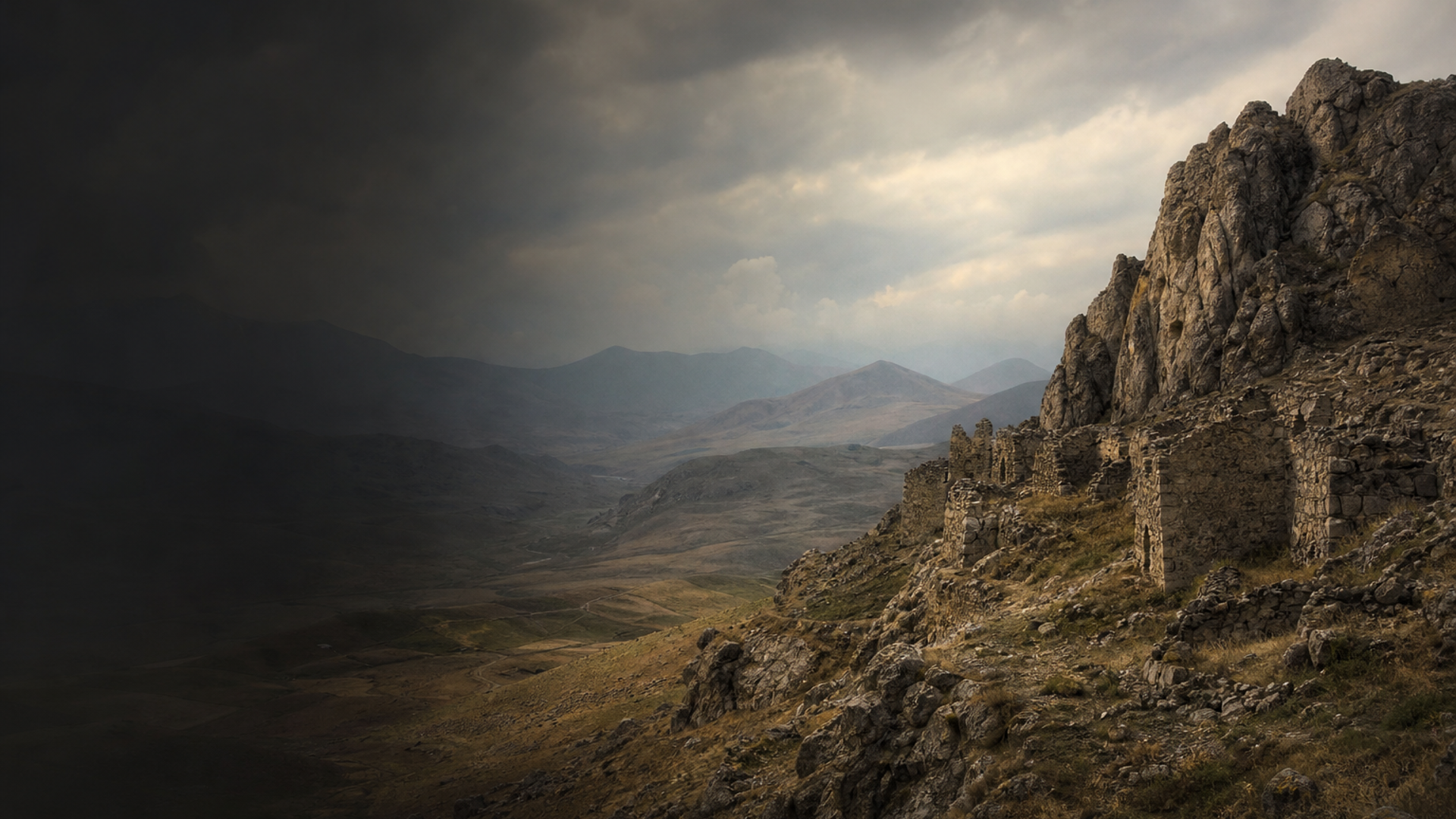
Agarak sits in the eastern Armenian plateau, a landscape of high plains and river valleys that has witnessed waves of movement and empire. Between 1100 and 1379 CE the site lies within the tumultuous arc of medieval Armenian history: the aftermath of Bagratid decline, the emergence of regional lords, periodic Seljuk and Mongol incursions, and connections to the Armenian Kingdom of Cilicia by trade and exile. Archaeological layers at Agarak reveal domestic architecture, ceramics, and funerary practices that echo long-standing Caucasian traditions while also reflecting contacts with neighboring Iranianate and Anatolian cultures.

Limited evidence suggests that communities here practiced mixed agrarian and pastoral economies, with material culture showing both local continuity and adaptive reuse of imported forms. Radiocarbon dates and stratigraphic sequences place key occupation phases across the 12th–14th centuries CE. The cinematic sweep of ruined walls and hearths at Agarak gives a tangible sense of people negotiating survival and identity amid broader geopolitical change. Archaeological data indicates continuity with earlier Armenian rural lifeways, but the picture is patchy: many structures are fragmentary and the sequence is punctuated by episodes of destruction and rebuilding, consistent with medieval regional instability.

  • Located on the eastern Armenian plateau; occupied 1100–1379 CE
  • Material culture shows local continuity plus external influences
  • Occupation phases interrupted by destruction and rebuilding
Chapter IV

Daily Life & Society

Life in medieval Agarak can be imagined from pottery sherds, hearths, and burial goods. Houses were modest, built with local stone and mudbrick; household assemblages reveal cooking wares, loom weights, and agricultural tools that point to mixed farming, textile production, and small-scale craft. Animal bone assemblages indicate sheep, goats, and cattle were central to diet and economy, while occasional exotic imports—fine glazed ceramics or metalwork—imply access to wider trade routes.

Burials at Agarak, though few, show variability: primary inhumations with personal items and occasional secondary deposits. Funerary practice reflects Christianized Armenian rites by this period, layered over older local traditions. Social life likely revolved around kin networks, village-level elites, and church institutions that mediated landholding and dispute resolution. Archaeological data indicates the community experienced cycles of prosperity and stress, likely tied to shifting tribute demands and the movements of armies across the Caucasus.

These everyday traces are evocative but incomplete; excavation areas remain limited and many domestic contexts are poorly preserved, so reconstructions emphasize plausible scenarios grounded in comparable regional sites.

  • Households engaged in mixed farming, textile production, and crafts
  • Burials reflect Christianized rites layered on local traditions
Chapter V

Genetic Profile

Genetic sampling from Agarak currently comprises three individuals dated between 1100 and 1379 CE. All three yielded mitochondrial DNA profiles: one U lineage, one R6b, and one T. These maternal haplogroups are found across West Eurasia and the Caucasus, and their presence at Agarak is consistent with broader maternal diversity documented in medieval and modern Armenian populations. However, the sample count is very small (<10), so any population-level inference is preliminary and should be treated cautiously.


No consistent Y-chromosome signal is yet reported from these samples, leaving paternal lineages undetermined. Archaeogenetic patterns in the Caucasus often show deep continuity punctuated by episodes of admixture; preliminary Agarak mtDNA aligns with a continuity model for maternal ancestry but cannot exclude localized migration or gene flow. When integrated with archaeological context—settlement continuity, Christian funerary indicators, and material exchange—the genetic data suggest a community rooted in regional ancestry with potential links to wider West Eurasian gene pools.

Future sampling with larger numbers and genome-wide data (autosomal analyses) will be necessary to clarify population structure, levels of kinship within the cemetery, and possible genetic connections to neighboring medieval Armenian and Caucasus groups.

  • Three mtDNA samples: U, R6b, T—consistent with regional West Eurasian/Caucasus diversity
  • No robust Y-DNA signal; results are preliminary due to small sample size
Chapter VI

Legacy & Modern Connections

The fragments from Agarak are a whisper of medieval Armenian lifeways that feed into the long story of the Armenian people. Archaeologically, the site links rural lifeways of the medieval plateau to enduring cultural practices—crafts, agricultural strategies, and Christian ritual—that persist in local memory and material culture. Genetically, the maternal lineages identified reflect haplogroups that continue to appear in modern Armenian and Caucasus datasets, suggesting threads of biological continuity across a millennium.

Yet the picture is nuanced: centuries of migration, conquest, and exchange have layered the genetic and cultural landscape. The Agarak samples are an evocative first glimpse, but limited in number. Expanding excavations and integrating genome-wide data with isotopic and archaeological analysis will be essential to map how medieval communities at Agarak contributed to the genetic mosaic of the modern Caucasus. In museum display, the artifacts and DNA together can humanize medieval individuals—anchoring personal stories to broader historical currents.

  • mtDNA lineages at Agarak resonate with modern regional diversity
  • Expanded sampling needed to clarify connections to contemporary Armenian populations
AI Powered

AI Assistant

Ask questions about the Agarak — Early Medieval Armenia culture

AI Assistant by DNAGENICS

Unlock this feature
Ask questions about the Agarak — Early Medieval Armenia culture. Our AI assistant can explain genetic findings, historical context, archaeological evidence, and modern connections.
Sample AI Analysis

The Agarak — Early Medieval Armenia culture represents a fascinating chapter in human history...

Genetic analysis reveals connections to earlier populations while showing evidence of unique adaptations and cultural innovations. The ancient DNA samples provide insights into migration patterns, social structures, and the biological relationships between ancient populations.

This is a preview of the AI analysis. Unlock the full AI Assistant to explore detailed insights about:

  • Genetic composition and ancestry
  • Migration patterns and origins
  • Daily life and cultural practices
  • Modern genetic legacy
Use code for 35% off Expires May 20