Menu
Store
Blog
Aghitu, Armenian Highlands (modern Armenia)

Aghitu: Late Hellenistic Armenia

Three genomes from Aghitu offer a cautious glimpse into Armenia’s Hellenistic crossroads

72 BCE - 60 CE
Scroll to begin
Chapter I

The Story

Understanding the Aghitu: Late Hellenistic Armenia culture

Archaeological and genetic evidence from Aghitu (72 BCE–60 CE) illuminate maternal diversity in Late Hellenistic Armenia. Three mtDNA lineages (W, T2h, H) hint at West Eurasian connections; small sample size makes conclusions preliminary but evocative of regional interaction.

Time Period

72 BCE–60 CE

Region

Aghitu, Armenian Highlands (modern Armenia)

Common Y-DNA

Unknown / insufficient data

Common mtDNA

W, T2h, H (each in 1 sample)

Chapter II

Timeline

Key moments in the history of this culture

2500 BCE

Early highland occupation

Archaeological evidence indicates human occupation of the Armenian Highlands, establishing long-term settlement patterns that shaped later societies.

Chapter III

Origins & Emergence

The ruins and burials at Aghitu sit like a quiet prologue to a turbulent era. Archaeological data indicates activity at this site during the Late Hellenistic period when the Armenian Highlands were a nexus between the Mediterranean world, Iranic realms, and the Caucasus. Material culture from contemporaneous sites in the region—ceramics with Hellenistic shapes, metalwork resonant with Parthian styles, and locally produced wares—suggests a landscape of both enduring local traditions and layered foreign influences.

Limited evidence suggests that settlement patterns in this era combined continuity with earlier Iron Age lifeways and new expressions tied to increased long-distance exchange. Aghitu’s funerary contexts, while sparsely reported, reflect localized burial rites punctuated by imported objects in some cases, implying participation in regional trade networks. The chronological window of 72 BCE to 60 CE places these individuals in the century when Armenian polities negotiated sovereignty and cultural exchange across imperial frontiers.

Caution is essential: with only three genomic samples from the site, any reconstruction of population history is provisional. Yet the archaeological picture—fragmentary pottery assemblages, hearth features, and grave assemblages—paired with genetic glimpses, invites a narrative of a community living at the crossroads of Mediterranean, Anatolian, and Iranian currents.

  • Aghitu lies in the Armenian Highlands, active during Late Hellenistic era
  • Material culture shows local continuity with Hellenistic and Parthian influences
  • Evidence suggests participation in regional exchange networks
Chapter IV

Daily Life & Society

Archaeological traces from Late Hellenistic sites in Armenia evoke tactile scenes: threshing floors, simple domestic hearths, and workshops where metal and textiles were shaped for local use and trade. At Aghitu, funerary deposits and stray finds point to a society organized around agriculture and pastoralism, augmented by artisanal specialization. Archaeobotanical and zooarchaeological data from nearby contexts in the Armenian Highlands indicate cultivation of cereals, pulses, and managed herds—patterns that likely held true for Aghitu’s inhabitants.

Trade left quieter marks: fineware fragments and the occasional imported object reveal connections to wider exchange networks extending toward the Mediterranean and Mesopotamia. Social life would have been structured by household units, kinship ties, and local elites who mediated external contacts. Ritual practice visible in mortuary variability hints at persistent local identities even as styles and goods circulated across borders.
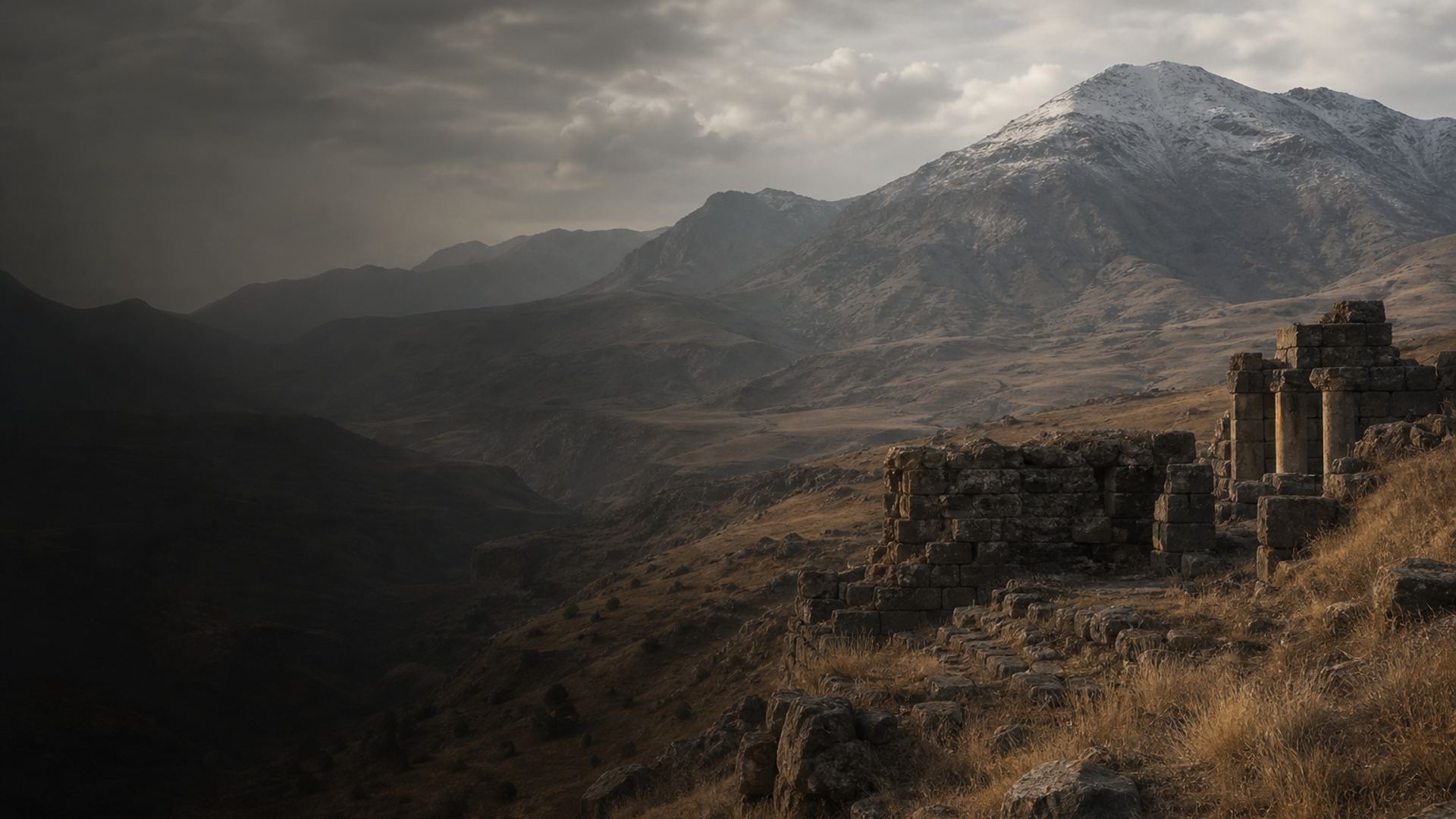

Archaeological interpretation must remain modest: the site’s assemblage is not yet large enough to reconstruct full social hierarchies or craft economies. Instead, we can read Aghitu as a small stage where everyday resilience met the ebb and flow of Hellenistic-era interaction.

  • Economy centered on mixed farming and herding with local craft production
  • Material exchange brought imported wares alongside persistent local traditions
Chapter V

Genetic Profile

Three mitochondrial genomes recovered from Aghitu provide a slender but meaningful thread tying people to place. The mtDNA lineages—W, T2h, and H—are all broadly West Eurasian in distribution. Haplogroup H is common across Europe and parts of West Asia, haplogroup W appears sporadically in West Eurasia and South Asia, and T2h is a subclade often found in Near Eastern and European contexts. These maternal lineages suggest a mosaic of maternal ancestries consistent with the Armenian Highlands’ role as a crossroad of populations.

Importantly, no robust Y-DNA profile is reported for these samples, and the total sample count is only three. When sample count is low (<10), genetic patterns may reflect individual life histories rather than population-level structure; therefore conclusions must be framed as preliminary. Nonetheless, the presence of three distinct mtDNA haplogroups in three individuals hints at maternal diversity rather than homogeneity.

When integrated with archaeological data—signs of trade, hybrid material culture, and long-term occupation—these mitochondrial results align with a model of continuity punctuated by mobility and admixture. Future, larger genomic datasets (including autosomal data and Y-chromosome information) will be required to test hypotheses about ancestry proportions, sex-biased migration, and continuity with earlier Bronze/Iron Age populations.

  • mtDNA lineages W, T2h, H indicate diverse West Eurasian maternal ancestries
  • Sample size (n=3) is too small for firm population-level conclusions
Chapter VI

Legacy & Modern Connections

The genetic and archaeological glimpses from Aghitu contribute to a larger tapestry of the Armenian Highlands’ deep past. Modern Armenian populations carry genetic continuity with ancient inhabitants of the region, but that continuity is interwoven with layers of admixture from neighboring regions over millennia. The mtDNA variants observed at Aghitu are part of haplogroup lineages still present, in varying frequencies, among contemporary West Eurasian populations, suggesting threads of maternal connection across time.

Archaeologically, the Late Hellenistic period marks a chapter in which local traditions endured even as new artistic styles and goods circulated. For museum visitors and descendants alike, Aghitu’s story is evocative: it is a reminder that identities are forged in contact zones where continuity and change coexist. Yet the small number of ancient genomes cautions us against overconfidence—these three individuals open a window, not a panoramic view. Expanding the dataset will sharpen the picture of how ancient inhabitants of Aghitu relate to both their predecessors and modern populations.

  • mtDNA continuity suggests maternal links between ancient and modern West Eurasian groups
  • Aghitu exemplifies cultural persistence amid regional interaction; genetic inferences remain provisional
AI Powered

AI Assistant

Ask questions about the Aghitu: Late Hellenistic Armenia culture

AI Assistant by DNAGENICS

Unlock this feature
Ask questions about the Aghitu: Late Hellenistic Armenia culture. Our AI assistant can explain genetic findings, historical context, archaeological evidence, and modern connections.
Sample AI Analysis

The Aghitu: Late Hellenistic Armenia culture represents a fascinating chapter in human history...

Genetic analysis reveals connections to earlier populations while showing evidence of unique adaptations and cultural innovations. The ancient DNA samples provide insights into migration patterns, social structures, and the biological relationships between ancient populations.

This is a preview of the AI analysis. Unlock the full AI Assistant to explore detailed insights about:

  • Genetic composition and ancestry
  • Migration patterns and origins
  • Daily life and cultural practices
  • Modern genetic legacy
Use code for 35% off Expires May 21



