Menu
Store
Blog
Bolivia_Akapana_Tiwanaku Akapana, Tiwanaku, Bolivia (Lake Titicaca basin)

Akapana at Tiwanaku: Echoes on the Altiplano

Late Tiwanaku-era people from Akapana (773–1047 CE): archaeology meeting ancient DNA

773 CE - 1047 CE
5 Ancient Samples
Scroll to begin
Chapter I

The Story

Understanding the Akapana at Tiwanaku: Echoes on the Altiplano culture

Archaeological and genetic data from five individuals excavated at the Akapana mound, Tiwanaku (Bolivia) dated 773–1047 CE reveal Indigenous Andean lineages—Y haplogroup Q and diverse Native American mtDNA—suggesting local continuity during the late Tiwanaku era, though conclusions remain preliminary.

Time Period

773–1047 CE (sample dates)

Region

Akapana, Tiwanaku, Bolivia (Lake Titicaca basin)

Common Y-DNA

Q (3 of 5 samples)

Common mtDNA

C1b, B2, D1, B2b, C1c (one each)

Chapter II

Timeline

Key moments in the history of this culture

300 CE

Emergence of Tiwanaku cultural horizon

Regional ceremonial centers and distinctive material culture begin to coalesce around Lake Titicaca.

600 CE

Major construction at Akapana

Archaeological evidence indicates significant building phases and ritual activity at the Akapana mound.

1000 CE

Decline and regional transformation

Tiwanaku’s core influence wanes and the region undergoes social and political reorganization.

Chapter III

Origins & Emergence

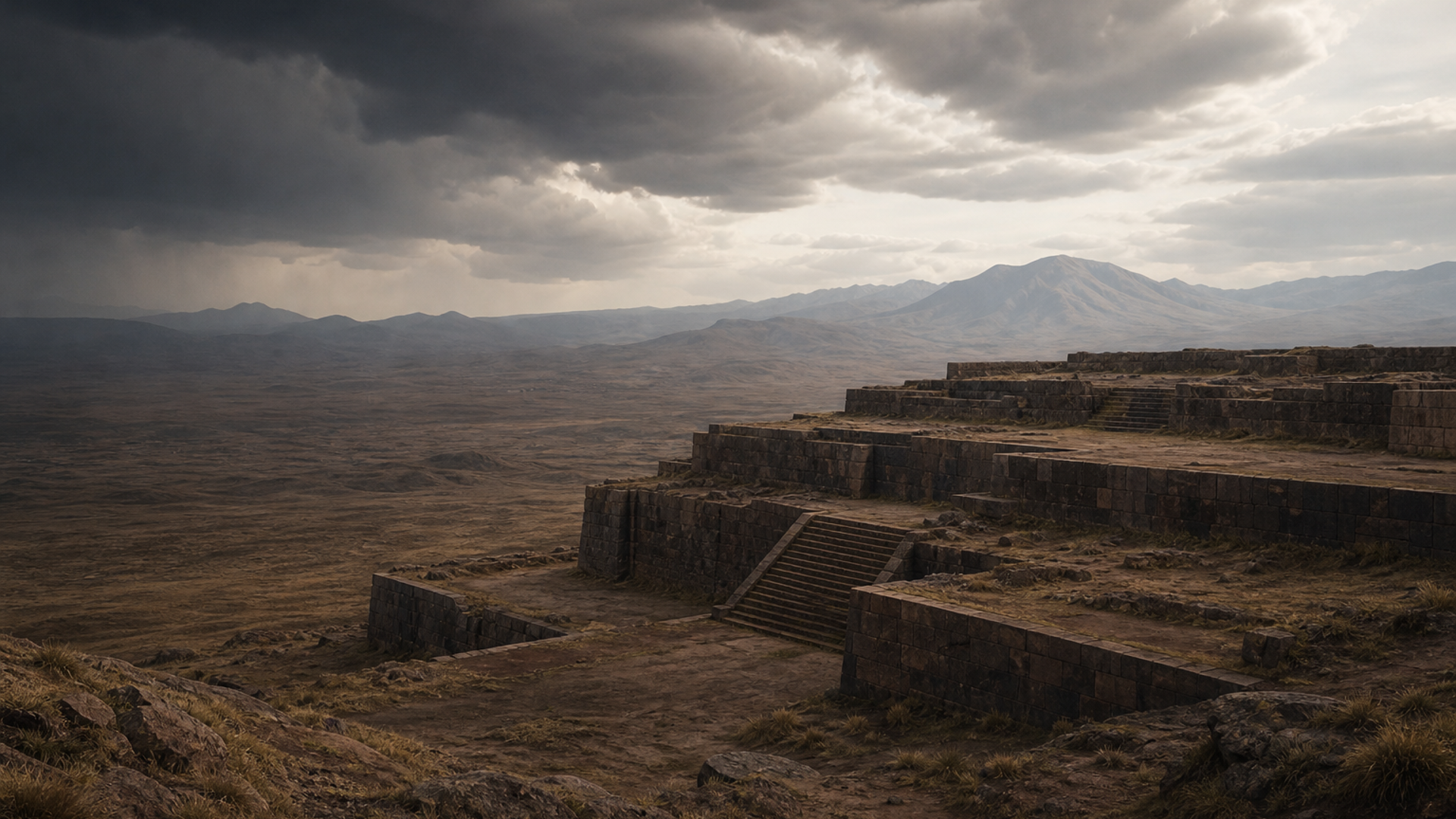
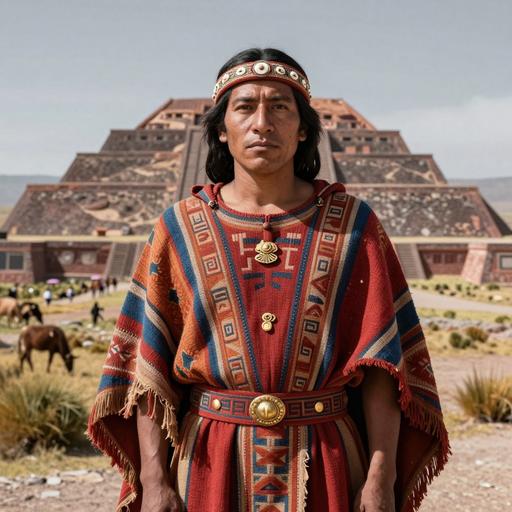
Rising like a colossal staircase from the wind-swept altiplano, the Akapana mound at Tiwanaku anchors a story of ceremonial power and regional integration. Archaeological data indicates Akapana was a monumental, multi-phased platform mound at the heart of the Tiwanaku polity on the southern shores of Lake Titicaca (modern-day Bolivia). The broader Tiwanaku cultural horizon is generally placed between roughly 300 and 1000 CE, with its heyday of ritual and regional influence often dated to ca. 500–900 CE.

Material evidence from excavations—stone architecture, carved stelae, ceramic styles, and ritual deposits—attests to long-term construction episodes and pilgrimage-related activity at Akapana. The five individuals in this dataset were sampled directly from contexts at Akapana and are radiocarbon dated between 773 and 1047 CE, placing them in the later phases of Tiwanaku occupation and the period of regional transformation that follows the culture’s nucleus.

Limited evidence suggests Akapana functioned as a focal point for ritual gatherings, elite display, and possibly redistribution. However, stratigraphic disturbance, post-depositional processes, and uneven sampling mean interpretations of social identity and monument function remain probabilistic rather than definitive. Ongoing excavation and targeted dating will refine the timeline of construction episodes and human activities at the mound.

  • Akapana: monumental stepped mound at Tiwanaku (Lake Titicaca basin)
  • Tiwanaku cultural horizon broadly 300–1000 CE; samples dated 773–1047 CE
  • Monumental ritual use indicated, but construction phases and functions remain under study
Chapter IV

Daily Life & Society

Against a cinematic backdrop of high-altitude plains and shifting weather, everyday life in the Tiwanaku world combined intensive agriculture with long-distance exchange. Archaeobotanical and geoarchaeological studies across the altiplano document raised-field agriculture (suka kollus), tuber cultivation (notably potatoes and oca), quinoa, and careful water management—technologies that supported dense populations on the puna. Camelids (llama and alpaca) appear frequently in faunal assemblages and iconography, supplying transport, fiber, and meat.

Archaeological contexts at Akapana reveal ritual deposits, specialized craft production areas, and funerary evidence suggesting social differentiation. Offerings and human interments associated with the mound imply both elite ceremonies and broader community participation in ritual cycles. Pottery styles and exotic materials—obsidian, seashells—document exchange networks reaching from the highlands to lower valleys and possibly the Pacific coast or Amazonian edges.

Yet, caution is essential: the five genetic samples in this dataset represent a tiny slice of a complex society. Archaeological indicators point to hierarchical ritual centers and a mixed economy, but they cannot alone reconstruct household composition, social mobility, or the full diversity of lived experience at Akapana.

  • Intensive raised-field agriculture supported dense altiplano populations
  • Akapana contexts show ritual deposits, craft activity, and evidence of exchange
Chapter V

Genetic Profile

The ancient DNA signal from Akapana is intimate and provisional: five individuals dated 773–1047 CE were successfully analyzed, a small sample that constrains broad population claims. Yet the genetic affinities they present align with larger patterns known for the Andes. Three of the five males carried Y-chromosome haplogroup Q—a lineage widespread among Indigenous peoples of the Americas and commonly found in Andean contexts—supporting a primarily Indigenous paternal ancestry in this Akapana assemblage.

Mitochondrial diversity among the five samples includes C1b, B2, D1, B2b, and C1c (one individual each). These mtDNA haplogroups are canonical Native American maternal clades and are commonly reported across southern Andean and neighboring regions. Taken together, the Y and mtDNA profiles point to local Andean genetic continuity during the late Tiwanaku period rather than a dominant influx of genetically distant outsiders.

However, with fewer than 10 samples, conclusions must remain cautious. The data are consistent with a population rooted in long-standing Andean lineages, but they do not preclude episodic gene flow, social mobility, or regional heterogeneity. Future increases in sample size, genome-wide analyses, and comparative datasets from contemporaneous sites across the Lake Titicaca basin and adjacent valleys will be required to resolve fine-scale demographic processes.

  • Y-haplogroup Q found in 3 of 5 individuals—typical Native American paternal lineage
  • mtDNA shows diverse Native American clades (C1b, C1c, B2, B2b, D1); sample size remains small
Chapter VI

Legacy & Modern Connections

The stones of Akapana still cast long shadows over modern communities around Lake Titicaca. Genetic continuity suggested by Y and mtDNA lineages in these late Tiwanaku-era individuals echoes the deep roots of Andean populations: many modern Aymara and Quechua-speaking communities carry related genetic signatures. Archaeology and genetics together paint a picture of persistence—cultural landscapes and biological lineages shaped over centuries of local adaptation and social interaction.
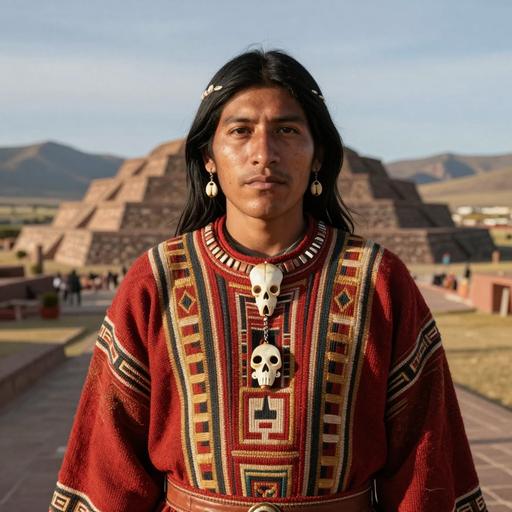
Nevertheless, it is essential to avoid simplistic ancestry narratives. Ancient individuals do not map directly onto present-day ethnic identities, and the small sample set means any connection to modern groups should be framed probabilistically. Continued engagement with descendant communities, expanded sampling, and interdisciplinary work will deepen understanding of Tiwanaku’s human legacy without overstating the evidence.

  • Genetic patterns suggest continuity with highland Andean populations, but links to modern groups are probabilistic
  • Archaeology + DNA together illuminate long-term human adaptation around Lake Titicaca
Chapter VII

Sample Catalog

5 ancient DNA samples associated with the Akapana at Tiwanaku: Echoes on the Altiplano culture

Ancient DNA samples from this era, providing genetic insights into the people who lived during this period.

5 / 5 samples
Portrait Sample Country Era Date Culture Sex Y-DNA mtDNA
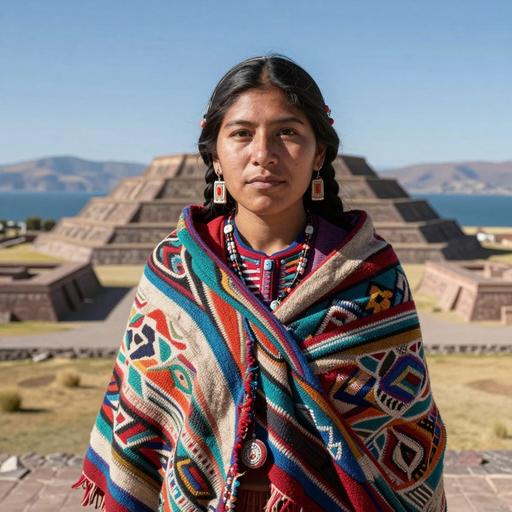
Portrait of ancient individual TW004 from Bolivia, dated 773 CE
TW004
Bolivia Bolivia_Akapana_Tiwanaku 773 CE Andean Civilizations M Q1b1a1a1 C1b
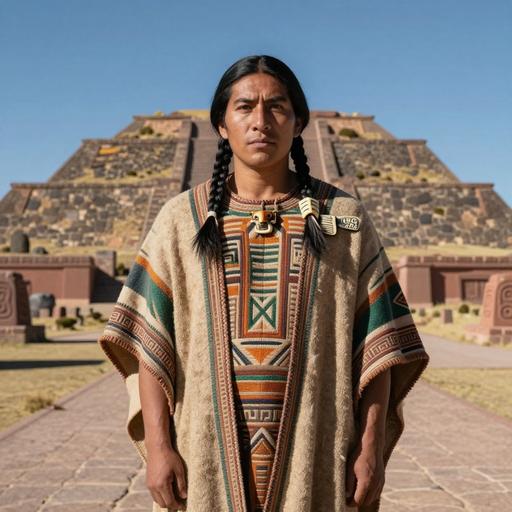
Portrait of ancient individual TW008 from Bolivia, dated 778 CE
TW008
Bolivia Bolivia_Akapana_Tiwanaku 778 CE Andean Civilizations M Q1b1a1a1w B2
Portrait of ancient individual TW060 from Bolivia, dated 901 CE
TW060
Bolivia Bolivia_Akapana_Tiwanaku 901 CE Andean Civilizations F - D1
Portrait of ancient individual TW061 from Bolivia, dated 991 CE
TW061
Bolivia Bolivia_Akapana_Tiwanaku 991 CE Andean Civilizations F - B2b
Portrait of ancient individual TW097 from Bolivia, dated 885 CE
TW097
Bolivia Bolivia_Akapana_Tiwanaku 885 CE Andean Civilizations M Q1b1a C1c
AI Powered

AI Assistant

Ask questions about the Akapana at Tiwanaku: Echoes on the Altiplano culture

AI Assistant by DNAGENICS

Unlock this feature
Ask questions about the Akapana at Tiwanaku: Echoes on the Altiplano culture. Our AI assistant can explain genetic findings, historical context, archaeological evidence, and modern connections.
Sample AI Analysis

The Akapana at Tiwanaku: Echoes on the Altiplano culture represents a fascinating chapter in human history...

Genetic analysis reveals connections to earlier populations while showing evidence of unique adaptations and cultural innovations. The ancient DNA samples provide insights into migration patterns, social structures, and the biological relationships between ancient populations.

This is a preview of the AI analysis. Unlock the full AI Assistant to explore detailed insights about:

  • Genetic composition and ancestry
  • Migration patterns and origins
  • Daily life and cultural practices
  • Modern genetic legacy
Use code for 35% off Expires May 21