Menu
Store
Blog
Armenia (Transcaucasia)

Armenia, Early Iron Age: Echoes in Stone

A vivid portrait of communities in Armenia (1150–420 BCE) seen through archaeology and ancient DNA

1150 CE - 420 BCE
Scroll to begin
Chapter I

The Story

Understanding the Armenia, Early Iron Age: Echoes in Stone culture

Archaeological remains from Bover, Pijut, Bragdzor, Noratus and Sarukhan (1150–420 BCE) reveal Early Iron Age lifeways in Armenia. Genetic data from 14 individuals offers preliminary maternal lineages and hints at regional continuity and contact.

Time Period

1150–420 BCE (Early Iron Age)

Region

Armenia (Transcaucasia)

Common Y-DNA

Not well characterized (insufficient or diverse data)

Common mtDNA

T2b (2), K (2), H (1), U3c (1), U7a (1)

Chapter II

Timeline

Key moments in the history of this culture

1150 BCE

Early Iron Age transition

Archaeological horizons show shifts in metallurgy, ceramics and funerary styles marking Early Iron Age beginnings in Armenia.

800 BCE

Regional interaction intensifies

Material culture and trade networks show increased connections across the highlands, Anatolia and Mesopotamia.

550 BCE

Integration into wider imperial spheres

Archaeological evidence indicates incorporation of Armenian highland communities into larger political and economic networks.

Chapter III

Origins & Emergence

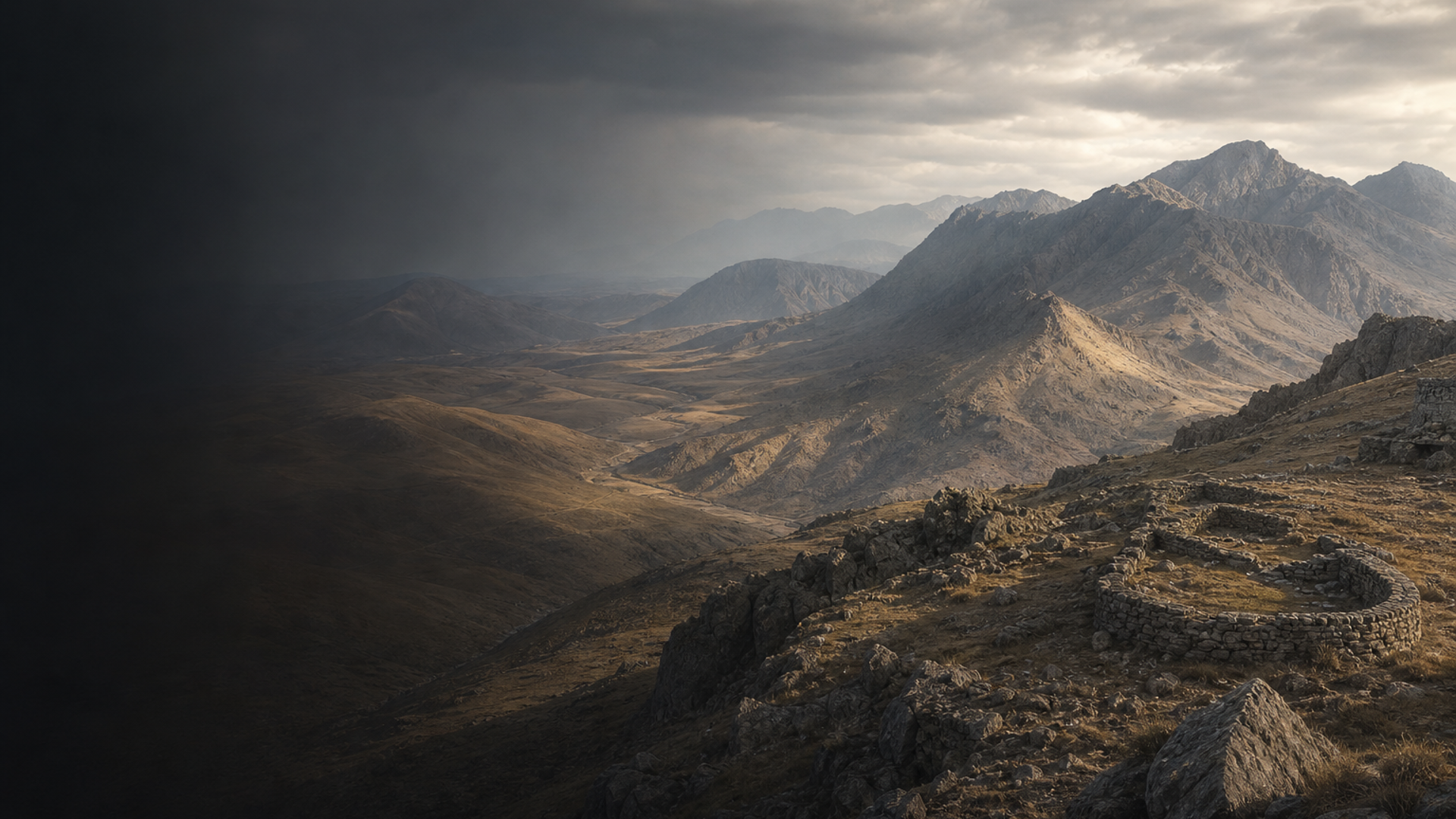
The transition into the Early Iron Age in the Armenian Highlands (beginning ca. 1150 BCE) unfolds across volcanic plateaus and lake-strewn valleys. Archaeological horizons at sites such as Bover Cemetery and the Pijut Archaeological Complex show a landscape of reconfigured settlements, specialized craft production, and new funerary expressions. Stone-built tombs, pottery styles shifting toward iron tools, and changes in mortuary ritual suggest social reorganization rather than abrupt population replacement.

Material culture indicates continuing connections with earlier Bronze Age traditions while also absorbing influences from neighboring highland and lowland polities. Excavations at Bragdzor cemetery and the lakeside necropolis at Noratus provide stratified sequences where ceramics, weapon types, and burial architecture can be followed through the 9th–6th centuries BCE. Archaeological data indicates both local continuity and episodes of wider interaction, consistent with a region acting as a crossroads between the steppe, Anatolia, and Mesopotamia.

Genetically, the 14 sampled individuals (1150–420 BCE) are enough to suggest patterns but are still modest for population-wide claims. Limited evidence suggests maternal lineages include several West Eurasian mtDNA types (T2b, K, H, U3c, U7a), pointing to deep regional roots and connections across West Asia. Overall, the Early Iron Age in Armenia appears as a palimpsest of inherited traditions and incoming influences—an emergence written in stone, bone, and genes.

  • Transition marks 1150 BCE onset of Early Iron Age in Armenian Highlands
  • Key sites: Bover, Pijut, Bragdzor, Noratus, Sarukhan
  • Evidence points to cultural continuity plus regional contacts
Chapter IV

Daily Life & Society

Daily life in Early Iron Age Armenia was anchored in mixed agrarian economies, pastoral mobility, and artisanal production. At sites like Sarukhan and Bragdzor, archaeologists recover hearths, spindle whorls, iron blades and bronze ornaments that evoke the tactile rhythms of household craft — weaving, metalworking, and food preparation. Burial assemblages range from modest inhumations to richly furnished tombs, indicating social differentiation and possibly emerging elite households.

Landscape use combined seasonal transhumance with permanent settlements around fertile river valleys and lakeshores (Noratus region). The visual culture — carved stelae, pottery decoration, and metalwork — suggests identities expressed through craft and ritual. Funerary patterns indicate attention to dress, weaponry, and sometimes feasting, which archaeologists interpret as markers of social rank and community memory.

Archaeobotanical and zooarchaeological traces, where recovered, point to barley and wheat cultivation, sheep and cattle herding, and use of wild resources. Architectural remains are often ephemeral, but stone foundations and cemetery layouts provide glimpses of settlement planning and communal practices. While cinematic images of fortified citadels populate modern imagination, the ground-level evidence often speaks of households negotiating environment and exchange across a dynamic highland world.

  • Economy: mixed farming, herding, craft specialization
  • Burials reveal social differentiation and ritual practices
Chapter V

Genetic Profile

Fourteen individuals dated between 1150 and 420 BCE provide a first window into the maternal and limited paternal genetic landscape of Early Iron Age Armenia. Mitochondrial DNA in this sample shows recurring West Eurasian haplogroups: T2b and K each appear twice, with single occurrences of H, U3c, and U7a. These maternal lineages are broadly distributed across West Asia and the eastern Mediterranean in the Bronze and Iron Ages, supporting archaeological inferences of long-standing regional continuity and connectivity.

Y-chromosome data for this cohort are not consistently reported or do not show a dominant local lineage in the available dataset; consequently, assertions about paternal structure or migration must remain cautious. The modest sample size (n=14) limits demographic resolution: while mtDNA points to ancestry ties within broader West Asian networks, it cannot alone resolve whether population change was driven by gene flow, elite movement, or cultural diffusion.

When integrated with archaeological evidence — shared ceramic motifs, burial rites, and material exchange — the genetic signals suggest a population rooted in the Armenian Highlands but engaged in wide-ranging contacts. Future sampling, especially increased Y-DNA recovery and denser sampling across time and space, will be critical to test hypotheses about migration, kinship, and social stratification in this formative era.

  • mtDNA: T2b (2), K (2), H (1), U3c (1), U7a (1) — suggests West Asian connections
  • Y-DNA: insufficiently characterized here; conclusions remain preliminary
Chapter VI

Legacy & Modern Connections

The Early Iron Age strata of Armenia are part of the deep background to later historic identities in the highlands. Archaeological continuities in settlement patterns, funerary forms, and material crafts can be traced forward into the first millennium BCE, creating cultural threads visible in later Urartian and subsequent Armenian traditions. Genetic continuity suggested by maternal lineages aligns with a landscape where local population persistence and gradual admixture were likely more common than wholesale replacement.

For modern ancestry seekers, the data are evocative but provisional: 14 samples open a doorway, not a map. They hint that many people living in the Armenian Highlands during 1150–420 BCE shared maternal ancestry components that persist in West Asian gene pools today. As ancient DNA sampling expands, those connections will sharpen, allowing more confident narratives about migration, identity, and how the past is woven into present genomes.

  • Archaeological and mtDNA continuity suggest long-term regional roots
  • Current genetic sample is promising but preliminary for modern ancestry claims
AI Powered

AI Assistant

Ask questions about the Armenia, Early Iron Age: Echoes in Stone culture

AI Assistant by DNAGENICS

Unlock this feature
Ask questions about the Armenia, Early Iron Age: Echoes in Stone culture. Our AI assistant can explain genetic findings, historical context, archaeological evidence, and modern connections.
Sample AI Analysis

The Armenia, Early Iron Age: Echoes in Stone culture represents a fascinating chapter in human history...

Genetic analysis reveals connections to earlier populations while showing evidence of unique adaptations and cultural innovations. The ancient DNA samples provide insights into migration patterns, social structures, and the biological relationships between ancient populations.

This is a preview of the AI analysis. Unlock the full AI Assistant to explore detailed insights about:

  • Genetic composition and ancestry
  • Migration patterns and origins
  • Daily life and cultural practices
  • Modern genetic legacy
Use code for 35% off Expires May 21