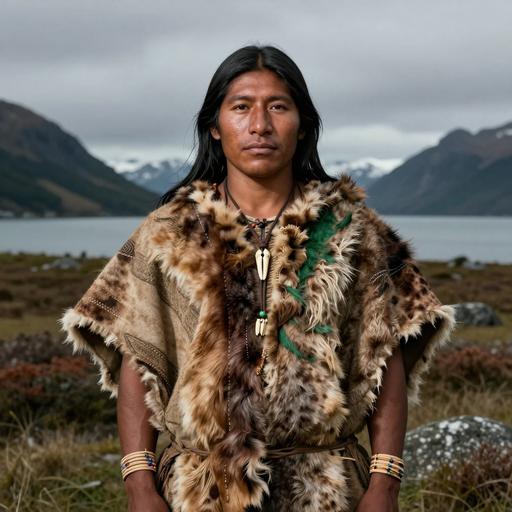
The human presence along the Beagle Channel is a story of navigation and survival at the southern edge of the Americas. Archaeological remains at coastal localities such as Río Pipo in Tierra del Fuego attest to recurrent occupation by highly mobile, marine-adapted peoples. Radiocarbon-calibrated contexts that bracket the genetic sample place this individual between roughly 260 and 600 CE — about 1,500 years before present — fitting into what archaeologists refer to as the Beagle Channel Yamana cultural horizon. Shell middens, bone and lithic toolkits, and ephemeral hearths across the archipelago indicate repeated seasonal fishing, seabird and pinniped exploitation, and a toolkit optimized for cutting, scraping and hunting from small craft.
Climatic variability and the rich kelp and intertidal ecosystems likely shaped patterns of settlement, encouraging dispersed band-level groups with intimate ecological knowledge. Archaeological data indicates long-term coastal continuity in the region, but the precise emergence of Late Holocene adaptations in the Beagle Channel remains incompletely resolved. Importantly, the genetic evidence currently rests on a single ancient genome; limited sample size constrains robust reconstruction of population origins, demographic shifts, or migratory episodes. Thus, narratives of emergence blend evocative coastal life with cautious, provisional inference until more samples and well-dated contexts are available.