Menu
Store
Blog
Shirak Province, Armenia

Beniamin, Shirak — Early Iron Age Echo

A single Early Iron Age genome from Beniamin opens a cautious window onto Iron Age Armenia

1213 CE - 1055 BCE
Scroll to begin
Chapter I

The Story

Understanding the Beniamin, Shirak — Early Iron Age Echo culture

Archaeological and ancient DNA evidence from a single burial at Beniamin (Shirak Province, Armenia; 1213–1055 BCE) offers preliminary insights into local Early Iron Age lifeways and continuity with earlier Bronze Age populations. Limited sample count makes conclusions tentative.

Time Period

1213–1055 BCE

Region

Shirak Province, Armenia

Common Y-DNA

Unknown (single sample)

Common mtDNA

Unknown (single sample)

Chapter II

Timeline

Key moments in the history of this culture

1213 BCE

Burial at Beniamin dated

A single human burial in Beniamin, Shirak Province, is radiocarbon-dated to 1213–1055 BCE, providing the Armenia_Beniamin_EIA ancient DNA sample.

Chapter III

Origins & Emergence

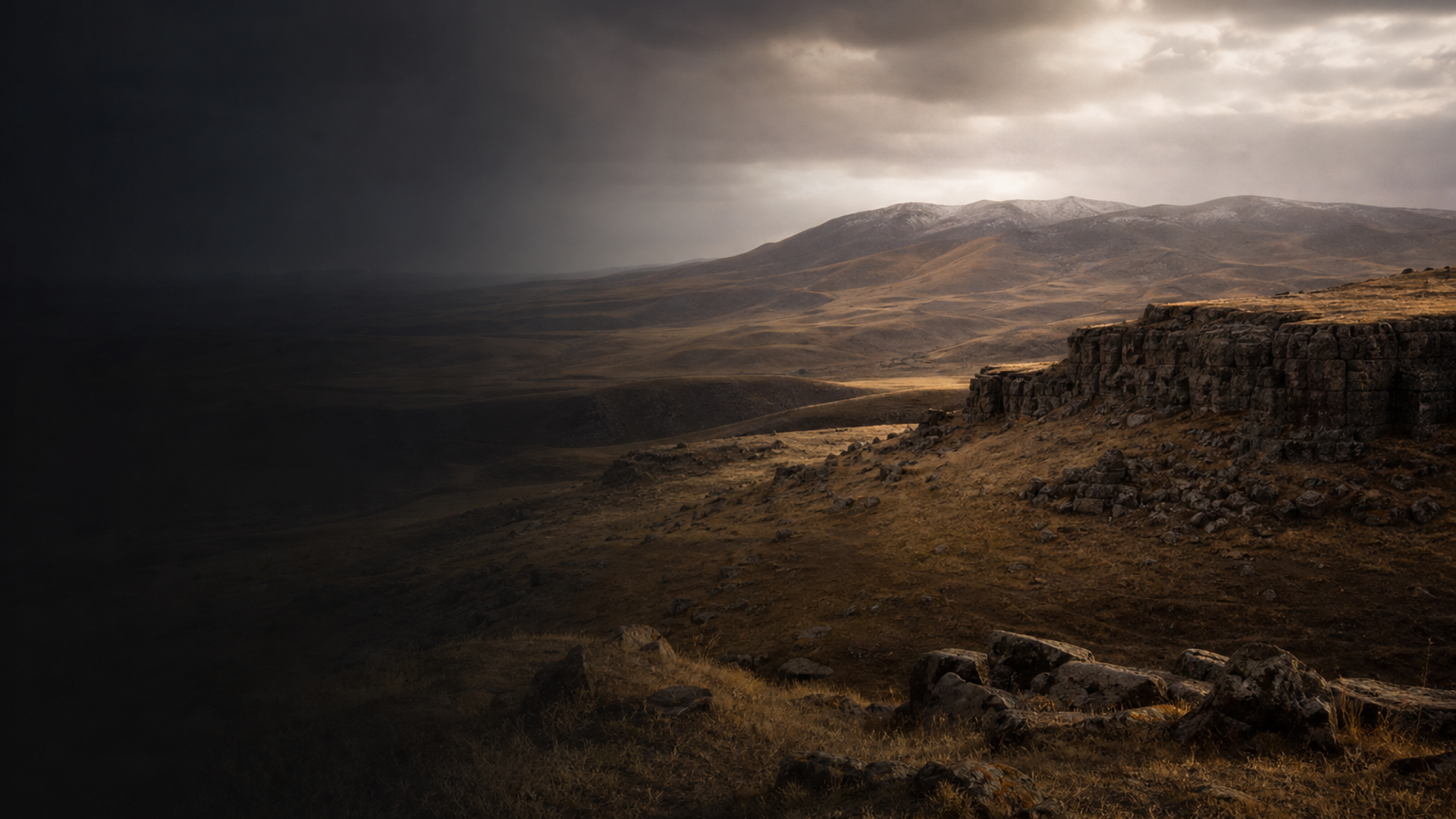
Beniamin sits on a high plateau of the Shirak Basin where hills catch the late light like hammered bronze. Archaeological data indicates human presence in this area from the Late Bronze Age into the Early Iron Age, and the dated burial associated with the Armenia_Beniamin_EIA genetic sample (1213–1055 BCE) anchors a local expression of Early Iron Age culture in a precise chronological window.

From the archaeological record across the Armenian Highlands, the Early Iron Age marks a period of shifting settlement patterns, intensifying hilltop occupation, and new craft techniques such as ironworking and refined ceramics. Limited evidence from Beniamin itself—one securely dated burial—means we must be cautious: this single individual may reflect a local continuity from nearby Late Bronze Age communities or participation in broader regional demographic processes, such as mobility along trade and pastoral routes.

Cinematic imagery—smoke curling above hearths, iron tools dimly smiting—helps convey the lived world, but the scientific story remains statistical and provisional. Archaeological parallels in Shirak Province and neighboring valleys hint at cultural connections with contemporaneous communities to the south and east, yet the genomic data from this site are too sparse to resolve migration versus cultural transmission. Ongoing excavation and additional ancient DNA sampling are required to clarify whether Beniamin represents an enduring local population or a more complex tapestry of incoming and resident groups.

  • Dated burial: 1213–1055 BCE in Beniamin, Shirak Province
  • Occupational continuity suggested between Late Bronze and Early Iron Age
  • Conclusions are preliminary given a single sampled individual
Chapter IV

Daily Life & Society

Archaeological evidence from the wider Shirak region paints a picture of agrarian households, seasonal herding, and small-scale craft specialization during the Early Iron Age. At sites contemporary with Beniamin, excavations reveal modest domestic compounds, storage pits, and ceramics reflecting both local traditions and wider stylistic influences.

Inhabitants likely balanced dryland farming—barley, wheat—and sheep-goat pastoralism with opportunistic trade across valleys. Metalworking traces in nearby settlements indicate practical iron tools and small personal ornaments rather than monumental metallurgy, suggesting household-level craft rather than state-sponsored industry. Funerary contexts, including the burial at Beniamin, are often modest; grave goods are sparse or utilitarian, pointing to a society where social distinctions existed but were not always expressed in elaborate tombs.

Material culture and landscape use imply resilient communities adapting to climatic and political shifts at the end of the Bronze Age. Archaeobotanical and zooarchaeological datasets from comparable sites show diets relying on cereals and pastoral products, while lithic and ceramic styles retain local continuity with incremental innovations. For Beniamin itself, the single burial offers a human face—age, sex, health indicators from osteology, and isotopic signatures when available can reveal diet and mobility, but such inferences are conditional on expanding the sample.

  • Mixed farming and pastoralism dominated subsistence
  • Crafts and iron use appear at household level rather than large-scale industry
Chapter V

Genetic Profile

The genetic dataset labeled Armenia_Beniamin_EIA comprises a single individual dated to 1213–1055 BCE from Beniamin, Shirak Province. Ancient DNA from a solitary sample is a valuable but fragile piece of evidence: it provides a direct genetic snapshot of one life but cannot by itself capture population-level diversity. Analytical results therefore must be framed as provisional and hypothesis-generating rather than definitive.


Preliminary genomic analysis can address questions of continuity and affinity. Archaeogenetic comparisons with earlier Bronze Age individuals from the Armenian Highlands and neighboring regions can reveal whether the Beniamin individual clusters with local Bronze Age ancestry (suggesting continuity) or shows increased admixture from steppe or Near Eastern ancestries (suggesting recent contact or movement). At present, no robust pattern of common Y-DNA or mtDNA haplogroups can be stated for Beniamin because the published dataset contains only one sample; identified haplogroups, if reported, should be treated cautiously.

Genetic data can be integrated with isotopic and archaeological evidence to infer mobility, marriage networks, and ancestry sources. If future sampling in Shirak increases, population-level statistics (f-statistics, PCA, and admixture models) would enable stronger inferences about demographic events at the Bronze–Iron transition in Transcaucasia. For now, the Beniamin genome is a cinematic yet solitary voice—intimate and important, but not yet representative.

  • Single ancient genome provides a preliminary individual-level snapshot
  • Cannot yet resolve population-level ancestry or common haplogroups
Chapter VI

Legacy & Modern Connections

The human story of Beniamin contributes a measured verse to the larger epic of the Armenian Highlands. Archaeological continuity suggested by material culture and the cautious genetic signal from the single Early Iron Age sample point toward deep-rooted connections between Bronze Age inhabitants and later Iron Age communities in the region.

Modern populations in Armenia and the South Caucasus carry a mosaic of ancestries shaped by millennia of local continuity and episodic migrations. While the Beniamin sample alone cannot be used to draw direct lines to present-day genetic patterns, it supports a research trajectory that combines archaeology and ancient DNA to trace how cultural traditions and biological ancestry intertwined across generations. Continued sampling across Shirak and adjacent provinces will refine links between these early Iron Age inhabitants and the peoples who followed, allowing a richer, evidence-based narrative of continuity and change.

  • Adds an early data point toward understanding continuity in the Armenian Highlands
  • Future sampling is required to map connections to modern populations
AI Powered

AI Assistant

Ask questions about the Beniamin, Shirak — Early Iron Age Echo culture

AI Assistant by DNAGENICS

Unlock this feature
Ask questions about the Beniamin, Shirak — Early Iron Age Echo culture. Our AI assistant can explain genetic findings, historical context, archaeological evidence, and modern connections.
Sample AI Analysis

The Beniamin, Shirak — Early Iron Age Echo culture represents a fascinating chapter in human history...

Genetic analysis reveals connections to earlier populations while showing evidence of unique adaptations and cultural innovations. The ancient DNA samples provide insights into migration patterns, social structures, and the biological relationships between ancient populations.

This is a preview of the AI analysis. Unlock the full AI Assistant to explore detailed insights about:

  • Genetic composition and ancestry
  • Migration patterns and origins
  • Daily life and cultural practices
  • Modern genetic legacy
Use code for 35% off Expires May 21