Menu
Store
Blog
Sicily, Italy (Grotta dell'Uzzo)

Castelnovian Sicily — Grotta dell'Uzzo

Late Mesolithic hunter‑gatherers of Sicily (6773–6245 BCE) through archaeology and DNA

6773 CE - 6245 BCE
Scroll to begin
Chapter I

The Story

Understanding the Castelnovian Sicily — Grotta dell'Uzzo culture

Archaeological and genetic evidence from Grotta dell'Uzzo (Sicily) illuminates the Late Mesolithic Castelnovian horizon (6773–6245 BCE). Seven individuals show mitochondrial U lineages and Y haplogroup I in two males, consistent with wider European Mesolithic hunter‑gatherer ancestry. Conclusions remain preliminary.

Time Period

6773–6245 BCE (Late Mesolithic)

Region

Sicily, Italy (Grotta dell'Uzzo)

Common Y-DNA

I (2 of 7)

Common mtDNA

U (7 of 7)

Chapter II

Timeline

Key moments in the history of this culture

6773 BCE

Earliest dated Castelnovian‑associated remains at Uzzo

Direct dates place Castelnovian-associated human remains at Grotta dell'Uzzo around 6773 BCE, anchoring Late Mesolithic occupation on Sicily.

Chapter III

Origins & Emergence

The Castelnovian in Sicily is a Late Mesolithic cultural horizon visible in coastal caves and rock shelters, with Grotta dell'Uzzo (northwest Sicily) among the most important stratified sequences. Radiocarbon determinations associated with Castelnovian material at Grotta dell'Uzzo fall within the window 6773–6245 BCE, anchoring the industry to the first half of the 7th millennium BCE on the island. Archaeological data indicates a technological emphasis on geometric microliths and composite tools adapted for a maritime-rich environment; the Castelnovian toolkit appears as a flexible response to Mediterranean coasts and riverine valleys. Stratigraphy at Uzzo preserves transitions that hint at shifting subsistence and contact networks as the Neolithic horizon approaches.

The cinematic image is of small bands moving along rocky shores and estuaries, carving stone and bone into precise hunting implements. Limited evidence suggests these groups practiced seasonal rounds, exploiting shellfish, fish, and terrestrial game. Material connections with other Italian and central Mediterranean Mesolithic assemblages suggest regional interaction rather than complete isolation. However, given the modest number of well-sampled individuals and complex taphonomy at coastal sites, models of emergence and spread remain open to revision. Archaeology provides the stage; ancient DNA offers lines of dialogue to test hypotheses of continuity, mobility, and contact.

  • Grotta dell'Uzzo: key stratified site in NW Sicily
  • Dates: 6773–6245 BCE tie the samples to the Late Mesolithic Castelnovian
  • Material culture: microlithic and coastal-adapted toolkits
Chapter IV

Daily Life & Society

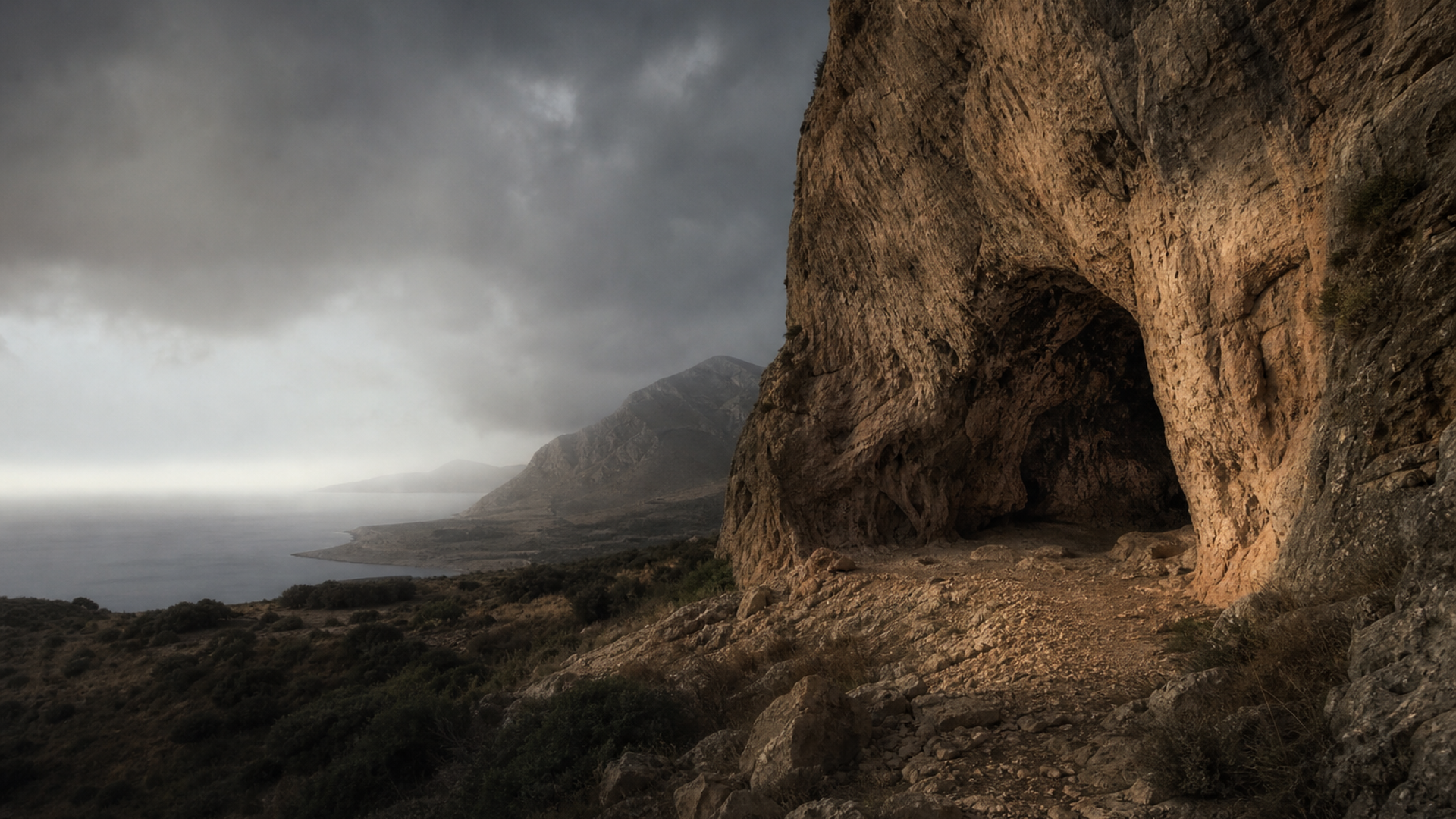
Archaeological traces from the Castelnovian world at Grotta dell'Uzzo paint a life shaped by the sea and the light of limestone cliffs. Shell middens, fish remains, and specialized tools indicate a diet that blended marine resources with hunted mammals and gathered plants. Hearth features and clustered refuse point to repeatedly used base locations where families or extended kin groups prepared food, repaired gear, and shared labor.

Socially, Late Mesolithic groups in Sicily likely organized in small, mobile bands with extensive seasonal mobility along coastlines and river valleys. Ornamentation and curated tool types suggest social signaling and long-distance exchange: raw materials or stylistic traits linking Uzzo to other Mediterranean foraging communities. Burial practices at coastal caves sometimes record personal items and deliberate placement, implying social identities and memory. Still, the archaeological record remains fragmentary: preservation biases in caves and the challenges of coastal taphonomy mean many aspects of daily life are reconstructed from scattered, often ephemeral remains.

For visitors imagining the scene: groups waking at dawn to mend nets, the metallic glint of small flint points being retouched, smoke drifting from low hearths while children learn to read tides. These practices created the material residues that archaeologists and geneticists now read as traces of lifeways and passage.

  • Mixed marine and terrestrial economy evidenced by faunal and shell remains
  • Small, mobile social groups with material links across the central Mediterranean
Chapter V

Genetic Profile

Seven individuals dated to 6773–6245 BCE from Grotta dell'Uzzo provide a rare genetic window into Castelnovian Sicily, but the small sample size means interpretations must be cautious. Mitochondrial DNA in all seven individuals is from haplogroup U — a lineage widely reported among European Mesolithic hunter‑gatherers — suggesting maternal continuity with broader hunter‑gatherer populations of the continent. Two male individuals carry Y‑chromosome haplogroup I, a haplogroup commonly observed in Mesolithic European males. These uniparental markers together form a genetic signature consistent with hunter‑gatherer ancestry present across much of prehistoric Europe.

Beyond uniparental markers, limited autosomal data (given the modest sample count) tentatively aligns these individuals with established Mesolithic genomic profiles rather than with early Neolithic farming groups. This pattern is compatible with a scenario in which Late Mesolithic Sicilian populations retained substantial local hunter‑gatherer ancestry at the moment samples were dated. However, the island setting makes it plausible that later interactions with incoming Neolithic farmers produced admixture and demographic shifts — processes attested elsewhere in the Mediterranean. Because fewer than ten genomes are available from this horizon at Uzzo, conclusions about population structure, sex-biased mobility, and regional continuity are preliminary and should be tested with additional samples and direct comparisons to contemporaneous sites.

  • All seven individuals carry mtDNA haplogroup U, common in European Mesolithic groups
  • Y haplogroup I observed in two males, aligning with known Mesolithic male lineages
Chapter VI

Legacy & Modern Connections

The Castelnovian inhabitants of Grotta dell'Uzzo contributed to the deep human story of Sicily: a story of island lifeways, coastal economies, and networks that predate large‑scale farming. Genetic echoes of Mesolithic lineages — especially mitochondrial U and Y haplogroup I — are part of the ancestral mosaic that later populations inherited. Archaeological continuity in tool types and coastal occupations suggests cultural threads that regional Neolithic arrivals encountered rather than instantly erased.

For modern genetic landscapes, the signal of Mesolithic ancestry in Sicily is detectable but reworked by subsequent demographic events: Neolithic migration, Bronze Age movements, and historic population turnovers. Thus, while ancient DNA from Uzzo offers a clear snapshot of Late Mesolithic genomes, any direct line from these individuals to modern Sicilians is complex and mediated by millennia of admixture. Continued sampling and integrated archaeological research will refine how strongly Castelnovian genomes contributed to later populations.

  • Mesolithic genetic signatures form part of Sicily's deep ancestral substrate
  • Later farming and historic migrations likely reshaped the genetic landscape
AI Powered

AI Assistant

Ask questions about the Castelnovian Sicily — Grotta dell'Uzzo culture

AI Assistant by DNAGENICS

Unlock this feature
Ask questions about the Castelnovian Sicily — Grotta dell'Uzzo culture. Our AI assistant can explain genetic findings, historical context, archaeological evidence, and modern connections.
Sample AI Analysis

The Castelnovian Sicily — Grotta dell'Uzzo culture represents a fascinating chapter in human history...

Genetic analysis reveals connections to earlier populations while showing evidence of unique adaptations and cultural innovations. The ancient DNA samples provide insights into migration patterns, social structures, and the biological relationships between ancient populations.

This is a preview of the AI analysis. Unlock the full AI Assistant to explore detailed insights about:

  • Genetic composition and ancestry
  • Migration patterns and origins
  • Daily life and cultural practices
  • Modern genetic legacy