Menu
Store
Blog
Austria_KremsWA3 Belgium, France, Italy, Austria, Czechia, Romania

Echoes of the European Paleolithic

Gravettian-era hunter-gatherers across ice-age Europe revealed by archaeology and DNA

39956 CE - 9400 BCE
1 Ancient Samples
Scroll to begin
Chapter I

The Story

Understanding the Echoes of the European Paleolithic culture

Archaeological remains (38 samples, 39956–9400 BCE) from Gravettian and Late Upper Paleolithic sites across Belgium, France, Italy, Austria, Czechia and Romania illuminate lifeways and genetic ancestries. Genetic data highlight Y-haplogroups I, C, R and maternal U lineages amid regional diversity and temporal change.

Time Period

c. 39956–9400 BCE

Region

Belgium, France, Italy, Austria, Czechia, Romania

Common Y-DNA

I (12), C (4), R (4), C1a (1), K (1)

Common mtDNA

U (8), U2 (6), U5* (6), U6* (4), U5 (4)

Chapter II

Timeline

Key moments in the history of this culture

30000 BCE

Gravettian florescence

Widespread Gravettian technocomplex and burial traditions flourish across central and western Europe; many archaeological contexts represented in the genetic sample date to this interval.

Chapter III

Origins & Emergence

The European_Paleolithic cluster emerges against the long, cold canvas of the Upper Paleolithic. Material culture and radiocarbon dates place these individuals within the Gravettian and later Late Upper Paleolithic horizons, with direct or associated finds from Troisieme caverne of Goyet (Belgium), Dolní Věstonice and Pavlov region (Czech Republic), Krems-Wachtberg (Austria), Aven des Iboussières (Rhône-Alpes, France) and multiple Romanian caves including Peștera cu Oase and Peștera Muierii. Archaeological data indicates complex hunter-gatherer lifeways tied to reindeer, horse and large-mammal economies in colder phases and more varied resources during amelioration. Gravettian technocomplexes—characterized by backed blades, personal ornaments, and burial practices—provide the cultural framework, but preservation biases and uneven sampling mean our geographic picture is patchy.

Genetically, the 38 samples span roughly 30,000 years of demographic change. Limited evidence suggests some continuity of maternal U lineages across time, while Y-lineages show regional differences. Where sample density is highest—Dolní Věstonice and Goyet—archaeology and ancient DNA can be directly overlapped, illuminating how cultural packages travelled alongside people or ideas. Nonetheless, caution is warranted: temporal gaps and the uneven number of specimens per site constrain broad generalizations about population-level origins.

  • Dates span c. 39956–9400 BCE, Gravettian and Late UP contexts
  • Key sites: Goyet, Dolní Věstonice, Pavlov, Krems-Wachtberg, Peștera cu Oase
  • Archaeological signal is regionally patchy; sampling bias limits inference
Chapter IV

Daily Life & Society

Stone tools, faunal remains and burial deposits paint a cinematic portrait of seasonal mobility, skilled craft and social expression. Gravettian camps yielded finely worked bladelets and backed points used for composite hunting weapons; sites such as Pavlov and Dolní Věstonice preserve hearth features, kilns for bone and ivory working, and dense artifact scatters consistent with repeated occupation. In caves like Goyet and Peștera Muierii, human remains occur alongside ornaments—perforated shells, mollusk beads, and decorated bone—suggesting personal identity and long-distance exchange networks.

Settlement patterns likely combined seasonal aggregation for large-game hunts with smaller family units exploiting local resources. Evidence for deliberate burial—grave goods, flexed interments—indicates social differentiation and ritual behavior, though practices vary markedly by region and period. Taphonomic processes, excavation histories and differential preservation mean our reconstructions are inferential; archaeological data indicate broad patterns rather than uniform lifeways across all sites included in the sample set.

  • Seasonal mobility with specialized hunting technology and craft production
  • Ornaments and burials suggest complex social identities and exchange
Chapter V

Genetic Profile

The 38 sequenced individuals yield a coherent, if nuanced, genetic picture of late Pleistocene Europe. Y-chromosome diversity is dominated by haplogroup I (12 individuals), alongside C (4), R (4), single counts of C1a and K. Maternal lineages are heavily weighted toward haplogroup U and its subclades (U, U2, U5*, U5, U6*), consistent with other Upper Paleolithic datasets. Archaeogenetic analyses indicate that U-related maternal ancestry was widespread and persistent, whereas Y-lineage composition shows regional structure and shifts through time.

These patterns align with archaeological regions: Gravettian-associated sites (Dolní Věstonice, Pavlov) and Goyet-cluster individuals display overlapping genetic signatures, suggesting local continuity punctuated by migrations or gene flow. However, several haplogroups are represented by only a few samples (C1a: 1, K: 1). When counts per lineage are low, conclusions must remain tentative. Genetic affinities also point toward later admixture events: some Late Upper Paleolithic individuals display genetic components that foreshadow the Villabruna-associated western hunter-gatherer ancestry documented in the subsequent millennia. Overall, the dataset links material culture with population dynamics but underscores the need for more samples to resolve fine-scale demographic processes.

  • Dominant paternal I lineages and widespread maternal U subclades
  • Some rare haplogroups (C1a, K) require cautious interpretation due to low counts
Chapter VI

Legacy & Modern Connections

The genetic and archaeological legacies of these Paleolithic communities persist as threads in the tapestry of later European ancestry. Maternal U lineages found in these samples are ancestral to many later hunter-gatherer groups and contribute to the deep maternal heritage of present-day Europeans, albeit diluted by subsequent migrations (Neolithic farmers, Bronze Age movements). Y-haplogroup I, prominent here, continues to appear in modern European populations, signaling paternal continuity in some regions.

Yet caution is essential: the 38-sample dataset covers vast geography and time, so drawing direct lines to modern populations oversimplifies a long history of population turnover and admixture. Archaeological contexts and ancient DNA together show that cultural change often accompanied but did not always mirror genetic change—people moved, integrated, and reinvented practices. Future sequencing and targeted sampling of underrepresented sites will sharpen the connections between these dramatic ice-age lives and the genetic landscape of Europe today.

  • Maternal U and paternal I lineages contribute to deep European ancestry
  • Long-term admixture and migrations mean modern connections are complex
Chapter VII

Sample Catalog

1 ancient DNA samples associated with the Echoes of the European Paleolithic culture

Ancient DNA samples from this era, providing genetic insights into the people who lived during this period.

1 / 1 samples
Portrait Sample Country Era Date Culture Sex Y-DNA mtDNA
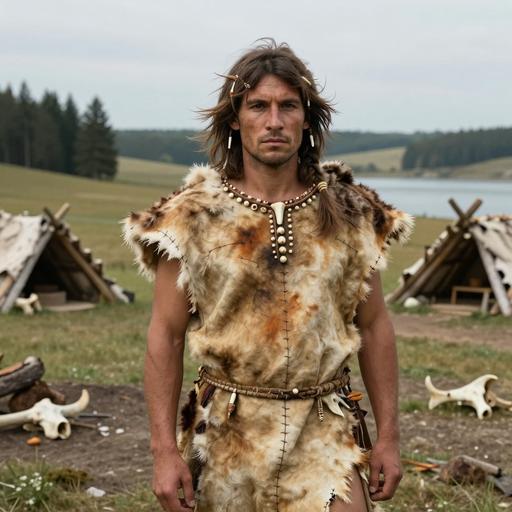
Portrait of ancient individual I1577 from Austria, dated 29500 BCE
I1577
Austria Austria_KremsWA3 29500 BCE European Paleolithic M I-L758 U5*
AI Powered

AI Assistant

Ask questions about the Echoes of the European Paleolithic culture

AI Assistant by DNAGENICS

Unlock this feature
Ask questions about the Echoes of the European Paleolithic culture. Our AI assistant can explain genetic findings, historical context, archaeological evidence, and modern connections.
Sample AI Analysis

The Echoes of the European Paleolithic culture represents a fascinating chapter in human history...

Genetic analysis reveals connections to earlier populations while showing evidence of unique adaptations and cultural innovations. The ancient DNA samples provide insights into migration patterns, social structures, and the biological relationships between ancient populations.

This is a preview of the AI analysis. Unlock the full AI Assistant to explore detailed insights about:

  • Genetic composition and ancestry
  • Migration patterns and origins
  • Daily life and cultural practices
  • Modern genetic legacy
Use code for 35% off Expires May 20