Menu
Store
Blog
Eleuthera Island, Bahamas

Eleuthera Ceramic Islanders

Ceramic-period communities of Eleuthera (500–1500 CE), seen through archaeology and DNA

500 CE - 1500 CE
Scroll to begin
Chapter I

The Story

Understanding the Eleuthera Ceramic Islanders culture

Archaeological and ancient-DNA evidence from Eleuthera Island (Preacher's Cave, Garden Cave, Blue Hole) reveals Ceramic-period Bahamian lifeways (500–1500 CE). Genetic signals (Y haplogroup Q; mtDNA B2, C variants) align with broader Indigenous Caribbean ancestries, though samples remain limited.

Time Period

500–1500 CE

Region

Eleuthera Island, Bahamas

Common Y-DNA

Q (observed n=3)

Common mtDNA

B2, C, C1b, C1d

Chapter II

Timeline

Key moments in the history of this culture

500 CE

Ceramic-style communities appear

Archaeological deposits on Eleuthera indicate settlement and ceramic use beginning around 500 CE, marking island participation in the Caribbean Ceramic Period.

1000 CE

Sustained island settlement

Caves and coastal sites show repeated occupation, shell midden accumulation, and local ceramic traditions by the middle of the first millennium CE.

1492 CE

Onset of historic contact era

European arrival heralds large-scale social and biological changes across the Bahamas; genetic continuity and change after this point vary regionally.

Chapter III

Origins & Emergence

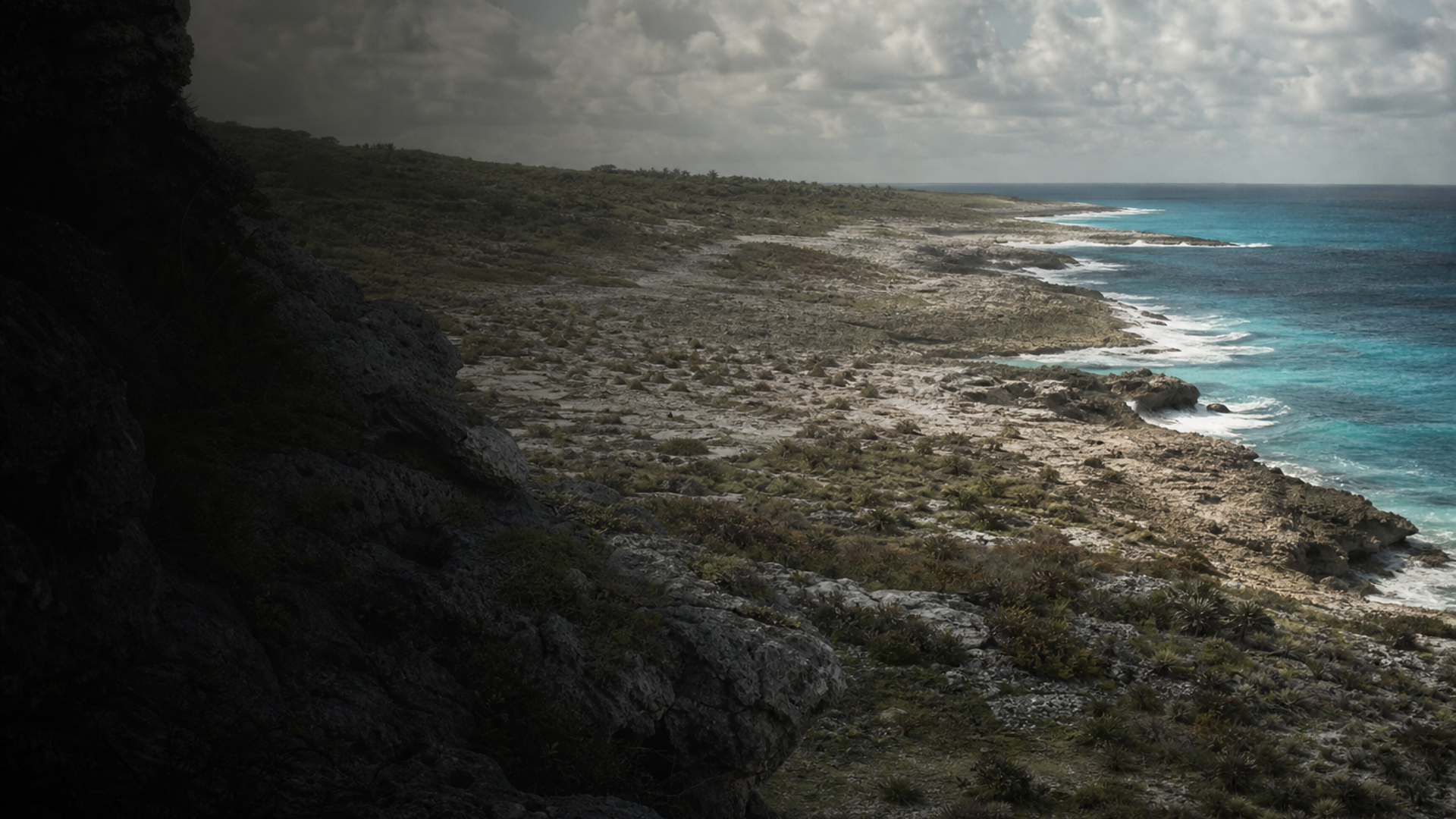
Under a rim of turquoise sky and salt, the Ceramic peoples of Eleuthera emerged as part of a wider Caribbean movement of pottery-bearing communities between roughly 500 and 1500 CE. Archaeological data indicates the appearance of decorated ceramics, coastal camp sites, and shell-rich middens at cave and sinkhole locales such as Preacher's Cave, Garden Cave, and the Blue Hole on North Eleuthera. Radiocarbon dates from associated stratified deposits place human activity in this island zone squarely within the regional Ceramic Period, when migrants and local groups across the Greater Antilles and Lucayan Archipelago developed new ceramic technologies, boat use, and intensified shoreline economies.

Material culture on Eleuthera shows affinities with broader Antillean ceramic styles, but island-specific variants suggest localized traditions and adaptations to Eleuthera's thin soils and karst landscape. Archaeological evidence indicates seasonal movement between sheltered caves and coastal foraging zones; caves often served as habitation, storage, or ritual space. The archaeological record on Eleuthera is patchy: taphonomic processes, sea-level change, and later disturbances have erased many contexts. As a result, interpretations of the exact origins, routes, and timing of arrival remain partly provisional and depend on both excavated artifacts and the growing—but still small—ancient DNA sample.

  • Ceramic Period presence dated ca. 500–1500 CE
  • Primary sites: Preacher's Cave, Garden Cave, Blue Hole (North Eleuthera)
  • Island-specific ceramic styles within broader Antillean networks
Chapter IV

Daily Life & Society

Life on Eleuthera was shaped by sea and cavern: archaeological deposits show intensive coastal foraging—fish, shellfish, and seabirds—supplemented by terrestrial resources where soil permitted cultivation or wild plant use. Ceramic vessels appear in household assemblages and cooking contexts; their forms suggest boiling, storage, and serving functions. Shell middens, where preserved, record long-term use of particular shorelines and provide seasonal signals of resource exploitation. Caves such as Preacher's Cave and Garden Cave offered stable microclimates for occupation, burial, and possibly ritual practice, evidenced by structured deposits and human remains in some contexts.

Social structure can be glimpsed through burial variability, the distribution of grave goods, and spatial organization of sites, though many interpretations remain tentative. Mobility was likely high: dugout canoes and open-water navigation connected Eleuthera communities to the Bahamian islands and the Greater Antilles. Trade and exchange networks are implied by non-local pottery styles and exotic shell ornaments. Because preservation is uneven and excavated sample sizes are limited, reconstructions of social hierarchy, gender roles, and political organization are best treated as provisional frameworks refined by ongoing fieldwork and genetic study.

  • Coastal foraging with marine-focused subsistence and seasonal patterns
  • Caves used for habitation, deposition, and possibly ritual/burial
Chapter V

Genetic Profile

Ancient DNA from 14 individuals recovered on Eleuthera (sites: Preacher's Cave, Garden Cave, Blue Hole) provides a rare island-scale glimpse into Ceramic-period ancestry in the Bahamas. Mitochondrial haplogroups identified include B2 (observed in 4 samples), C (4), C1b (3), and C1d (1) — lineages commonly associated with Indigenous peoples of the Americas and previously documented across the Caribbean. These maternal markers support archaeological interpretations of continuity with broader pre-Contact Indigenous Caribbean populations.

On the paternal side, Y-chromosome haplogroup Q appears in three individuals; haplogroup Q is widely recognized as a principal founding paternal lineage among Native American populations. Not all samples yielded high-resolution Y results, so paternal diversity may be underrepresented. Genomic affinities (autosomal data where available) often align Eleuthera individuals with other Ceramic-period Caribbean populations rather than later Afro-European admixture — consistent with pre-Contact contexts. However, 14 samples remain a modest dataset for population-level inferences: genetic patterns observed here should be treated as preliminary, useful for mapping connections to Greater Antilles source populations and for testing models of migration, but awaiting fuller sampling for fine-scale demographic reconstructions.

  • mtDNA dominated by Native American lineages: B2, C, C1b, C1d
  • Y-DNA includes haplogroup Q (observed n=3); some Y data unresolved
Chapter VI

Legacy & Modern Connections

The people of Ceramic-period Eleuthera left a layered legacy in landscape, material culture, and genetic heritage. Archaeological traces—pottery sherds, shell middens, and cave deposits—persist as fingerprints of daily life and long-distance connections across the Caribbean. Genetic signals from ancient Eleuthera individuals link local histories to broader Indigenous American ancestries; maternal lineages such as B2 and C variants and paternal Q connect these islanders to continental and inter-island networks predating European contact.

For modern Bahamians and descendant communities, these findings are part of an unfolding narrative that complements oral histories and ethnography. Scientific caution is essential: the dataset remains limited to 14 individuals from a few Eleuthera sites, so conclusions about island-wide demography or continuity with living communities must be made carefully and in dialogue with local stakeholders. Continued archaeology and more extensive ancient and modern DNA sampling will refine these connections and illuminate how Eleuthera's Ceramic-period peoples contributed to the genetic and cultural mosaic of the Caribbean.

  • Genetic links tie Eleuthera to broader Indigenous Caribbean ancestries
  • Limited sample size (n=14) means conclusions are provisional; local engagement is key
AI Powered

AI Assistant

Ask questions about the Eleuthera Ceramic Islanders culture

AI Assistant by DNAGENICS

Unlock this feature
Ask questions about the Eleuthera Ceramic Islanders culture. Our AI assistant can explain genetic findings, historical context, archaeological evidence, and modern connections.
Sample AI Analysis

The Eleuthera Ceramic Islanders culture represents a fascinating chapter in human history...

Genetic analysis reveals connections to earlier populations while showing evidence of unique adaptations and cultural innovations. The ancient DNA samples provide insights into migration patterns, social structures, and the biological relationships between ancient populations.

This is a preview of the AI analysis. Unlock the full AI Assistant to explore detailed insights about:

  • Genetic composition and ancestry
  • Migration patterns and origins
  • Daily life and cultural practices
  • Modern genetic legacy
Use code for 35% off Expires May 20