Menu
Store
Blog
Armenia (South Caucasus)

Shadows of the Armenian Late Bronze

Fortified hills, metal fires, and the genomes of a transforming landscape

1439 CE - 805 BCE
Scroll to begin
Chapter I

The Story

Understanding the Shadows of the Armenian Late Bronze culture

Armenia_LBA (1439–805 BCE): 47 individuals from cemeteries across Armenia reveal a landscape of local continuity and regional contact. Archaeology and ancient DNA together suggest persistent maternal lineages and selective male-line inputs amid Late Bronze Age social change.

Time Period

1439–805 BCE

Region

Armenia (South Caucasus)

Common Y-DNA

I (1), R (1), J (1)

Common mtDNA

U (8), T (5), K (4), J (4), N (3)

Chapter II

Timeline

Key moments in the history of this culture

1439 BCE

Earliest sampled burials

Oldest radiocarbon-dated contexts in the Armenia_LBA dataset mark active cemetery use and mounting regional exchange.

1200 BCE

Regional transformations

Shifts in material culture and apparent changes in settlement fortification reflect broader Late Bronze Age reorganization.

805 BCE

Latest Armenia_LBA contexts

Terminal dates in the dataset approach the rise of Urartian power and early Iron Age horizons.

Chapter III

Origins & Emergence

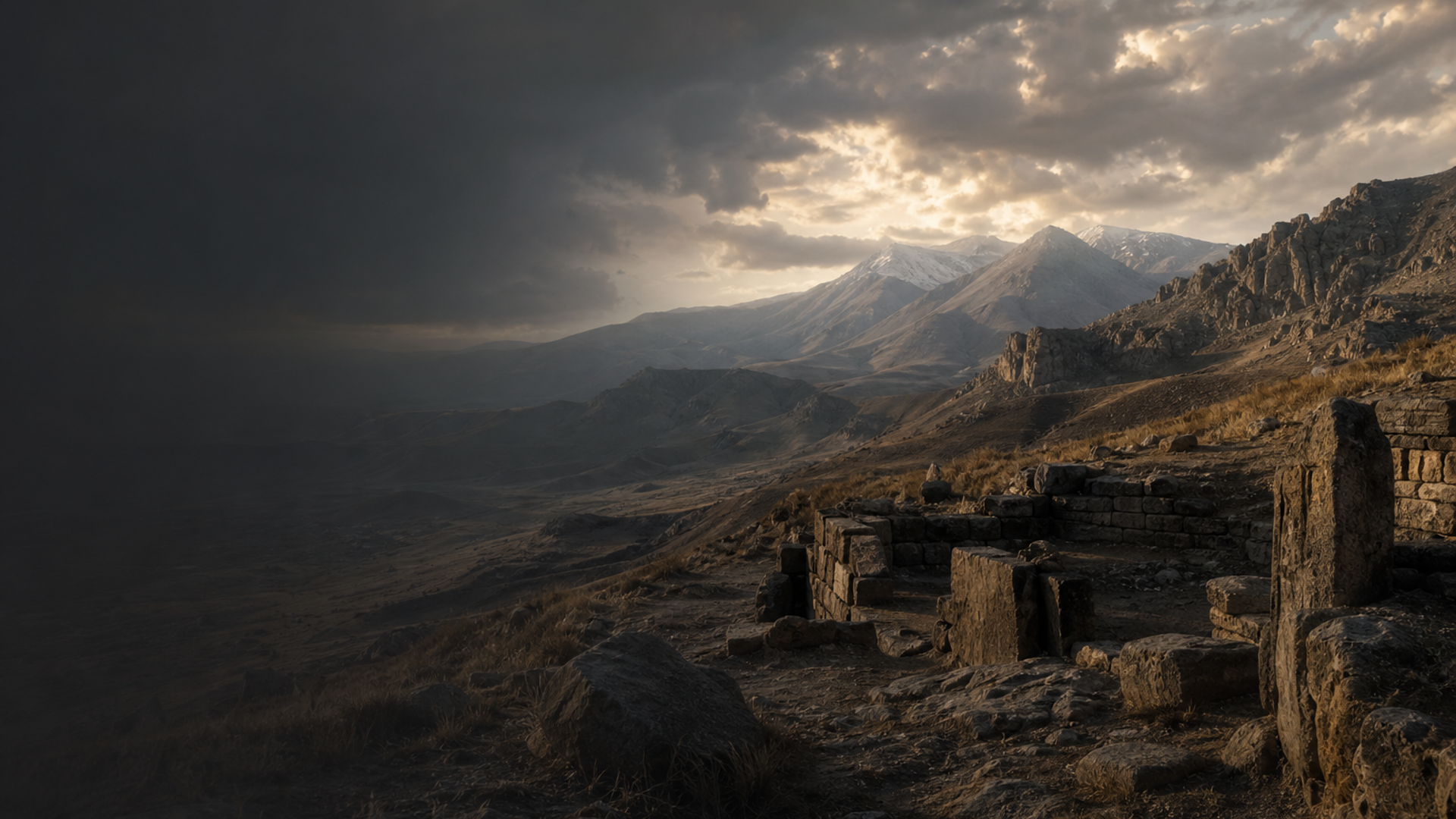
Across the high valleys and rocky promontories of central and eastern Armenia, the Late Bronze Age unfolds as a chiaroscuro of continuity and contact. Archaeological sites sampled for Armenia_LBA—Karashamb Cemetery, Lori Berd cemetery, Nerkin Getashen, Tekhut, Keti, Noratus, Sarukhan, Kapan and the Pidjut/Znganek monument—provide funerary and material traces dated between 1439 and 805 BCE. These contexts record fortified settlements, bronze metallurgy, and grave assemblages that suggest sustained local traditions intertwined with long-distance exchange with Anatolia and the Near East.

Archaeological data indicates household continuity from earlier Bronze Age assemblages alongside new burial rites and imported goods. The genomic dataset of 47 individuals offers a genetic lens on this cultural tapestry: maternal lineages (notably U, T, K, J, N) appear recurrent, hinting at substantial local matrilineal continuity. Male-line markers are few—single counts of I, R and J—suggesting either limited paternal sampling, social patterns that skew Y-chromosome visibility in the burial record, or specific episodes of male-mediated gene flow.

Limited evidence suggests a population shaped by internal resilience and selective incorporation of outsiders. While archaeology presents the physical gestures of identity—fortresses, pottery styles, bronze hoards—ancient DNA reveals the threads of ancestry that wove these gestures into the living communities of Late Bronze Age Armenia.

  • Sampled sites: Karashamb, Lori Berd, Nerkin Getashen, Tekhut, Keti, Noratus, Sarukhan, Kapan, Pidjut/Znganek
  • Date range: 1439–805 BCE; Late Bronze Age contexts
  • Material culture shows local continuity and regional exchange
Chapter IV

Daily Life & Society

Life in Armenia_LBA was carved from stone and bronze. Farmers and herders cultivated terraced plots and grazed flocks on upland pastures; artisans hammered copper and tin into weapons, tools, and ornament. Archaeological contexts—house remains, metalworking debris, and richly furnished graves—evoke workshops lit by furnace glow and marketplaces threaded by exchange networks. Fortified sites such as Lori Berd (and other hilltop enclosures represented in the dataset) testify to concerns about defense and control of routes across the Armenian Highlands.

Cemeteries provide intimate glimpses of social structure. Burials often include personal adornment, pottery, and metal objects whose varying richness suggests differences in status or role. Spatial clustering of graves at some sites may reflect kin groups or lineage-based burial grounds; however, taphonomic processes and excavation sampling can blur patterns. Archaeological evidence indicates craft specialization (bronze-working, lapidary work), seasonal mobility of herds, and participation in wider trade—amber, tin, and exotic ceramics moved along corridors linking the Caucasus, Anatolia, and Mesopotamia.

Limited osteological and isotopic data from these sites point to diets based on cereals, pulses and pastoral products, with mobility patterns that varied by age and sex. When paired with genetic data, these material traces help reconstruct households, kinship practices, and the lived rhythms of Late Bronze Age Armenian communities.

  • Agriculture, pastoralism, and specialized metalworking coexisted
  • Cemeteries show variable grave goods, suggesting social differentiation
Chapter V

Genetic Profile

The Armenia_LBA collection comprises 47 dated individuals (1439–805 BCE) from multiple cemeteries across Armenia. Mitochondrial DNA is relatively diverse: U (8), T (5), K (4), J (4), and N (3) are the most frequent maternal haplogroups recorded. These mtDNA lineages are consistent with a mixture of deep local Caucasus and Near Eastern maternal ancestries—haplogroup U often links to longstanding European and Caucasian threads, while T, K and J are widespread in the Near East and Anatolia.

Y-chromosome resolution in this dataset is limited: single counts of haplogroups I, R, and J were observed. Such low counts caution against strong conclusions about paternal structure—this could reflect preservation and sampling bias, the burial practices that preferentially include or exclude certain males, or genuine low Y-chromosome diversity in these communities. Therefore, claims about male-mediated migration or elite-line introductions must remain tentative.

Archaeogenetic interpretation benefits most from genome-wide data; where available, it can disentangle contributions from steppe-related, Anatolian, and indigenous Caucasus ancestries. For Armenia_LBA, the mtDNA pattern points toward substantial maternal continuity within the region, while the sparse Y-DNA signal suggests episodes of male-line inputs or reproductive asymmetry. Given the sample size (moderate at 47) and uneven locus recovery, these patterns should be treated as a working model that will be refined with additional genomes and complementary isotopic and archaeological analyses.

  • 47 individuals provide moderate-resolution insights into ancestry
  • mtDNA suggests local maternal continuity; Y-DNA counts are limited and provisional
Chapter VI

Legacy & Modern Connections

The final centuries of the Armenia_LBA sequence overlap the rise of early Iron Age polities in the region, including the expanding Urartian world by the early 1st millennium BCE. Archaeological continuities in settlement organization, metalworking techniques, and certain burial practices point to cultural threads that extend into the Iron Age. Genetically, many maternal lineages observed in the Late Bronze Age—haplogroups U, T, J, K, N—remain detectable in later ancient samples and among modern populations of the South Caucasus, suggesting degrees of continuity.

Caution is essential: the Armenia_LBA dataset is moderate in size and geographically clustered around known cemeteries, so it may not capture the full demographic complexity of the period. Nevertheless, when archaeology and ancient DNA are read together they reveal a picture of communities rooted in the highlands yet engaged in long-distance interaction. For museum audiences, this is a story of resilience—stone fortresses, bronze fires, and bloodlines that survived the upheavals of the Late Bronze to Iron Age transition.

  • Continuities into the Iron Age and early Urartian era are visible archaeologically
  • Maternal lineages show partial persistence into later populations, but conclusions remain cautious
AI Powered

AI Assistant

Ask questions about the Shadows of the Armenian Late Bronze culture

AI Assistant by DNAGENICS

Unlock this feature
Ask questions about the Shadows of the Armenian Late Bronze culture. Our AI assistant can explain genetic findings, historical context, archaeological evidence, and modern connections.
Sample AI Analysis

The Shadows of the Armenian Late Bronze culture represents a fascinating chapter in human history...

Genetic analysis reveals connections to earlier populations while showing evidence of unique adaptations and cultural innovations. The ancient DNA samples provide insights into migration patterns, social structures, and the biological relationships between ancient populations.

This is a preview of the AI analysis. Unlock the full AI Assistant to explore detailed insights about:

  • Genetic composition and ancestry
  • Migration patterns and origins
  • Daily life and cultural practices
  • Modern genetic legacy
Use code for 40% off Expires Feb 26