Menu
Store
Blog
Armenia (Areni‑1, Vayots Dzor)

Areni Chalcolithic Horizon

Small, evocative DNA sample set ties Areni cave life to wide Chalcolithic networks

4350 CE - 3500 BCE
Scroll to begin
Chapter I

The Story

Understanding the Areni Chalcolithic Horizon culture

Armenia_C (4350–3500 BCE) derives from five Areni‑1 samples. Archaeology — cave occupation, early winemaking, and copper use — combines with preliminary DNA (Y: L, L1a; mt: H, K, U4a) to suggest local continuity with surprising external threads.

Time Period

4350–3500 BCE

Region

Armenia (Areni‑1, Vayots Dzor)

Common Y-DNA

L (incl. L1a)

Common mtDNA

H, K, U4a

Chapter II

Timeline

Key moments in the history of this culture

4000 BCE

Areni‑1 occupation and early winemaking

Areni‑1 shows intensive cave use, craft production, and early evidence of winemaking around 4100–3900 BCE; human remains from this horizon form the Armenia_C genetic sample.

Chapter III

Origins & Emergence

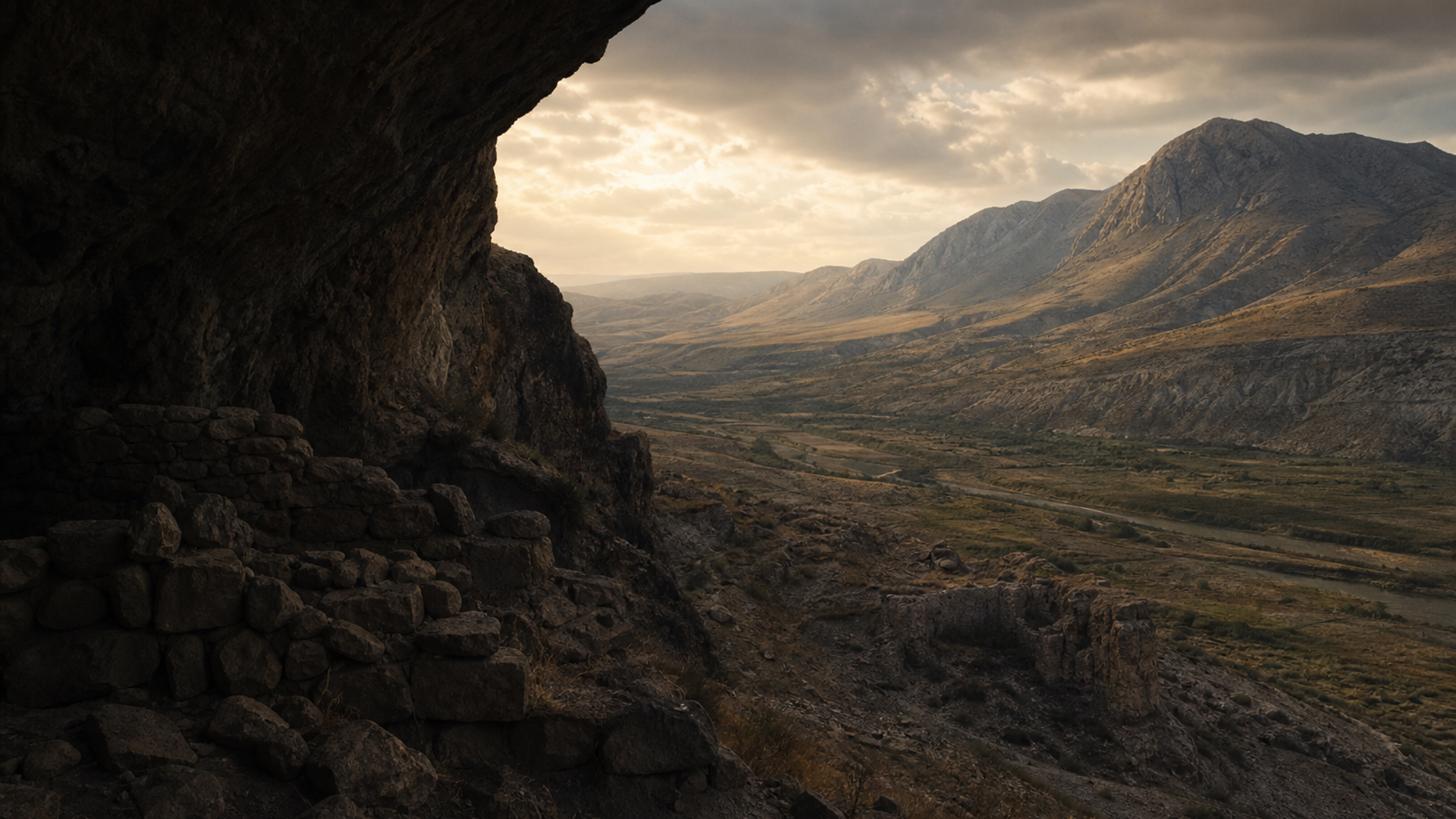
The Armenia_C assemblage comes from the stratified occupation of Areni‑1 cave in Vayots Dzor, Armenia, within a Chalcolithic world of growing craft specialization and long‑distance exchange (dated here to 4350–3500 BCE). Archaeological data indicates repeated human presence in the cave complex: hearths, storage pits, ceramic assemblages, and organic remains. Notably, Areni‑1 has yielded some of the region’s most iconic finds — a well‑preserved leather shoe and evidence for early winemaking — that anchor this horizon in a landscape of domestic innovation and ritual practice.

Genetic data from five samples offers a narrow but tangible glimpse into the people who lived and worked at Areni: a mixture of maternal lineages typical of West Eurasia (H, K) alongside U4a, a lineage with deeper northern affinities, and an unexpected presence of Y‑chromosome haplogroup L (including L1a). Limited evidence suggests these genetic signals may reflect small founder groups, rare incoming males, or contact networks stretching south and east. Archaeological parallels in material culture link Areni to neighboring highland and lowland traditions, but the small sample count means any narrative of population movement must remain provisional. Future excavation and more ancient genomes will be required to move from evocative possibility to robust model.

  • Site: Areni‑1 cave, Vayots Dzor, Armenia
  • Dates: 4350–3500 BCE (Chalcolithic)
  • Evidence: cave occupation, storage, early winemaking, craft specialization
Chapter IV

Daily Life & Society

Areni‑1 evokes intimate domestic scenes preserved under arid cave conditions: cord‑impressed pottery, worked bone and stone tools, storage jars for dried grapes or grain, and traces of copper working that place inhabitants on the cusp of the metal age. Archaeological layers reveal repeated episodes of household activity — cooking, weaving, leatherwork — suggesting households oriented around mixed farming, herding, and crafts. The famous leather shoe and basketry fragments speak to skilled artisanship and long‑term use of specific domestic spaces.

Mobility was likely seasonal and strategic: herding on nearby slopes, visiting lowland trade nodes, and occasional long‑distance exchange for exotic goods or raw copper. Social life probably revolved around small kin groups with access to communal resources such as cave storage and shared ceremonial spaces. Recent excavations emphasize material links to neighboring highland settlements and the broader southern Caucasus, hinting at both local continuity and participation in wider exchange networks.

Because direct evidence of social ranking is limited at Areni, reconstructions favor household variability rather than rigid hierarchy. Ritual deposits and carefully placed offerings do indicate structured behaviors — a society attuned to cycles of production, feasting, and memory.

  • Household crafts: leatherwork, basketry, pottery
  • Economy: mixed farming, herding, early metallurgy
Chapter V

Genetic Profile

Genetic sampling for the Armenia_C group comprises five individuals from Areni‑1, making conclusions tentative. Y‑chromosome results include haplogroup L twice and L1a once; mitochondrial lineages are H (2), K (2), and U4a (1). This combination is notable: H and K are common maternal clades across West Eurasia and often appear in Neolithic and Chalcolithic contexts, while U4a is frequently associated with older northern hunter‑gatherer ancestries. The presence of Y‑haplogroup L, more often reported in South and Southwest Asia today, is unexpected in a small Chalcolithic Armenian sample and may signal one of several scenarios: long‑distance male mobility, low‑frequency local survival of a rare lineage, or stochastic sampling effects in a tiny dataset.

Archaeological contexts at Areni support connectivity — trade in copper and exotic goods plausibly moved people and genes across sizable distances. However, with only five genomes, statistical power to infer admixture proportions or directionality is very limited. Archaeogenetic interpretations therefore remain provisional: the maternal pool aligns broadly with West Eurasian Chalcolithic populations, while the Y‑lineages hint at more complex male‑mediated links. Expanded sampling across the southern Caucasus would clarify whether these signals reflect wider population patterns or the quirks of a single cave community.

  • Small sample: 5 individuals — interpretations are preliminary
  • Maternal: H, K (common West Eurasian); U4a (northern affinity)
  • Paternal: unexpected presence of L/L1a — suggests possible long‑distance links or rare local lineage
Chapter VI

Legacy & Modern Connections

The human story at Areni‑1 resonates into the present through material culture — winemaking, leatherwork, and communal cave use — and possibly through genetic threads that persist in West Eurasia. Archaeological continuity in the southern Caucasus indicates long‑term occupation and cultural resilience across millennia. Genetically, the maternal haplogroups observed (H and K) remain widespread in West Eurasia today, suggesting some degree of matrilineal continuity in the broader region. The paternal presence of haplogroup L in this tiny sample is intriguing; because L is generally rare in the Caucasus today, its appearance in Areni‑1 invites further investigation rather than firm claims about direct descent.

In sum, Areni’s people lived at a crossroads of innovation and exchange. Their bones and artifacts whisper of daily labors and distant ties. While the genetic picture from five samples is evocative, larger datasets are essential to trace which threads persisted into later populations of the Caucasus and beyond.

  • Material legacy: early viticulture and craft traditions still remembered archaeologically
  • Genetic legacy: some maternal continuity likely; paternal signals require more data
AI Powered

AI Assistant

Ask questions about the Areni Chalcolithic Horizon culture

AI Assistant by DNAGENICS

Unlock this feature
Ask questions about the Areni Chalcolithic Horizon culture. Our AI assistant can explain genetic findings, historical context, archaeological evidence, and modern connections.
Sample AI Analysis

The Areni Chalcolithic Horizon culture represents a fascinating chapter in human history...

Genetic analysis reveals connections to earlier populations while showing evidence of unique adaptations and cultural innovations. The ancient DNA samples provide insights into migration patterns, social structures, and the biological relationships between ancient populations.

This is a preview of the AI analysis. Unlock the full AI Assistant to explore detailed insights about:

  • Genetic composition and ancestry
  • Migration patterns and origins
  • Daily life and cultural practices
  • Modern genetic legacy
Use code for 40% off Expires Feb 26